Key takeaways:
- Gut health videos with lower-quality claims got about three times more likes than high-quality ones.
- 83% of the TikTok gut health creators studied had no medical background.
- 92% of gut health creators had something to sell.
- IBS guidelines recommend evidence-based options like gut-brain therapy over cleanses and quick fixes.
Gut health advice on TikTok is often unreliable – a 2026 Tufts University study found the least accurate gut health claims got the most likes, and most creators had something to sell.¹
For people living with IBS, that matters. When you’re desperate for relief, a confident video promising a quick fix can feel more convincing than a doctor’s advice, and it’s easy to end up cutting foods, trying cleanses, or buying supplements that don’t help.
Popularity isn’t proof, so it pays to check where advice comes from before you change what you eat or buy.
Why people with IBS turn to TikTok for gut health advice
People with IBS often turn to TikTok because their symptoms are unpredictable, appointments can take months, and social media offers instant answers. Seeing someone describe the same bloating or urgency you live with can feel validating, especially if you’ve felt dismissed before.
There’s also the hope of a cure. IBS can affect what you eat, where you go, and how you plan your day, so a creator promising to “fix your gut” in a week is hard to scroll past. Their stories are personal, their before-and-afters are convincing, and they’re available at 2 am when no one else is.
“So many people go undiagnosed and they’re searching the internet and they are restricting food because there’s such a connection of I eat and then I feel poorly so if I take away the things that I’m eating I won’t feel as bad.”
– Dr. Megan Riehl, GI Psychologist, Clinical Director of the GI Behavioral Health Program at the University of Michigan
Part of why these stories feel so real is that many people with IBS do feel better for a while after trying something new, even when it’s a placebo. Across 73 clinical trials, around 38% of people with IBS improved on a placebo.² That’s why one person’s success with a detox tea or supplement can look like proof, even when the product hasn’t been tested properly.
The catch is that advice built for views, not evidence, can leave you more restricted, more anxious about eating, and still not feeling better. Each new food you cut out can shrink your diet further, without getting to the gut-brain sensitivity that’s often driving symptoms in the first place.
What the Tufts TikTok gut health study found
The Tufts University study found that lower-quality gut health claims on TikTok got about three times the likes of high-quality claims, and non-medical creators were the most likely to share them.¹ Researchers analysed videos from 174 gut health creators with more than 5,000 followers each:
No medical background: 83% of creators
Lower-quality claims: nonmedical creators were about 2.3 times more likely to share them
Something to sell: 92% used a product showcase, paid subscription, or external link
Engagement: lower-quality claims got about 3 times the expected likes
A separate 2026 study presented to US gastroenterologists found the same pattern, with potentially misleading gut health content getting more engagement.³ In other words, the algorithm rewards what’s catchy, not what’s correct.
“Not all research is equal. One small study, or a study with no comparison group, can make almost anything look like it works. What I trust is when several well-designed trials in real patients keep finding the same result. That’s the bar any gut health advice should clear before you change your diet or spend your money.”
– Claire Hall, Research Lead, Mindset Health
Popular TikTok gut health trends vs. what the evidence says
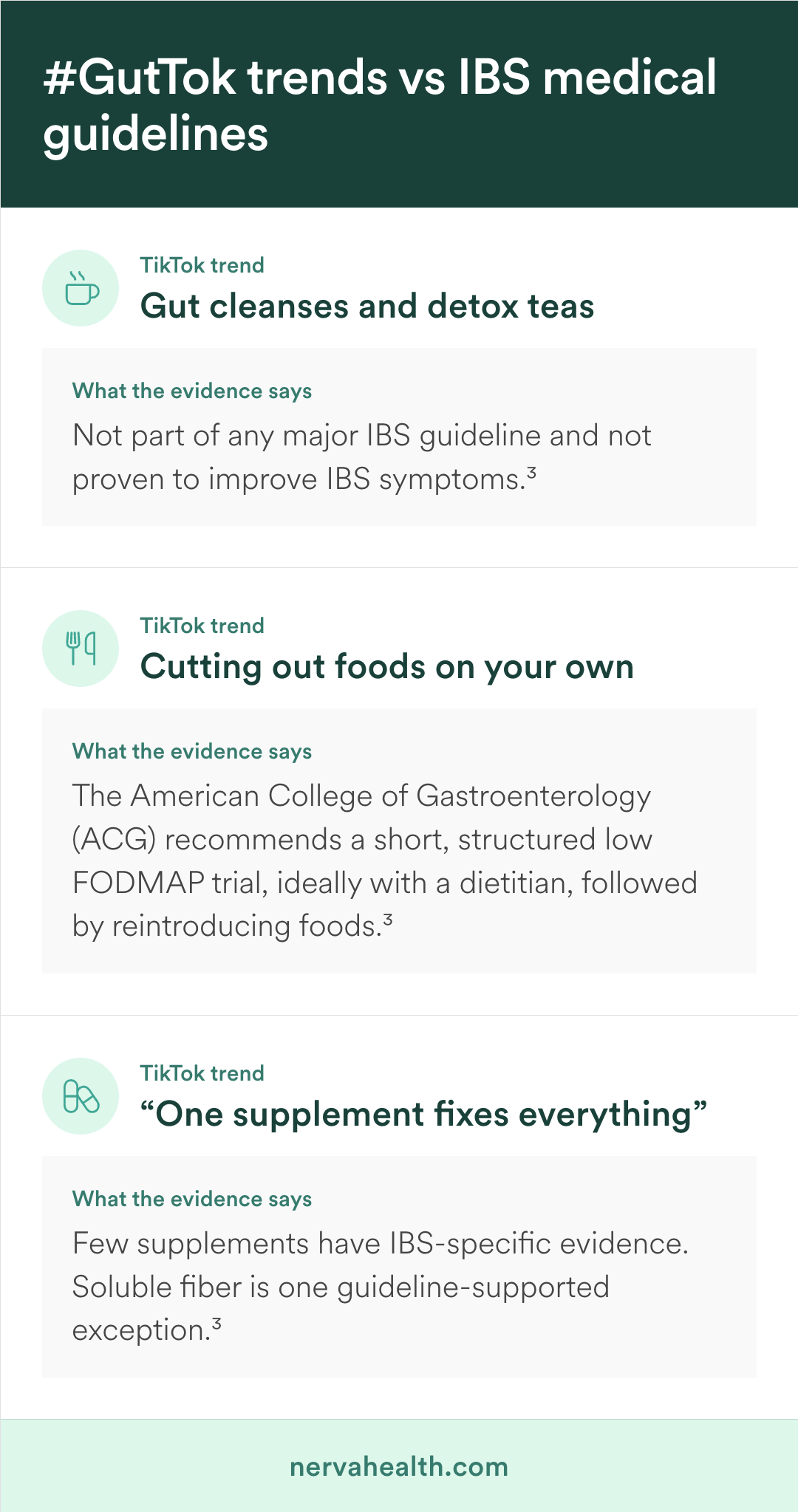
Many viral gut health trends aren’t supported by IBS guidelines, while some evidence-based options rarely go viral. And when you’re living with IBS, the search for a cure can feel overwhelming, and it’s understandable to listen to anyone who promises one. Here’s how common trends compare with what the evidence says:
Here’s how common trends compare:
How to tell if gut health advice is credible
Credible gut health advice comes from a qualified expert, is backed by clinical trials in people with IBS, and isn’t tied to something the person is selling.
A few questions can help you weigh up what you see online:
What are their qualifications? Gastroenterologists, registered dietitians, and GI psychologists are trained to manage IBS. Lived experience is valuable, but it isn’t the same as clinical expertise.
What’s the evidence? Advice backed by randomised controlled trials in people with IBS is far more reliable than one person’s results, however convincing their story.
Do they benefit if you buy in? A product link doesn’t automatically make advice wrong, but it’s worth asking whether the recommendation would change without it.
Does it sound too simple? IBS involves the gut, the brain, and how they communicate, so a single food, supplement, or cleanse rarely explains everything.
How does it fit your situation? What works for one person may not suit you. Your doctor or dietitian can help you decide whether it’s worth trying.
What actually helps IBS, according to the evidence
The evidence supports an integrated approach to IBS that combines diet, medication when needed, and brain-gut behavioural therapies.⁴ ⁵
IBS is a gut-brain disorder, meaning the gut and brain communicate in a way that makes the gut more sensitive.
That’s why the American College of Gastroenterology, which sets the IBS treatment guidelines US doctors follow, and the Rome Foundation, the international group of experts that defines how gut-brain disorders are diagnosed, both recommend therapies like gut-directed hypnotherapy alongside diet and medication.⁴ ⁵ These therapies work by targeting the gut-brain signalling behind symptoms.
Is Nerva evidence-based?
Nerva is an evidence-based gut-brain therapy program, tested in a randomised controlled trial where 81% of people achieved a clinically meaningful improvement in IBS symptoms.⁶
It was developed with Dr. Simone Peters, a co-creator of Nerva, whose Monash University research found gut-directed hypnotherapy worked as well as the low FODMAP diet for IBS.⁷
Unlike the latest GutTok trend, Nerva won’t ask you to cleanse, cut out foods, or buy another supplement. Instead, it works alongside your existing medical care to help calm the gut-brain signalling behind your symptoms. Every part of the program is built on clinical trials, not likes, so you can trust it’s been tested in people like you before it ever reached your phone.
Frequently asked questions
What is GutTok?
GutTok is the nickname for gut health content on TikTok, from bloating hacks to supplement reviews. It can help people feel less alone with digestive symptoms, but the quality of advice varies widely.
Should I tell my doctor about gut health advice I found online?
Telling your doctor about advice you’ve found online helps them understand what you’ve already tried and spot anything that could be affecting your symptoms. Gastroenterologists and dietitians expect these conversations, so there’s no need to feel embarrassed.
Can stress make IBS symptoms worse?
Stress can make IBS symptoms worse because the gut and brain are in constant two-way communication. Many people notice flare-ups during busy or stressful periods, even when their diet hasn’t changed.
Is gut-directed hypnotherapy the same as regular hypnosis?
Gut-directed hypnotherapy is different from stage hypnosis – it uses guided relaxation and gut-focused suggestions to calm gut-brain signalling, and you stay in control the whole time. Gut-brain therapy programs like Nerva deliver it in short daily sessions you can do at home.
References
Vu K, Garcia-Rogers K, Li B, et al. Gut health claims and monetization features on TikTok: cross-sectional analysis. Online J Public Health Inform. 2026;18:e105391. doi:10.2196/105391
Ford AC, Moayyedi P. Meta-analysis: factors affecting placebo response rate in the irritable bowel syndrome. Aliment Pharmacol Ther. 2010;32(2):144-158. doi:10.1111/j.1365-2036.2010.04328.x
[Authors]. Potentially misleading GI health content on TikTok receives greater engagement. Am J Gastroenterol. 2026;[vol(suppl)]:S3297.
Lacy BE, Pimentel M, Brenner DM, et al. ACG clinical guideline: management of irritable bowel syndrome. Am J Gastroenterol. 2021;116(1):17-44.
Keefer L, Ballou SK, Drossman DA, et al. A Rome Working Team Report on brain-gut behavior therapies for disorders of gut-brain interaction. Gastroenterology. 2022;162(1):300-315.
Anderson J, et al. Comparison of digitally delivered gut-directed hypnotherapy program with an active control for irritable bowel syndrome. Am J Gastroenterol. 2025;120(2):[pages].
Peters SL, Yao CK, Philpott H, et al. Randomised clinical trial: the efficacy of gut-directed hypnotherapy is similar to that of the low FODMAP diet for the treatment of irritable bowel syndrome. Aliment Pharmacol Ther. 2016;44(5):447-459.