


Key takeaways:
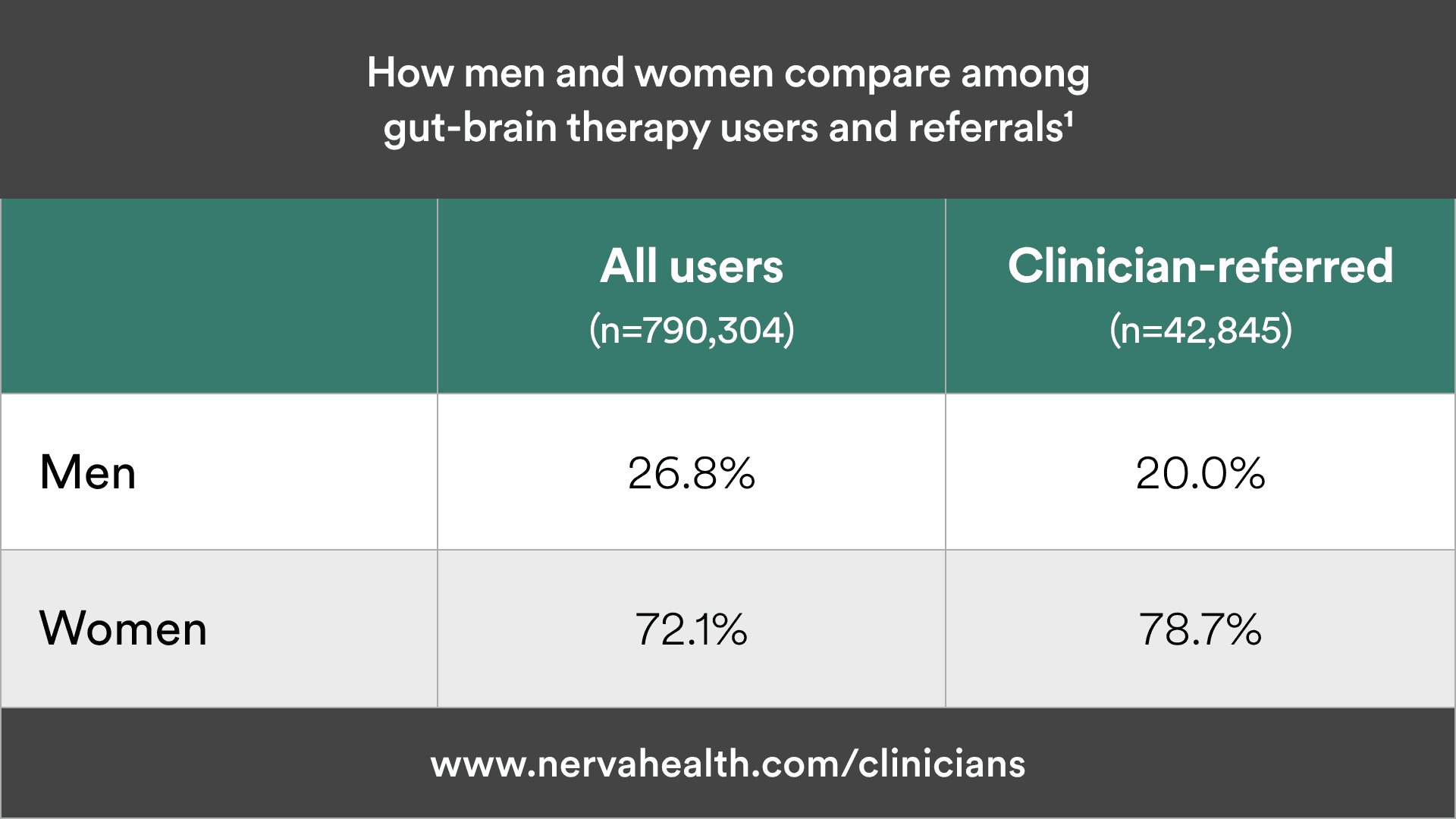
- New ACG 2026 research found men made up 26.8% of gut-brain therapy users but only 20.0% of clinician referrals.¹
- Male providers referred men at nearly twice the rate of female providers (31.3% vs 16.4%).¹
- Matching provider and patient gender did not improve program conversion or completion.¹
- Earlier research found 74% of men using the program self-referred, pointing to strong unmet interest.²
Men with IBS are less likely than women to be referred to digital gut-brain therapy, making up 26.8% of all users but only 20% of clinician referrals, according to new research presented at ACG 2026.¹ As outcomes were similar for men and women, a more consistent referral habit could give more of your male patients a guideline-recognised option that may be missing from their care.¹ ³
So where does the gap start?
Think about the last few IBS patients you recommended gut-brain therapy to. If most of them were women, IBS being more common in women is only part of the story.⁴ Men with IBS are also less likely to be diagnosed in the first place, even when they meet Rome IV criteria (the version used in this study, before Rome V).⁵ So the gap can open long before referral, and men can slip through at more than one step.
Working with researchers at Mayo Clinic led by Dr. Austin Hoeg, we looked at more than 790,000 users to see where men drop out of the referral picture.¹ And what we found gives you a simple way to check who might be missing out in your own clinic.
IBS referral rates for gut-brain therapy in men and women
Men are underrepresented among patients referred to gut-brain therapy by a clinician, pointing to a gap in referral rather than a lack of interest from men themselves.¹
The pattern also shifts depending on who's doing the referring.
Across 25,517 referrals with provider data, 81.3% came from female providers, who referred 16.4% men, compared with 31.3% among male providers.¹
That difference may simply reflect who each provider tends to see in their practice. However, matching provider and patient gender made no difference to whether patients started or finished the program.¹
Applying this in practice: How to close the gender gap in IBS referrals
Offer gut-brain therapy to male IBS patients as routinely as you would to women. Men are already seeking it out, with 74% of male users finding the program on their own.² A short check-in in the first few weeks also helps, since previous research found men were more likely to drop out early.²
Do men with IBS benefit from gut-brain therapy as much as women?
The abstract authors note similar outcomes between men and women using the program,¹ so the referral gap comes down to who gets offered it. Additionally, ACG guidelines recognise it as an option for IBS, with no distinction by sex.³
That gives every consult with a male IBS patient extra weight. Men are less likely to seek care for their symptoms and less likely to be diagnosed, so by the time one is sitting in front of you, he's already made it past the points where many men drop off.⁵ If gut-brain therapy doesn't come up in that visit, there may not be another chance soon.
"Brain-gut behavioural therapies have great efficacy. They work really well in placebo-controlled trials. The effectiveness is strong long-term, up to seven years, and they're very safe. Should these therapies be offered earlier? The data suggests yes."
– Dr. Jordan Shapiro, Internist and Gastroenterologist, Founder of Gentle GI PLLC, Houston, Texas
How to recommend gut-brain therapy to men with IBS
Recommending gut-brain therapy to men with IBS gives you a guideline-recognised option that's actually within reach.³ GI psychologists are scarce, waitlists can stretch for months, and in many areas there's no access at all.
For men, who are already less likely to seek care, a long wait is one more opportunity to be lost to follow-up, so a digital program they can start at home straight away keeps the momentum from your consult going.⁵
Patients in this study used Nerva's gut-directed hypnotherapy program, developed with Monash University researchers. In this study, men made up more than a quarter of its users, so you're pointing patients to something men already take up.¹
It's also backed by a randomised controlled trial, in which 81% of participants had a clinically meaningful drop in IBS symptom severity (at least 50 points on the IBS-SSS) at week 6, compared with 63% in the active control group.⁶ Your patients work through the program via an app at home, while you remain across their wider care plan.
When you recommend Nerva in a consult, patients who finish the program and don't find it helpful can request a refund. And if you refer them through our clinician form, you'll also pass on a 25% discount.
Frequently asked questions
Is IBS more common in women or men?
IBS is more common in women, with about 1.7 times the odds of men.⁴ Men are also less likely to be diagnosed, so the real gap may be smaller than it looks.⁵
Do IBS symptoms differ between men and women?
IBS with constipation is more common in women, while IBS with diarrhoea is more common in men.⁴ Women also tend to report more severe bloating and abdominal pain.⁵
Is gut-brain therapy safe for men with IBS?
No serious adverse effects have been reported with digital gut-directed hypnotherapy in real-world use.⁷ It also fits alongside the diet and medication options you may already be using.
Is gut-directed hypnotherapy for IBS covered by insurance?
Coverage for gut-directed hypnotherapy programs varies by plan. Some patients may be able to use HSA or FSA funds, subject to their plan's rules, and a Letter of Medical Necessity from the referring clinician can support that claim.
About this research: Austin Hoeg presented this study at ACG 2026 with co-authors from Mayo Clinic and Mindset Health. It's a retrospective analysis, so differences by provider gender may reflect practice composition rather than referral decisions.¹
References
Hoeg AJ, Jin M, Hall C, Naoumidis A, Wang XJ. S1322 Provider and patient gender differences in clinician referral to digital brain-gut behavioral therapy for IBS. Am J Gastroenterol. 2026;121(10S1). doi:10.14309/01.ajg.0001214540.06371.2b
Hoeg AJ, Wang XJ, et al. Gender differences in early attrition during digitally delivered brain-gut behavioral therapy for IBS. Poster of Distinction presented at: Digestive Disease Week; May 2026; Gastroenterology. Read poster
Lacy BE, Pimentel M, Brenner DM, et al. ACG clinical guideline: management of irritable bowel syndrome. Am J Gastroenterol. 2021;116(1):17-44.
Lovell RM, Ford AC. Effect of gender on prevalence of irritable bowel syndrome in the community: systematic review and meta-analysis. Am J Gastroenterol. 2012;107(7):991-1000.
Almario CV, Liu J, Higgins C, Yerneni N, Boules M, Chey WD, Chang L. Disparities in health care seeking and physician diagnosis of irritable bowel syndrome: results from a US survey. Clin Gastroenterol Hepatol. 2026. doi:10.1016/j.cgh.2026.03.008
Anderson EJ, Peters SL, Gibson PR, Halmos EP. Comparison of digitally delivered gut-directed hypnotherapy program with an active control for irritable bowel syndrome. Am J Gastroenterol. 2025;120(2):440-448.
Peters SL, Gibson PR, Halmos EP. Smartphone app-delivered gut-directed hypnotherapy improves symptoms of self-reported irritable bowel syndrome: a retrospective evaluation. Neurogastroenterol Motil. 2023;35(4):e14533.


