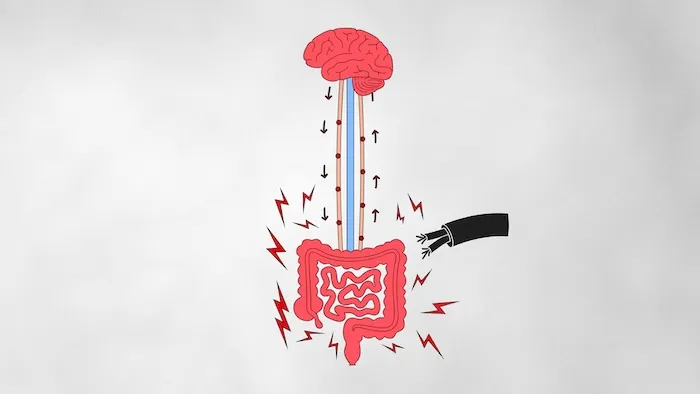
Unlike true food allergies or celiac disease, which involve immune reactions or tissue damage, gut-brain disorders cause no structural injury – the problem is a nervous system that responds to food more sensitively than it should.
These conditions are formally recognized by gastroenterologists worldwide as disorders of gut-brain interaction under the Rome IV criteria² – diagnosed not by what shows up on tests, but by the pattern and history of symptoms.
Neurogastroenterologist Dr Justin Brandler describes these criteria as "clinical guardrails" that help determine whether what someone is experiencing reflects a gut-brain disorder – not a problem with the food they're eating.³
This is why strict elimination diets often provide only partial relief. Remove one suspected trigger and another takes its place – because the underlying sensitivity remains, regardless of what's on the plate.
What actually helps if food keeps upsetting my stomach?
Long-term improvement usually involves addressing both food triggers and nervous system regulation. Evidence-based dietary strategies combined with therapies that calm the gut-brain system – such as gut-directed hypnotherapy and stress-modulation techniques – can help reduce symptom amplification.
If you're also dealing with pain, the IBS Pain Guide covers the causes, locations, and relief strategies in depth.
If you live with a gut-brain disorder, your symptoms are real – and so are your food reactions. But your digestive system isn't damaged – it's sensitive. Understanding that distinction can help you move beyond fear-based dieting toward a more sustainable path to relief.
Watch: Dr Simone Peters of Monash University explains how gut-directed hypnotherapy compares to the low FODMAP diet in this short overview.
Frequently asked questions
Why does everything I eat seem to upset my stomach?
Usually it's not the food – it's a sensitive gut-brain system. In gut-brain disorders like IBS, dyspepsia, and functional constipation, the gut's nerves are more reactive than they should be, which is why foods that most people tolerate easily can still trigger real bloating, pain, and urgency.
Is it food intolerance or a gut-brain disorder?
It could be both, but they're different things. True food intolerances involve a reaction to a specific food. Gut-brain disorders cause widespread food sensitivity because the nervous system responds to normal digestion more intensely than it should – not because of immune reaction or tissue damage.
Why doesn't cutting out foods fix my symptoms?
Because elimination diets reduce fermentation and gas but don't change the underlying nerve sensitivity. This is why removing one trigger often leads to reacting to another – the root cause is a reactive gut-brain system, not any individual food.
What is visceral hypersensitivity?
Visceral hypersensitivity is increased sensitivity of the nerves in the digestive tract, making normal digestive activity – stretching, gas, and acid – feel more intense or painful than it should. It is a core feature of gut-brain disorders and explains why symptoms can be severe even when all tests come back normal.
Can food sensitivity in gut-brain disorders improve?
Yes. The most effective approach addresses both dietary triggers and nervous system regulation together. Therapies that calm gut-brain signaling, combined with evidence-based dietary strategies, can significantly reduce how reactive the gut is to food – without relying on permanent elimination diets.
References
Rome Foundation. What is a disorder of gut-brain interaction (DGBI)? Rome Foundation. Accessed February 20, 2026. https://theromefoundation.org/what-is-a-disorder-of-gut-brain-interaction-dgbi/
American College of Gastroenterology. Irritable bowel syndrome. American College of Gastroenterology. Accessed February 20, 2026. https://gi.org/topics/irritable-bowel-syndrome
Cleveland Clinic. Acid reflux (GERD). Cleveland Clinic. Accessed February 20, 2026. https://my.clevelandclinic.org/health/diseases/17019-acid-reflux-gerd
Ford AC, Lacy BE, Talley NJ. Irritable bowel syndrome. N Engl J Med. 2017;376(26):2566-2578. doi:10.1056/NEJMra1607547
Yao CK, Gibson PR, Shepherd SJ; Rome Foundation Working Group. Design of clinical trials evaluating dietary interventions in patients with functional gastrointestinal disorders. Am J Gastroenterol. 2013;108(5):748-758. doi:10.1038/ajg.2013.77
.webp)

.jpeg)

.jpeg)