.webp&w=3840&q=75)

Key takeaways:
- In the US, you can pay for Nerva with HSA or FSA funds using a Letter of Medical Necessity from a licensed healthcare provider.
- IBS is a diagnosed medical condition, so treating it is a qualified medical expense under IRS rules.
- The process is simple: sbscribe to Nerva, get a Letter of Medical Necessity, then submit your receipt to your plan administrator.
- Eligibility rules vary by plan, so always confirm the details with your HSA or FSA administrator first.
In the US, you can pay for Nerva with HSA or FSA funds, as long as you have a Letter of Medical Necessity (LMN) from a licensed healthcare provider confirming that Nerva is recommended to manage your IBS or another gut-brain disorder. Requirements vary by plan, so it's worth checking with your plan administrator before you submit.
It may sound like a lot of extra paperwork, but if you've been managing IBS for a while – sometimes for years on end – you already know how quickly the costs add up. Using pre-tax HSA or FSA dollars is one of the simplest ways to make an evidence-based program like Nerva more affordable.
What is an HSA or FSA?
An HSA (Health Savings Account) and an FSA (Flexible Spending Account) are both tax-advantaged accounts that let you pay for qualified medical expenses with pre-tax dollars, which effectively lowers what you pay out of pocket.
HSA (Health Savings Account)
An HSA is a savings account you can use for medical expenses if you're enrolled in a high-deductible health plan (HDHP). The funds roll over year to year, the account is yours to keep if you change jobs, and the 2025 contribution limits are $4,300 for an individual and $8,550 for a family.¹ Roughly 40 million HSAs now cover an estimated 59 million Americans, or about 1 in 4 working adults.²
FSA (Flexible Spending Account)
An FSA is an employer-sponsored account that doesn't require a high-deductible health plan. The main catch is that FSAs are generally "use-it-or-lose-it" each year, with only a limited carryover allowed (around $660 for 2025), and the 2025 contribution limit is $3,300.¹ If you have unspent FSA funds late in the year, putting them toward IBS treatment is a practical way to use them before they expire.
Why Nerva is eligible for HSA or FSA funds
Nerva is eligible because IBS is a diagnosed medical condition, and the IRS treats spending on the diagnosis, treatment, or prevention of a medical condition as a qualified medical expense under Section 213 of the tax code.³
A solution doesn't have to be a prescription drug to qualify, but it must be for a genuine medical purpose rather than general wellness.
IBS is one of the most common gut-brain disorders, affecting an estimated 10 to 15% of people worldwide, and it is formally recognized by the Rome Foundation as a disorder of gut-brain interaction.⁴ Because the symptoms trace back to a real, diagnosable condition, it’s on solid footing as a medical expense rather than a lifestyle purchase.
"Symptoms are very real and they are driven by what happens between the gut and the brain and the brain to the gut along what's called the brain-gut axis." – Dr. Megan Riehl, GI Psychologist, Clinical Director of the GI Behavioral Health Program, University of Michigan
Using digital therapeutics to manage a diagnosed condition is increasingly recognized for HSA and FSA reimbursement when accompanied by a Letter of Medical Necessity.
The key is documentation: your plan administrator needs to see that the expense is tied to managing your IBS.
How much you can potentially save using your HSA or FSA for IBS support
If you opt to pay for a 12-month subscription to Nerva's gut-brain therapy program with your HSA or FSA, your pre-tax dollars will stretch further – most Americans save about 30%. If you are referred to Nerva by your healthcare provider, you save even more.
Pay for Nerva with your HSA or FSA
| Option | Price | With pre-tax dollars | You save |
|---|---|---|---|
| Standard price | $199/yr | ~$139/yr | About $60 back |
| With a provider referral (25% off the standard price) | $149/yr | ~$104/yr | About $95 back total |
Nerva is an annual subscription ($199 USD/year) and is HSA/FSA eligible. Actual savings depend on your tax bracket, state taxes, and payroll setup. ~30% is a common average, not a guarantee. Consult a tax professional.
How to pay for Nerva with your HSA or FSA in 3 steps
Paying for Nerva with HSA or FSA funds is a reimbursement process, which means you pay first and then claim the cost back from your account.
Subscribe to Nerva using any regular payment method.
Get a Letter of Medical Necessity from your doctor, gastroenterologist, or another licensed healthcare provider, stating that Nerva is recommended to manage your IBS or other gut-brain disorder.
Submit your Nerva receipt and the Letter of Medical Necessity to your HSA or FSA plan administrator for reimbursement.
Because requirements vary by plan, check with your administrator to confirm what they need before you submit, so your claim isn't held up.
What is a Letter of Medical Necessity?
A Letter of Medical Necessity (LMN) is a short document from a licensed healthcare provider that states your diagnosis and explains why a specific treatment is recommended for you.⁵ It's the piece of paperwork that connects your Nerva subscription to your IBS, which is what most plans need to approve the expense.
A strong LMN usually names your diagnosis (for example, IBS), identifies the recommended approach (Nerva), and confirms it is being used to directly address that condition rather than for general wellness. Any provider treating you can write one, including a primary care doctor, gastroenterologist, nurse practitioner, dietitian, or psychologist.
How does Nerva help IBS?
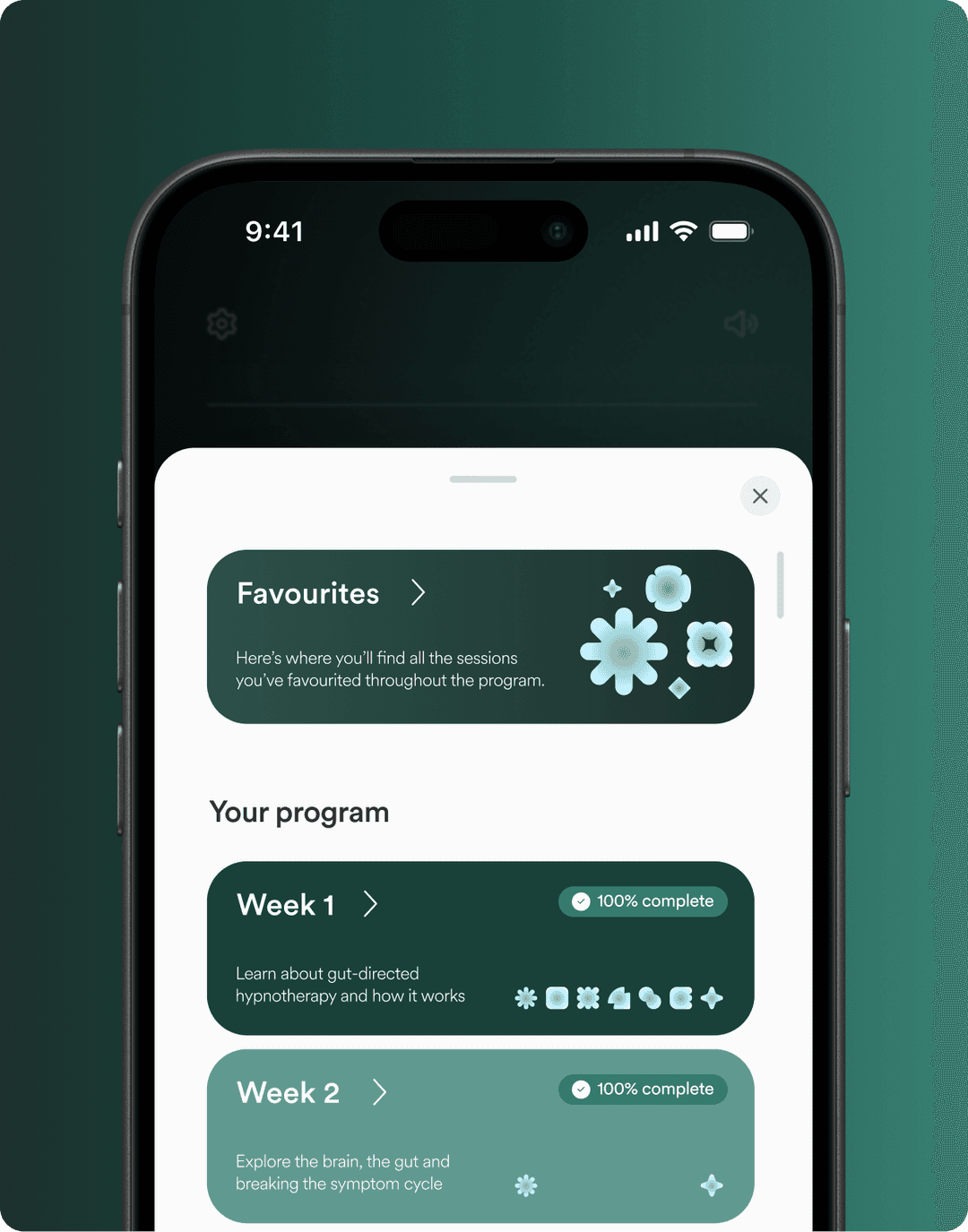
Nerva is a gut-brain therapy program that uses gut-directed hypnotherapy and evidence-based techniques to target the overactive gut-brain communication that drives IBS symptoms. It's a structured 6-week program designed to be completed in just 15 to 20 minutes a day, and it aligns with guideline-recommended, first-line behavioral therapies for IBS.⁶
In Nerva's randomized controlled trial, 81% of participants achieved a clinically significant improvement on the IBS Symptom Severity Scale, and 71% had a clinically significant reduction in abdominal pain.⁷
Nerva is offered as an annual subscription, and patients referred through a clinician automatically receive 25% off, bringing the cost to $149.25, which is comparable to a single GI psychology session for 12 months of access.
Everyone starts with a 7-day free trial, and there's a 42-day money-back guarantee for extra peace of mind.
Frequently asked questions
Is gut-directed hypnotherapy HSA eligible?
Gut-directed hypnotherapy can be HSA or FSA eligible when it's used to treat a diagnosed medical condition such as IBS and you have a Letter of Medical Necessity from a licensed provider. Nerva delivers gut-directed hypnotherapy as part of a structured program, so the same documentation pathway applies.
What if my HSA or FSA plan rejects my Nerva claim?
A rejected claim is often a documentation issue rather than a final decision, so ask your administrator what was missing before resubmitting. A clearer Letter of Medical Necessity that names your IBS diagnosis and the treatment recommendation usually resolves it.
Can I use my FSA before the end of the year on Nerva?
FSA funds are typically use-it-or-lose-it, so spending them on Nerva before your plan's year-end deadline is a practical way to avoid forfeiting them. Confirm your specific deadline and any carryover allowance with your administrator, since these vary by plan.
Do I need a new Letter of Medical Necessity to renew Nerva each year?
Many plans require a current Letter of Medical Necessity for each benefit year, so you may need an updated letter when your annual Nerva subscription renews. Check with your administrator on how often they require the documentation to be refreshed.
What if my doctor hasn't heard of Nerva?
A provider doesn't need prior experience with Nerva to write a Letter of Medical Necessity, only to confirm your IBS diagnosis and that gut-brain therapy is a reasonable treatment. You can share that Nerva is a guideline-aligned gut-brain therapy program to help them complete the letter.
References
Internal Revenue Service. Rev. Proc. 2024-25: 2025 inflation-adjusted amounts for Health Savings Accounts and high-deductible health plans. IRS; 2024.
Devenir Research. 2024 Year-End HSA Market Statistics & Trends. Devenir; 2025.
Internal Revenue Service. Publication 502: Medical and Dental Expenses (Section 213 qualified medical expenses). IRS; 2025.
Sperber AD, Bangdiwala SI, Drossman DA, et al. Worldwide prevalence and burden of functional gastrointestinal disorders: results of the Rome Foundation Global Study. Gastroenterology. 2021;160(1):99-114.
GoodRx. What is a Letter of Medical Necessity? GoodRx Health; 2024.
Lacy BE, Pimentel M, Brenner DM, et al. ACG Clinical Guideline: Management of Irritable Bowel Syndrome. Am J Gastroenterol. 2021;116(1):17-44.
Mindset Health. Nerva randomized controlled trial: gut-directed hypnotherapy for IBS. Mindset Health; 2024.
.jpeg)
.jpeg)