Key takeaways:
- Nearly half of US adults live more than 25 miles from a listed in-person GI psychology specialist.¹
- GI psychology services are typically limited to large health systems.²
- Specialists in GI-focused psychology draw on 5 main types of brain-gut therapy, including CBT and gut-directed hypnotherapy.³
- 81% of people using a digital gut-directed hypnotherapy programme saw meaningful IBS improvement in a clinical trial.⁴
GI psychology specialists who provide gut-brain therapy for irritable bowel syndrome (IBS) and other gut-brain disorders can be hard to find. There aren't enough of them, many work in large hospitals rather than local clinics, and you may live far from the nearest one or face a long waitlist. That can make gut-brain therapy difficult to access, even when your healthcare provider recommends it. In fact, nearly half of US adults live more than 25 miles from a listed in-person GI psychology specialist.¹
And that's frustrating when you've already spent months, or even years, trying to get your gut symptoms under control. Gut-directed hypnotherapy and cognitive behavioural therapy (CBT) can help manage IBS symptoms by working with the connection between your gut and brain.³ ⁵ The good news is that accessing this kind of care doesn't always mean travelling to see a specialist. Depending on your needs, telehealth or self-guided digital gut-brain therapy may also be worth considering.
So where do you start? We'll look at what these specialists do, how to find one, and what to consider if in-person care is out of reach.
The main barriers to seeing a GI psychology specialist
The biggest barriers to GI-focused psychological care are how few specialists there are, where they work, how long the waitlists run, and what it costs. As GI psychologist Dr. Megan Riehl puts it, “Although access to a gastrointestinal (GI) dietitian is limited, there are even fewer GI psychologists available.”² Those who do practice usually work in large health systems, which can leave whole regions without one nearby.²
Here's how those barriers tend to show up:
Location: if you don't live near a major hospital, the nearest specialist may be a long drive away.
Waitlists: GI psychology clinics often have long wait times, so even with a referral, you may wait weeks for a first appointment.²
Cost: what you pay depends on your insurance or health system cover, and out-of-pocket costs can add up over several sessions.
Time: therapy usually means regular appointments over several weeks, which can be tricky to fit around work and family.
Comfort: not everyone feels ready to talk to someone about their gut symptoms, or wants to do it face to face.
None of this means in-person care isn't worth seeking out. It just means finding a specialist can take some persistence, and it helps to have a plan B.
What this means for you
If you've struggled to find a specialist, or in-person therapy doesn't feel right for you yet, you're not alone. Supply is part of it, but so are cost, time, and simply wanting to start somewhere more private. Whatever's holding you back, self-guided digital gut-brain therapy programmes like Nerva let you start gut-directed hypnotherapy at home, with no waitlist or travel.
What does a GI psychology specialist do?
A GI psychology specialist is a clinician trained in GI-focused psychological care, who helps calm the communication between your gut and brain using therapies designed for digestive symptoms. They include psychologists, social workers, therapists, and other mental health clinicians with specialist training in GI-focused psychology.⁶
These specialists aren't there to suggest your symptoms are "all in your head." Their job is to help settle the oversensitive gut-brain signals that make normal digestion feel painful, urgent, or unpredictable.
“Symptoms are very real and they are driven by what happens between the gut and the brain and the brain to the gut along what's called the brain-gut axis.”
– Dr. Megan Riehl, GI Psychologist, University of Michigan
A Rome Foundation working team, the international group of experts that defines how gut-brain disorders are diagnosed, identified 5 main types of brain-gut therapy.³ The ones you're most likely to come across are:
Gut-directed hypnotherapy: guided relaxation and gut-focused imagery that help calm an oversensitive gut
CBT for IBS: practical tools to ease the worry, symptom-checking, and avoidance that can build up around IBS
Relaxation and breathing: skills like slow belly breathing you can use when symptoms start to build
Learn more about the difference between CBT and gut-directed hypnotherapy here to determine which might be the right fit for you.
What this means for you
If your healthcare provider suggests seeing a GI psychology specialist, it's not because they think you're imagining things. It's a referral to a clinician who treats the gut-brain side of IBS, the same way a dietitian helps with the food side.
The benefits of seeing a GI psychology specialist
Seeing a specialist trained in GI-focused psychology has real benefits. They can tailor gut-brain therapy to you, and help with the worries, habits, and life stresses that often come with IBS, not just the gut symptoms themselves.
At the heart of that care is visceral hypersensitivity, one of the key drivers of IBS symptoms. Visceral hypersensitivity means the nerves in your gut are extra sensitive, so normal digestion, like gas moving through or your gut stretching after a meal, registers as pain, bloating, or urgency. It's a bit like the volume on your gut being turned up too high. Gut-brain therapy helps turn that volume back down by calming the signals between your gut and brain.³
Watch Nerva co-creator and Monash University researcher Dr. Simone Peters explain simply in under two minutes what a gut-brain disorder is.
The evidence for gut-brain therapy is strong, too. In the US, the American College of Gastroenterology, which sets the IBS treatment guidelines doctors follow, recommends gut-directed psychotherapy for overall IBS symptoms.⁵ And in a Monash University trial led by Dr. Peters, gut-directed hypnotherapy improved IBS symptoms about as much as the low FODMAP diet, with benefits that lasted at least six months.⁷ It got there without asking anyone to cut out a single food.
A specialist also becomes part of your wider care team, working alongside your other healthcare providers rather than replacing them.
“The combined efforts of not only the gastroenterologist, the dietitian, and the GI therapist can allow a patient to really feel completely heard and seen, as well as giving them that sense of having a team that really is dedicated to their care and their well-being.”
– Nancee Jaffe, GI expert Registered Dietitian, UCLA
What this means for you
If your healthcare provider suggests GI psychology care, it's a good option to explore. Gut-brain therapy can be part of your care at any stage, whether that's from the start, alongside diet and medication, or later on.
How do you find a GI psychology specialist near you?
The easiest ways to find one are to ask your healthcare provider, search The Rome Foundation's GastroPsych Directory, or look for a GI behavioural health programme at a university hospital. Here's where to look:
Your healthcare provider: your gastroenterologist or primary care provider (GP) may work with a GI psychology provider or know one they trust.
The Rome Foundation's GastroPsych Directory: search the directory for clinicians trained in GI-focused psychological care near you.⁶
University hospitals: because GI psychology services are often based in large health systems, academic medical centres are a good place to check.²
The Nerva Clinician Directory: we work with many experienced clinicians who specialise in gut-brain care. Search for one in your area.
Telehealth: many clinicians offer telehealth sessions, which can widen your options if no one is local. If you're in the US, they usually need to be licensed in the state you live in.
What this means for you
When you contact a provider, ask about cost, how long the waitlist is, and whether they offer telehealth. If the wait is long, put your name down anyway, and start other gut-brain care in the meantime.
What if you can't, or would rather not, see a GI psychology specialist?
If specialist care is hard to reach, or in-person therapy just isn't for you, you can still start gut-brain therapy from home. Digital gut-directed hypnotherapy programmes were developed for exactly this situation, and research shows they can help people manage IBS symptoms.⁴ ⁸
Dr. Riehl has described digital therapeutics as a way to improve access for some patients, especially those who would otherwise be on a long waitlist or receive nothing at all.² And in a study by Monash University researchers, people with IBS who completed an app-delivered gut-directed hypnotherapy programme saw notable improvements in their symptoms.⁸
A digital programme doesn't have to replace in-person care. You can use one while you wait for an appointment, alongside sessions once you're in, or on its own if in-person care just isn't practical for you.
If you're also living with significant anxiety, depression, trauma, or disordered eating, a clinician trained in GI-focused psychological care, or another mental health professional, is the better place to start. Your healthcare provider can help you work out the right fit.
How Nerva can help you manage IBS
If in-person care isn't an option right now or you'd simply prefer a different approach, Nerva is one way to start gut-brain therapy from home. It's a gut-brain therapy programme delivered via an app, developed with gut-directed hypnotherapy researchers from Monash University, including Dr. Simone Peters, a co-creator of Nerva.
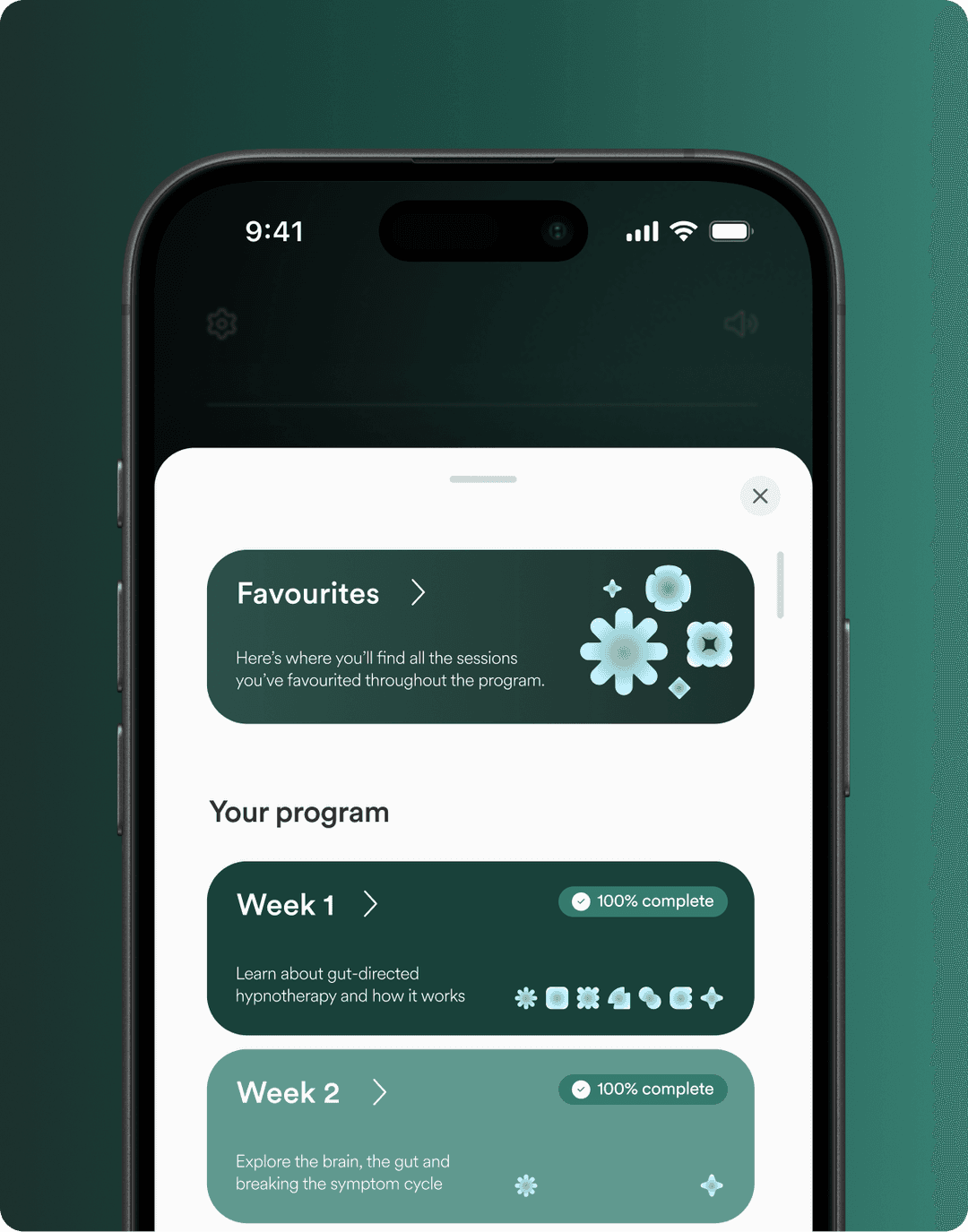
You start with a 6-week core programme of 15–20 minutes a day, then will have access to the maintenance plan for ongoing support and flare-up management. There's no waitlist, no commute.
In a clinical trial, 81% of people using Nerva saw a meaningful improvement in their IBS symptoms, compared with 63% on a comparison programme.⁴ Gut-brain therapy is recommended in major gastroenterology guidelines,⁵ and Nerva is designed to complement your medical care, not replace it. And if you finish the programme and it hasn't helped, you can request a refund.
Frequently asked questions
Do you need a referral to see a GI psychology specialist?
Whether you need a referral depends on the clinic, and many private practices let you book directly. Hospital-based GI behavioural health programmes are more likely to ask for a referral from a gastroenterologist.
Is GI psychology care covered by insurance?
Coverage for GI psychology care depends on where you live and your plan, and in the US, some specialists bill it under medical benefits rather than mental health benefits. If you'd like to start with a digital programme, many people in the US can pay for Nerva with HSA or FSA funds using a letter from their healthcare provider.
Can GI psychology care help with IBS-D or IBS-C?
GI-focused psychological care can help with every type of IBS, including IBS with diarrhoea (IBS-D), IBS with constipation (IBS-C), and mixed IBS, because brain-gut therapies target the gut-brain communication behind all of them. The core approaches stay the same whatever your main bowel symptoms are.
Can a GI psychology specialist help if I don't have anxiety or depression?
Specialists in GI-focused psychology help people with gut symptoms whether or not they also live with anxiety or depression, because brain-gut therapies target the communication between your gut and brain. Many people see one purely to get their IBS symptoms under control.
About this analysis: Mindset Health, which makes Nerva, mapped access to in-person GI psychology care using The Rome Foundation's GastroPsych Directory and US academic medical centre data in November 2026.
References
Mindset Health. GI psychology access map: distance from US adults to listed in-person GI psychology specialists. Rome Foundation GastroPsych Directory and US academic medical center data, November 2026. Unpublished analysis.
Riehl ME. Limited access to integral care: digital therapeutics show promise of scalable solutions to behavioral interventions. Clin Transl Gastroenterol. 2022;13(1):e00444. doi:10.14309/ctg.0000000000000444
Keefer L, Ballou SK, Drossman DA, Ringstrom G, Elsenbruch S, Ljótsson B. A Rome Working Team report on brain-gut behavior therapies for disorders of gut-brain interaction. Gastroenterology. 2022;162(1):300-315. doi:10.1053/j.gastro.2021.09.015
Anderson EJ, Peters SL, Gibson PR, Halmos EP. Comparison of digitally delivered gut-directed hypnotherapy program with an active control for irritable bowel syndrome. Am J Gastroenterol. 2025;120(2):440-448. doi:10.14309/ajg.0000000000002921
Lacy BE, Pimentel M, Brenner DM, et al. ACG clinical guideline: management of irritable bowel syndrome. Am J Gastroenterol. 2021;116(1):17-44.
The Rome Foundation. GastroPsych Directory. Accessed November 18, 2026. https://romegipsych.org
Peters SL, Yao CK, Philpott H, Yelland GW, Muir JG, Gibson PR. Randomised clinical trial: the efficacy of gut-directed hypnotherapy is similar to that of the low FODMAP diet for the treatment of irritable bowel syndrome. Aliment Pharmacol Ther. 2016;44(5):447-459. doi:10.1111/apt.13706
Peters SL, Gibson PR, Halmos EP. Smartphone app-delivered gut-directed hypnotherapy improves symptoms of self-reported irritable bowel syndrome: a retrospective evaluation. Neurogastroenterol Motil. 2023;35(4):e14533. doi:10.1111/nmo.14533