

Key takeaways:
- The best defence against IBS misinformation is raising social media proactively, explaining the gut-brain axis, and offering evidence-based alternatives.
- In a 2026 Tufts analysis, poor-quality TikTok gut health claims drew 3.37 times the likes of high-quality claims.¹
- 69% of US counties have no practising gastroenterologist, which pushes patients toward online sources.²
- ACG guidelines suggest peppermint oil and gut-directed psychotherapy for global IBS symptoms, and suggest against probiotics.³
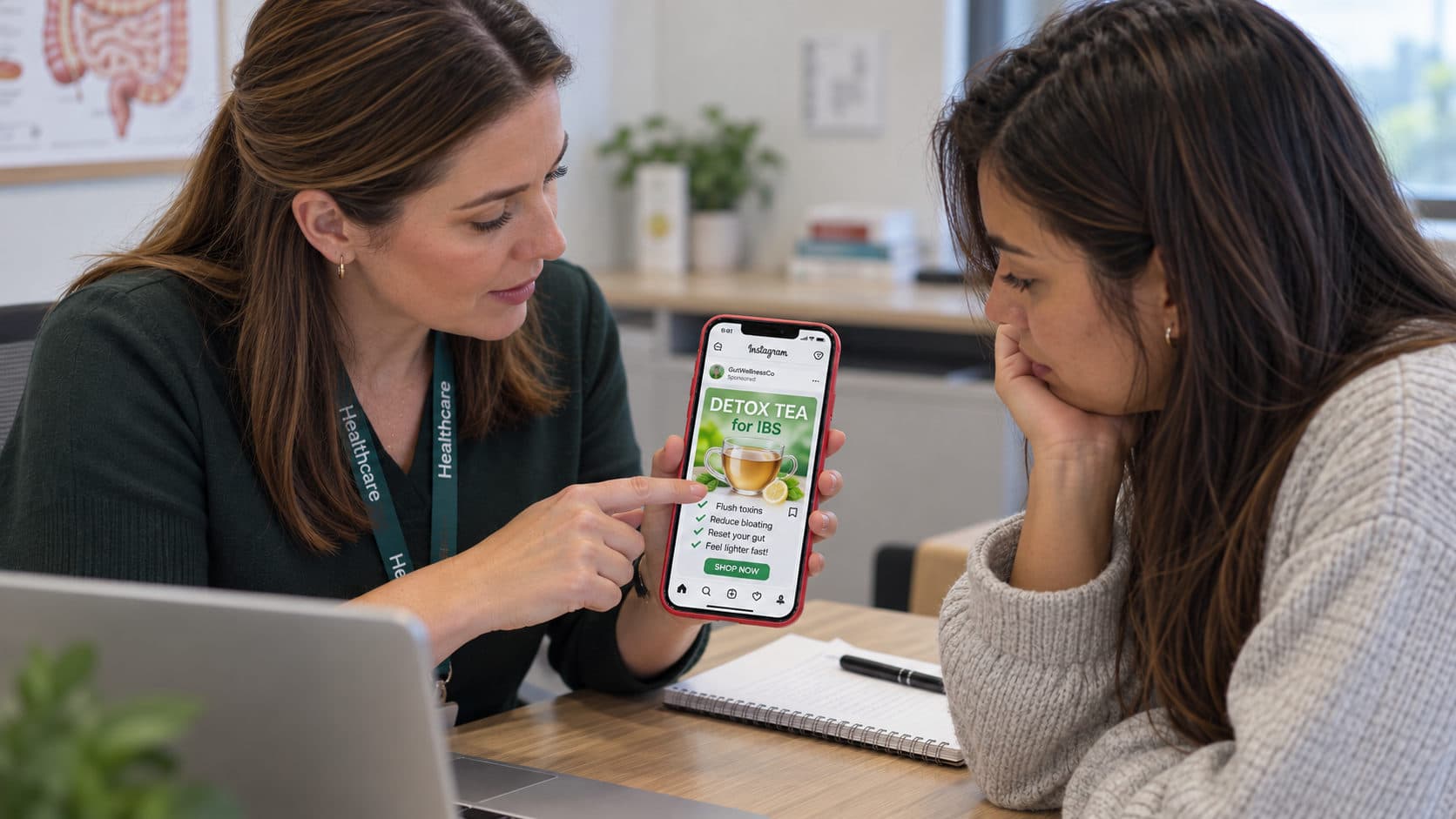
Most IBS content on social media comes from creators with no medical background, and the least accurate claims spread the furthest.¹ To counter it, clinicians can raise social media early in the consult, explain IBS as a real disorder of gut-brain interaction, and offer evidence-based alternatives to the advice patients find online.
If your IBS follow-ups have started to feel like fact-checking a feed, you’re not alone. Patients arrive with theories about everything from parasites and SIBO to detox teas, enzyme deficiencies, and whether IBS is even a real diagnosis. A 15-minute visit leaves little room to unpick all that and still build a plan. The good news is that a few small shifts in how you raise and respond to social media can save time and protect trust.
Free patient resource
Download our patient guide to trusted gut health resources to share in clinic.
Why IBS patients trust social media over their gastroenterologist
IBS patients turn to social media because specialist care is hard to reach and online answers are instant.
A 2025 analysis found that 69% of US counties have no practising gastroenterologist, and almost 50 million Americans live in those counties.²
Even patients with a GI can wait weeks for an appointment or a reply to a message. Their feed answers in seconds, and keeps serving up more.
That gap shows up in the exam room. Gastroenterologist and creator Dr. Wendi LeBrett (@SoCalGastroDoc) says correcting viral advice can take over the visit:
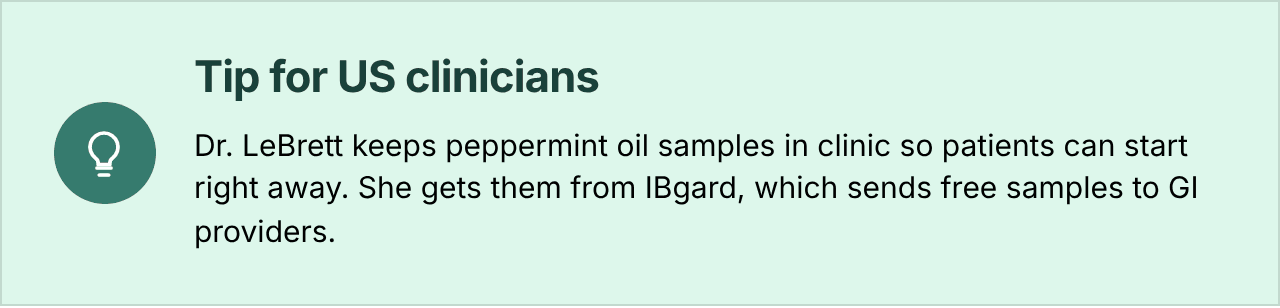
“I had to spend most of the visit debunking TikToks, let alone talk about evidence-based treatments, come up with a personalised plan.”
– Dr. Wendi LeBrett, gastroenterologist and founder of Modern Gut
Why gut health misinformation spreads faster than evidence on TikTok
Gut health misinformation spreads because social media algorithms reward engagement, not accuracy.
A single, alarming cause (a parasite, a toxin, a hidden infection) makes a far more compelling video than a nuanced diagnosis like IBS. For a patient with ongoing symptoms and normal test results, it can also feel more validating.
The data shows how wide that gap is. In a 2026 Tufts University analysis of 174 TikTok gut health creators, 83% had no medical background, and poor-quality claims drew 3.37 times the likes of high-quality claims.¹
Many creators also have something to sell. 92% had at least one financial conflict, such as a supplement, product, or program.¹
“Accurate information doesn’t spread the same way as misinformation on social media.”
– Dr. Wendi LeBrett
A white coat doesn’t guarantee accuracy either. Some of the most viral parasite and “toxin” videos come from creators in scrubs, which makes the claims harder for patients to question.
Is IBS a real diagnosis? Correcting the most common IBS myth on social media
The most common IBS myth on social media is that IBS isn’t a real diagnosis, just a label given when tests come back normal.
Once patients believe that, two things tend to follow. They start hunting for a “real” cause, often SIBO, parasites, or an enzyme deficiency. And they assume that if IBS isn’t real, nothing can be done for it.
“The most common misconception I hear, and unfortunately, I think it’s perpetuated by a lot of healthcare providers, is that IBS is this made up diagnosis, or IBS is a diagnosis that providers give you or doctors give you when your tests are normal.”
– Dr. Wendi LeBrett
That point about providers matters. In Nerva’s State of IBS 2025 survey of 3,403 people, 52.1% said their provider never discussed the gut-brain connection during diagnosis or treatment.⁴
How to explain IBS as a real disorder of gut-brain interaction
Connect the mechanism to the symptoms the patient is actually experiencing.
Explain that IBS is driven by altered communication between the gut and brain. Then link that directly to their day: visceral hypersensitivity explains the pain and bloating, and changes in motility explain the constipation, diarrhoea, or both.
Be explicit that a gut-brain disorder is not a psychological one:
“IBS is a real diagnosis and it’s not that there’s nothing wrong with you, but we don’t have a perfect test for IBS ... just because it’s an issue between gut and brain, it doesn’t mean it’s in your head.”
– Dr. Wendi LeBrett
The language you use around stress matters too. Patients who hear that stress causes their IBS often take it to mean the problem is psychological. Framing the gut as stress-sensitive keeps the focus on the gut-brain axis:
“A DGBI is not a psychiatric diagnosis. I think using the term stress sensitive versus stress-induced is way more helpful. DGBIs are stress sensitive.”
– Dr. Mark Salvatore, Paediatric Gastroenterologist, Mass General Brigham for Children
How to talk to IBS patients about health misinformation from social media
The most effective way to address IBS misinformation is to raise social media yourself, early in the consult, and without judgment.
Many patients are embarrassed to admit where their ideas came from, so they won’t always bring it up. A dismissive response can make them stop sharing altogether, and a strong patient-provider relationship is closely tied to better outcomes in IBS.⁵
Six steps to talking TikTok with patients
Here's how to open the door and guide the conversation from curiosity to evidence:
Ask early: “What have you read or seen online about IBS?”
Find the source: “Where did you come across that?”
Normalise it: let them know you get health information from social media too.
Validate the motivation: “It’s great that you’re looking into your health.”
Name the risk: most health creators aren’t clinicians, and many are selling something.
Make it shared: admit that even clinicians get caught out.
That last step does a lot of the work. It takes the shame out of the conversation and puts you on the patient’s side:
“It’s easy to get fooled by misinformation online. You’re not alone and it happens to everyone.”
– Dr. Wendi LeBrett
What IBS guidelines say about detox teas, probiotics, and other viral gut health claims
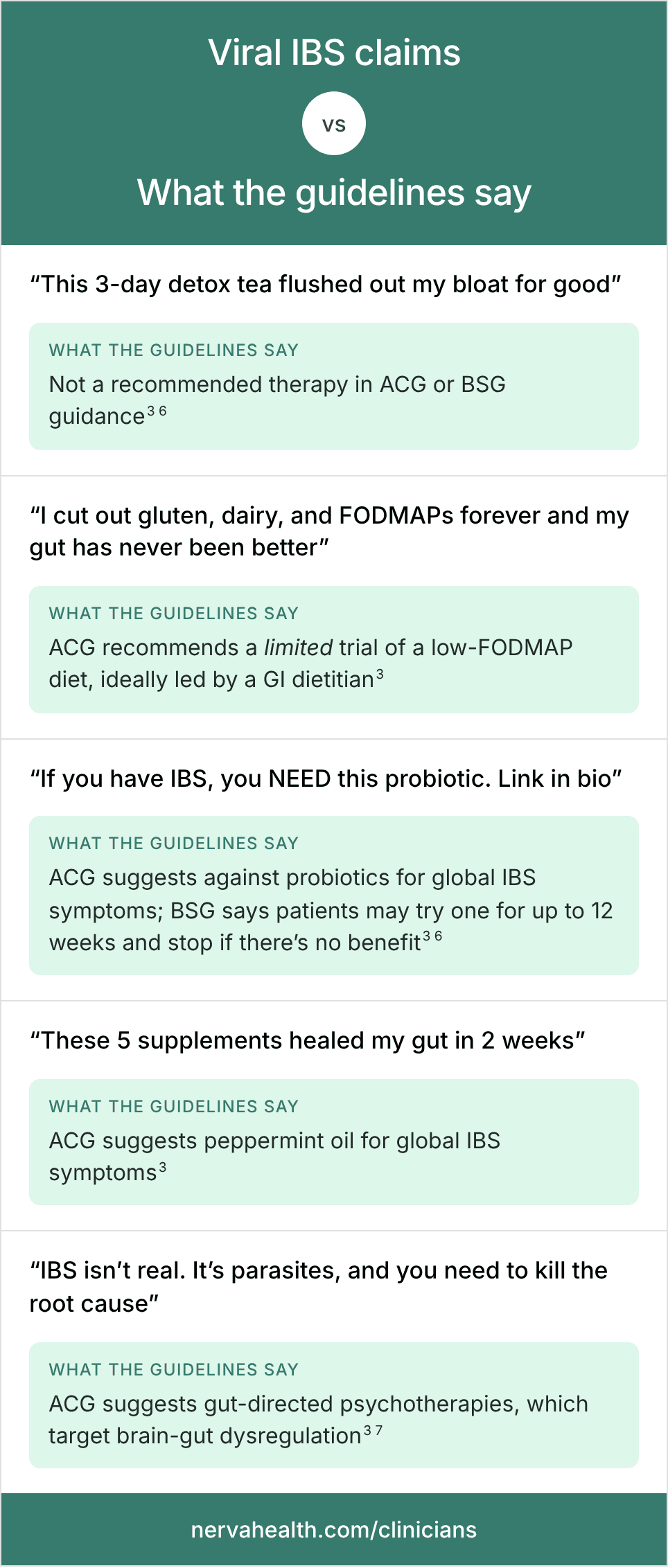
The fastest way to correct a viral gut health claim is to show patients what the IBS guidelines actually recommend.
It moves the conversation from your opinion against an influencer’s to what the evidence shows. The ACG and BSG guidelines cover most of the claims patients bring in:
Applying this in practice
Keep a quick-reference version of these guideline points within reach, whether that’s a printout in the exam room or a note in your patient portal.
Pointing to a named guideline is quicker than debating the details of each video, and it gives patients something concrete to check for themselves.
It also changes the dynamic. Rather than your word against an influencer’s, the conversation becomes about what the evidence shows, which makes it easier for patients to change course without feeling foolish.
Why aligning IBS care with patient preferences reduces reliance on online advice
Matching IBS care to what patients are already open to, whether that’s diet, supplements, or a non-drug approach, builds trust and makes them more likely to stick with an evidence-based plan.
When the plan doesn’t fit, the gap tends to get filled by whatever their feed offers next.
“Patients, if they’re not getting the care that aligns with their preferences, they will look to other sources.”
– Dr. Wendi LeBrett
Social media is very good at selling quick fixes in exactly these areas. Rather than steering patients away from their preferences, meet them with the evidence-based version.
Applying this in practice
Find the guideline-backed option that matches what the patient is drawn to:
Interested in supplements: discuss psyllium (a soluble fibre) and peppermint oil, both supported by ACG guidelines for global IBS symptoms.³
Focused on food: if you’re not a dietitian yourself, refer to one who specialises in gut health. They can then assess whether a structured approach, such as a time-limited low-FODMAP trial, is the right fit for that patient.³
Wants to treat the root cause: introduce gut-brain behaviour therapy, which targets the brain-gut dysregulation behind symptoms.⁷
That last group is bigger than you might expect, and the framing resonates:
“A lot of patients want to identify or treat the root cause of their GI condition. And I tell them gut brain behaviour therapy is addressing directly the root cause.”
– Dr. Wendi LeBrett
It’s especially relevant for patients who have restricted their diet on their own. Gut-brain therapy or medication can help manage symptoms in the meantime, so patients feel well enough to reintroduce foods with a dietitian’s support.
Where digital gut-brain therapy fits when there’s no time for IBS education
Gut-brain therapy is guideline-supported for IBS, can be introduced at any point in care, and works alongside diet and medication.³ ⁷
It also helps with the problem this whole article is about: there’s rarely enough time in a visit to explain the gut-brain axis properly, let alone counter everything a patient has seen online.
Nerva is a 6-week digital gut-brain therapy program, taking 15–20 minutes a day. It combines gut-directed hypnotherapy with CBT-informed education and breathing exercises.
The evidence is strong. In a randomised controlled trial of 244 adults with IBS, 81% of Nerva participants achieved a clinically meaningful improvement on the IBS Symptom Severity Scale, compared with 63% in an active control group.⁸ An earlier Monash University trial found gut-directed hypnotherapy was as effective as the low-FODMAP diet.⁹
Extending IBS education beyond the 15-minute consult
Patients are far less likely to go back to their feed if they have a trusted source of education between visits. Structured programs can reinforce what you explained in clinic. In Nerva, for example, the daily sessions cover the gut-brain axis, visceral hypersensitivity, and the stress-symptom loop, plus a dedicated session on gut-brain myth-busting. Referred patients can also book a free call with a Gut-Brain Specialist to talk through their diagnosis before they start.
Patients don’t need to be fully convinced before you refer them. Referrals don’t expire, so they can start when they’re ready.
Navigating IBS misinformation with GI Dr. Wendi LeBrett
Frequently asked questions
What should I do when an IBS patient doesn’t trust their diagnosis?
When an IBS patient doesn’t trust their diagnosis, acknowledge their doubts, explain your reasoning, and make it clear you’re available when they’re ready to talk again. Some patients won’t come around in one visit, and keeping the door open protects the relationship for when they do.
Should gastroenterologists post IBS content on social media?
Gastroenterologists who post evidence-based IBS content add credible voices to a space dominated by creators with no medical background. Good starting points are answering questions patients asked in clinic that day and reviewing HIPAA, state licensure, and FTC disclosure rules before posting.
How can I find a GI dietitian for my IBS patients?
GI dietitians can be found through Monash University’s directory of FODMAP-trained dietitians and through national dietetic associations. Telehealth widens the options for patients with no local GI dietitian, although insurance coverage varies.
How long does gut-directed hypnotherapy take to work for IBS?
Gut-directed hypnotherapy usually takes 4–6 weeks before patients notice meaningful improvement in their IBS symptoms. Clinical trials show improvements can be maintained after the program ends.⁸ ⁹
References
Vu K, Garcia-Rogers K, Li B, et al. Gut health claims and monetization features on TikTok: cross-sectional analysis. Online J Public Health Inform. 2026;18:e105391. doi:10.2196/105391
Ying X, Yao L, Mathis WS, Congly SE, Jesudian AB. Geographic disparities in access to gastroenterologists in the United States. Gastroenterology. Published online February 1, 2025. doi:10.1053/j.gastro.2025.01.232
Lacy BE, Pimentel M, Brenner DM, et al. ACG clinical guideline: management of irritable bowel syndrome. Am J Gastroenterol. 2021;116(1):17-44. doi:10.14309/ajg.0000000000001036
Mindset Health. The State of IBS 2025 Report. Nerva by Mindset Health; 2025.
Drossman DA, Ruddy J. Improving patient-provider relationships to improve health care. Clin Gastroenterol Hepatol. 2020;18(7):1417-1426. doi:10.1016/j.cgh.2019.12.007
Vasant DH, Paine PA, Black CJ, et al. British Society of Gastroenterology guidelines on the management of irritable bowel syndrome. Gut. 2021;70(7):1214-1240. doi:10.1136/gutjnl-2021-324598
Keefer L, Ballou SK, Drossman DA, et al. A Rome Working Team report on brain-gut behavior therapies for disorders of gut-brain interaction. Gastroenterology. 2022;162(1):300-315. doi:10.1053/j.gastro.2021.09.015
Anderson EJ, Peters SL, Gibson PR, Halmos EP. Comparison of digitally delivered gut-directed hypnotherapy program with an active control for irritable bowel syndrome. Am J Gastroenterol. 2025;120(2):440-448. doi:10.14309/ajg.0000000000002921
Peters SL, Yao CK, Philpott H, et al. Randomised clinical trial: the efficacy of gut-directed hypnotherapy is similar to that of the low FODMAP diet for the treatment of irritable bowel syndrome. Aliment Pharmacol Ther. 2016;44(5):447-459.


