

Key takeaways:
- In a 2026 Tufts study, lower-quality TikTok gut health claims drew about three times the expected likes.
- 83% of the TikTok gut health creators studied had no medical background.
- IBS trials show a pooled placebo response of 37.5%, which makes uncontrolled testimonials look more convincing than they are.
- Brain-gut behavioural therapies like gut-directed hypnotherapy are guideline-recommended alongside diet and medication.
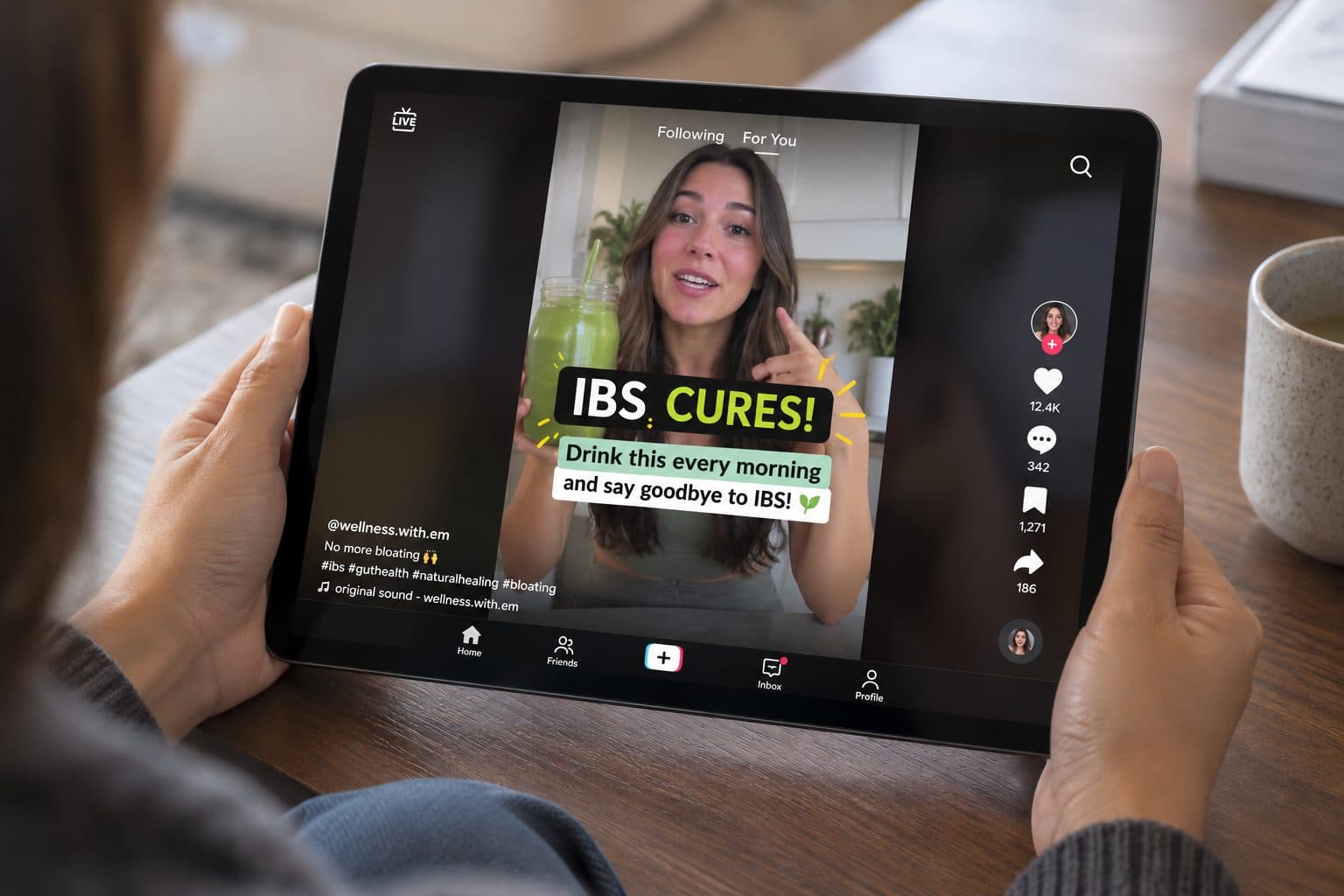
With so many eyes on the latest #GutTok trends, it’s increasingly common for IBS patients to arrive at your clinic having already acted on questionable gut health advice they found online, with a new Tufts study finding the least accurate claims get the most likes.¹ This means misinformation is often what your patients are seeing first – and potentially trusting the most.
Maybe they’ve cut an odd assortment of foods, tried a cleanse, or bought a supplement a creator swore by. Whatever they’ve tried, asking about it early and validating their search builds the trust you need to reset expectations from cure to management, and to guide them toward guideline-based care. Knowing what they’ve seen, and why it stuck, makes that conversation faster and more productive.
What the 2026 Tufts study found about gut health claims on TikTok
The Tufts study found that non-medical creators were more likely to post lower-quality gut health claims, and those claims earned significantly more engagement.¹ Researchers analysed one video each from 174 gut health creators with 5,000+ followers:
Non-medical creators: 83%
Poor or moderate-quality claims: 96.4% of nonmedical vs 40.7% of medical creators (adjusted prevalence ratio 2.33)
Monetisation: 92% used at least one feature, most often external links (70%) or a product showcase (59%)
Engagement: poor-quality claims drew 3.37 times the expected likes of high-quality claims
The design is cross-sectional with moderate interrater agreement on claim quality (κ = 0.41), so it shows association, not causation.¹
A separate ACG 2026 abstract found the same pattern: potentially misleading GI content receives greater engagement.²
Why TikTok gut health advice resonates with IBS patients
TikTok gut health advice resonates because it offers what IBS care often can’t: fast answers, relatable stories, and the promise of a cure. Wait times are long, and a creator describing the same urgency or bloating can feel more validating than a 15-minute visit.
“So many people go undiagnosed and they’re searching the internet and they are restricting food because there’s such a connection of I eat and then I feel poorly so if I take away the things that I’m eating I won’t feel as bad.”
– Dr. Megan Riehl, GI Psychologist, Clinical Director of the GI Behavioral Health Program at the University of Michigan
The placebo response explains why testimonials persuade. A meta-analysis of 73 IBS trials found a pooled placebo response of 37.5%,³ so plenty of people feel better after a detox tea or supplement, and their videos look like proof.
How to manage IBS patient expectations after TikTok advice
Managing expectations starts with asking what patients have already tried, then reframing the goal from cure to long-term symptom management. A strong patient-provider relationship improves outcomes in gut-brain disorders,⁴ and these steps build it:
Take a “digital history”. Ask “What have you tried or read about online?” alongside the usual medication and diet history. It often explains new food restriction, supplement use, or symptoms you’d otherwise attribute to the IBS itself.
Validate the search, not the claim. Acknowledge that searching for answers is a reasonable response to persistent symptoms before addressing what they found. Patients who feel judged for it tend to stop disclosing it, and keep doing it.
Screen for restriction. Where patients have cut multiple foods on their own, check for nutritional gaps and avoidant eating. In one neurogastroenterology clinic, nearly 1 in 4 patients showed clinically significant avoidant/restrictive eating, most often driven by fear of GI symptoms.⁵ A brief screen such as the Nine Item ARFID Screen (NIAS) can flag who needs dietitian input before any further elimination.⁶
Reset the goal from cure to control. Frame IBS as a chronic, fluctuating disorder of gut-brain interaction. The realistic aim is meaningful, sustained symptom management and better quality of life, not the one-off fix most online content promises.
Give a mechanism they can believe. A simple explanation of visceral hypersensitivity and altered gut-brain signalling explains why symptoms persist despite “clean” eating or supplements, and why brain-gut behavioural therapies are guideline-recommended.
Replace, don’t just remove. Patients let go of a trend more readily when they leave with a concrete, evidence-based plan: a structured dietary approach, appropriate pharmacotherapy, a brain-gut behavioural therapy, or a combination.
“Much of what is out there in social media, YouTube, in gut health, we know that it’s misinformation or wrong. But it is so confident. It is simplified to such a fault that it can be harming patients.”
– Dr. Kim Bretz, Naturopathic Doctor, Faculty at University of Waterloo School of Pharmacy
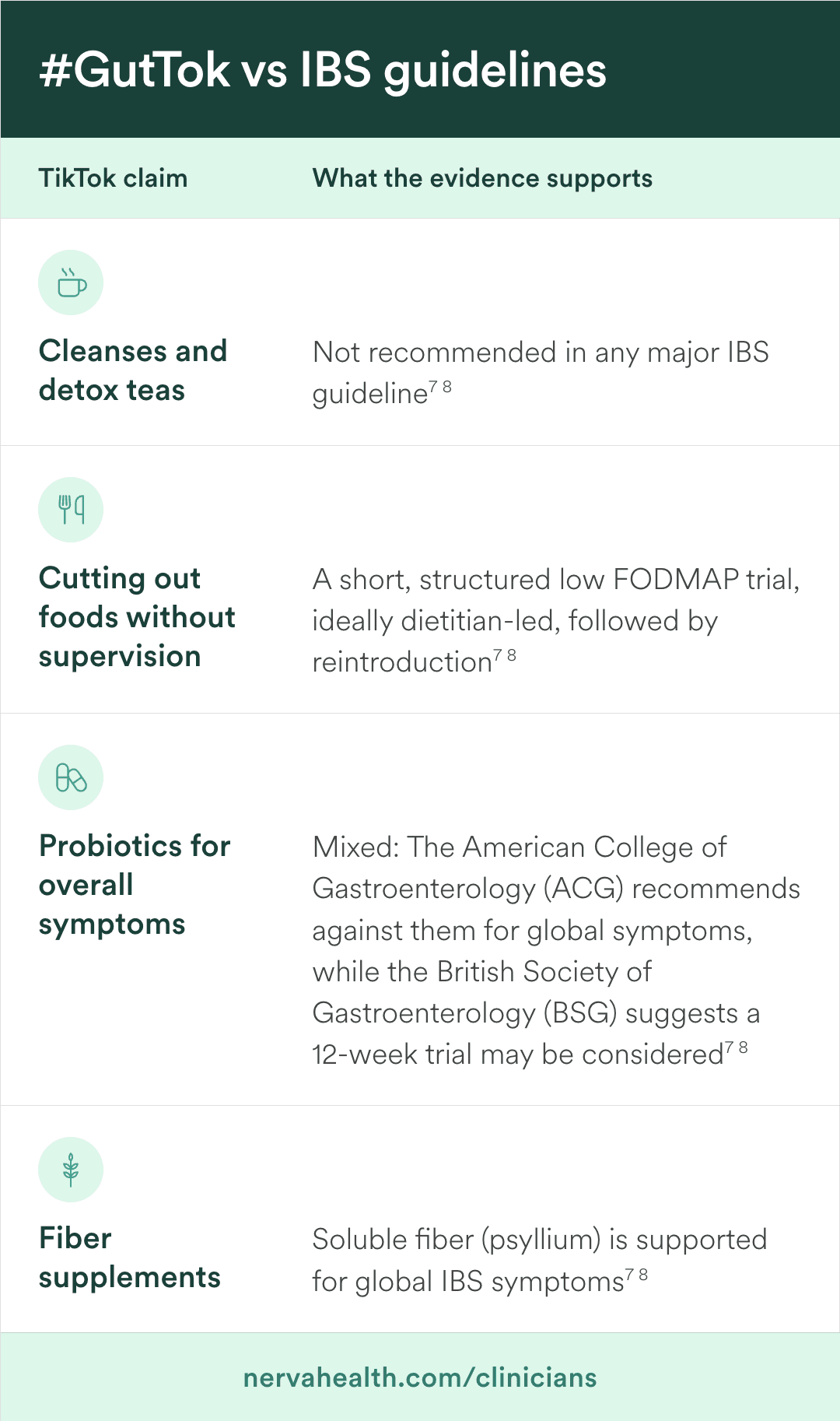
Where gut-directed hypnotherapy fits in evidence-based IBS care
Gut-directed hypnotherapy is a guideline-recommended brain-gut behavioural therapy that can be offered first line, alongside diet and medication, or later in care.⁷ ⁸ ⁹ The Rome Foundation recognises gut-directed hypnotherapy among the best-evidenced brain-gut behavioural therapies,⁹ and a Monash University RCT led by Dr. Simone Peters found it as effective as the low FODMAP diet.¹⁰
For a patient worn out by elimination diets, that’s a credible option that doesn’t depend on more restriction.
How to guide younger IBS patients from #GutTok to evidence-based care
Younger patients are the most likely to act on gut health advice they see online. In a US national survey of 5,041 adults, 18–34-year-olds were significantly more likely than every older age group to use health information from social media to make health decisions.¹¹ Many gut-brain disorders also start in childhood and adolescence, so by the time these patients reach an adult clinic, some have spent years searching online for answers.
For this group there’s a clear evidence-based alternative. The 2025 joint ESPGHAN/NASPGHAN guidelines for IBS and functional abdominal pain in children aged 4–18 strongly recommend hypnotherapy as a treatment option, based on moderate-certainty evidence.
They also strongly recommend cognitive behavioural therapy (CBT), and conclude that gut-brain psychotherapies, especially hypnotherapy, show the strongest evidence and effect size of the treatments reviewed.¹²
Applying this in practice with adolescents and young adults
Ask younger patients directly what they’ve seen on social media, because they may not offer it unprompted. Then meet them where they already are: a digital gut-brain therapy program delivered on their phone can replace the next trend with a guideline-backed option they’re likely to stick with.
Giving IBS patients an evidence-based option that can compete with #GutTok
Part of what makes #GutTok so persuasive is that it gives patients something to do, today, on the device they already use. Evidence-based care has to offer the same immediacy, or the next video will fill the gap.
Digital gut-brain therapy is one way to close it. Nerva is a digital program that patients access via a phone app. The difference from what’s on their feed is the evidence: in a randomised controlled trial, 81% of participants achieved a clinically meaningful improvement (≥50 points) on the IBS Symptom Severity Scale.¹³ It doesn’t ask patients to cut foods, cleanse, or buy supplements, and it works alongside the care you’re already providing.
For patients who arrive convinced by the last thing they watched, referring a program like this reframes the conversation. You’re not just telling them what to stop. You’re giving them something credible to start.
Frequently asked questions
Where can I send IBS patients for reliable information online?
Reliable IBS patient resources include the Rome Foundation, the American College of Gastroenterology’s patient centre, IFFGD, and Monash University’s FODMAP resources. Sharing one or two trusted links during the visit gives patients somewhere to go instead of their feed.
When should a dietitian be involved in IBS dietary changes?
A dietitian should be involved whenever a patient starts a low FODMAP diet or has already restricted several foods on their own. Dietitian-led care supports structured reintroduction and helps flag signs of disordered or avoidant eating.
Can gut-directed hypnotherapy be used as a first-line therapy for IBS?
Gut-directed hypnotherapy can be offered at any point in IBS care, including first line, alongside diet and medication. Guidelines support brain-gut behavioural therapies as part of an integrated approach rather than a last resort.
How long does gut-directed hypnotherapy take to work for IBS?
Gut-directed hypnotherapy programs typically run for 6–12 weeks, with outcomes usually assessed at the end of the course. Nerva’s program runs for 6 weeks with daily 15–20 minute sessions.
References
Vu K, Garcia-Rogers K, Li B, et al. Gut health claims and monetization features on TikTok: cross-sectional analysis. Online J Public Health Inform. 2026;18:e105391. doi:10.2196/105391
Schairer GH, Suresh S. S3297 Potentially misleading GI health content on TikTok receives greater engagement. Am J Gastroenterol. 2026;121(10S1):S718. doi:10.14309/01.ajg.0001222440.89439.cd
Ford AC, Moayyedi P. Meta-analysis: factors affecting placebo response rate in the irritable bowel syndrome. Aliment Pharmacol Ther. 2010;32(2):144-158. doi:10.1111/j.1365-2036.2010.04328.x
Drossman DA, Ruddy J. Improving patient-provider relationships to improve health care. Clin Gastroenterol Hepatol. 2020;18(7):1417-1426. doi:10.1016/j.cgh.2019.12.007
Murray HB, Bailey AP, Keshishian AC, et al. Prevalence and characteristics of avoidant/restrictive food intake disorder in adult neurogastroenterology patients. Clin Gastroenterol Hepatol. 2020;18(9):1995-2002. doi:10.1016/j.cgh.2019.10.030
Zickgraf HF, Ellis JM. Initial validation of the Nine Item Avoidant/Restrictive Food Intake disorder screen (NIAS): a measure of three restrictive eating patterns. Appetite. 2018;123:32-42. doi:10.1016/j.appet.2017.11.111
Lacy BE, Pimentel M, Brenner DM, et al. ACG clinical guideline: management of irritable bowel syndrome. Am J Gastroenterol. 2021;116(1):17-44.
Vasant DH, Paine PA, Black CJ, et al. British Society of Gastroenterology guidelines on the management of irritable bowel syndrome. Gut. 2021;70(7):1214-1240.
Keefer L, Ballou SK, Drossman DA, et al. A Rome Working Team Report on brain-gut behavior therapies for disorders of gut-brain interaction. Gastroenterology. 2022;162(1):300-315. doi:10.1053/j.gastro.2021.09.015
Peters SL, Yao CK, Philpott H, et al. Randomised clinical trial: the efficacy of gut-directed hypnotherapy is similar to that of the low FODMAP diet for the treatment of irritable bowel syndrome. Aliment Pharmacol Ther. 2016;44(5):447-459.
Chandrasekaran R, Sadiq T M, Moustakas E. Racial and demographic disparities in susceptibility to health misinformation on social media: national survey-based analysis. J Med Internet Res. 2024;26:e55086. doi:10.2196/55086
Groen J, Gordon M, Chogle A, et al. ESPGHAN/NASPGHAN guidelines for treatment of irritable bowel syndrome and functional abdominal pain-not otherwise specified in children aged 4–18 years. J Pediatr Gastroenterol Nutr. 2025;81(2):442-471. doi:10.1002/jpn3.70070
Anderson EJ, Peters SL, Gibson PR, Halmos EP. Comparison of digitally delivered gut-directed hypnotherapy program with an active control for irritable bowel syndrome. Am J Gastroenterol. 2025;120(2):440-448. doi:10.14309/ajg.0000000000002921


