.webp)

Key takeaways:
- There is no cure for IBS, but most people can achieve significant and lasting symptom relief with the right approach.
- The reason there is no single cure is that IBS involves multiple factors – including visceral hypersensitivity and disrupted gut-brain signaling.
- Treatments that only address symptoms have high relapse rates – lasting relief requires targeting the gut-brain connection itself.
- Gut-brain therapies have the strongest evidence for long-term IBS improvement, with benefits maintained for up to seven years.¹
There is no cure to IBS (irritable bowel syndrome), but it is a highly manageable condition – and for many people, long-term symptom relief is possible with the right management plan and combination of treatments.²
If you have been searching, perhaps desperately, for a cure to IBS or wondering whether this is something you will have to live with forever, you are not alone. But there is good news – and it starts with understanding what's actually driving your symptoms.
Here's what you need to know about cures, causes, and management strategies proven to calm IBS.
Is IBS a lifelong condition?
IBS is considered a chronic condition, meaning it tends to persist over time rather than resolving on its own.³
Research from the Mayo Clinic and other institutions suggests that for most people diagnosed with IBS, symptoms may come and go over months or years.³ However, chronic does not mean unchangeable.
Population studies show that 30–45% of people with IBS will experience prolonged symptom-free periods within a year of diagnosis.⁴ Symptoms naturally fluctuate, and with effective treatments and management strategies, many people reach a point where IBS no longer significantly disrupts their daily life.
The reason IBS behaves this way comes down to what it actually is: a gut-brain disorder.⁵ The nerves in the gut become overly sensitive, known as visceral hypersensitivity, and normal digestive activity gets amplified into pain, bloating, or urgency.
This is not structural damage: it's a communication problem between the gut and the brain – and communication problems can be retrained.
Why is there no cure for IBS?
IBS does not have a single cause, which is why there is no single cure.
It involves a complex interplay of factors – altered gut motility, changes in gut bacteria, visceral hypersensitivity, stress responses, and nervous system dysregulation – that vary from person to person.⁵
Most conventional treatments target one piece of this puzzle. Diet modifications reduce specific food triggers. Medications manage symptoms like diarrhea, constipation, or cramping. These approaches can be helpful – and for many people, they provide meaningful day-to-day relief.
But the reason IBS symptoms often return after stopping a treatment is that the underlying driver – the disrupted gut-brain signaling – has not been addressed.¹ Think of it this way: diet and medication work at the branches, managing what you feel day to day. Gut-brain therapy works at the roots, helping the nervous system become less reactive over time.
How to manage IBS long-term
There is no single cure for IBS – but there are proven ways to achieve lasting relief. Long-term improvement typically comes from combining approaches that address both symptoms and their underlying mechanism.²

Does diet help with IBS?
Dietary changes like the low FODMAP diet can help identify and reduce specific food triggers.⁶ Research from Monash University has shown eating a diet low in FODMAPs can significantly reduce IBS symptoms in the short term, and it remains one of the most commonly recommended starting points. However, it works best as a short-to-medium-term tool alongside other approaches – not as a permanent restriction.⁶
Can medication cure IBS?
Antispasmodics, laxatives, anti-diarrheal agents, and neuromodulators can provide meaningful symptom control, particularly during flare-ups. However, relapse rates when stopping medication alone are estimated at around 40–50% – often because the underlying nervous system sensitivity has not been addressed.⁷
Gut-brain therapy – the closest thing to a cure for IBS?
While there is no magical cure for IBS, gut-brain therapies offer the strongest evidence for making a real, lasting difference.
Both CBT and gut-directed hypnotherapy (GDH) have been shown to significantly reduce IBS symptoms, with research demonstrating improvements maintained for up to seven years.¹
Both GDH and CBT are recommended by the clinical guidelines that gastroenterologists around the world use to plan patient care, including those from the American College of Gastroenterology (ACG), the American Gastroenterological Association (AGA), and the UK's National Institute for Health and Care Excellence (NICE)– because they target the underlying mechanism driving IBS, not just the symptoms.⁸
Download ACG's quick guide to managing IBS.
Research shows that gut-directed hypnotherapy can directly reduce visceral hypersensitivity, improve gut motility, and normalize pain processing signals between the gut and brain.⁹ A landmark long-term study found that 71% of IBS patients initially responded to gut-directed hypnotherapy, and of those, 81% maintained their improvement for at least five years.¹⁰
This durability is what sets gut-brain approaches apart. By working on the nervous system patterns that keep the gut reactive, the improvements tend to persist even after the treatment period ends.
"Brain-gut behavioral therapies have great efficacy. They work really well in placebo-controlled trials. The effectiveness is strong long-term, up to seven years, and they're very safe. Should these therapies be offered earlier? The data suggests yes." – Dr. Jordan Shapiro, Gastroenterologist, The Gentle GI
What does gut-brain therapy actually involve for helping my IBS?
One of the barriers to gut-brain therapy has historically been access – traditional gut-directed hypnotherapy requires a trained specialist, often over a costly 6–12 weekly sessions in person, which can really add up.⁹ For many people searching for a lasting answer to IBS, that has put the most effective approach out of reach.
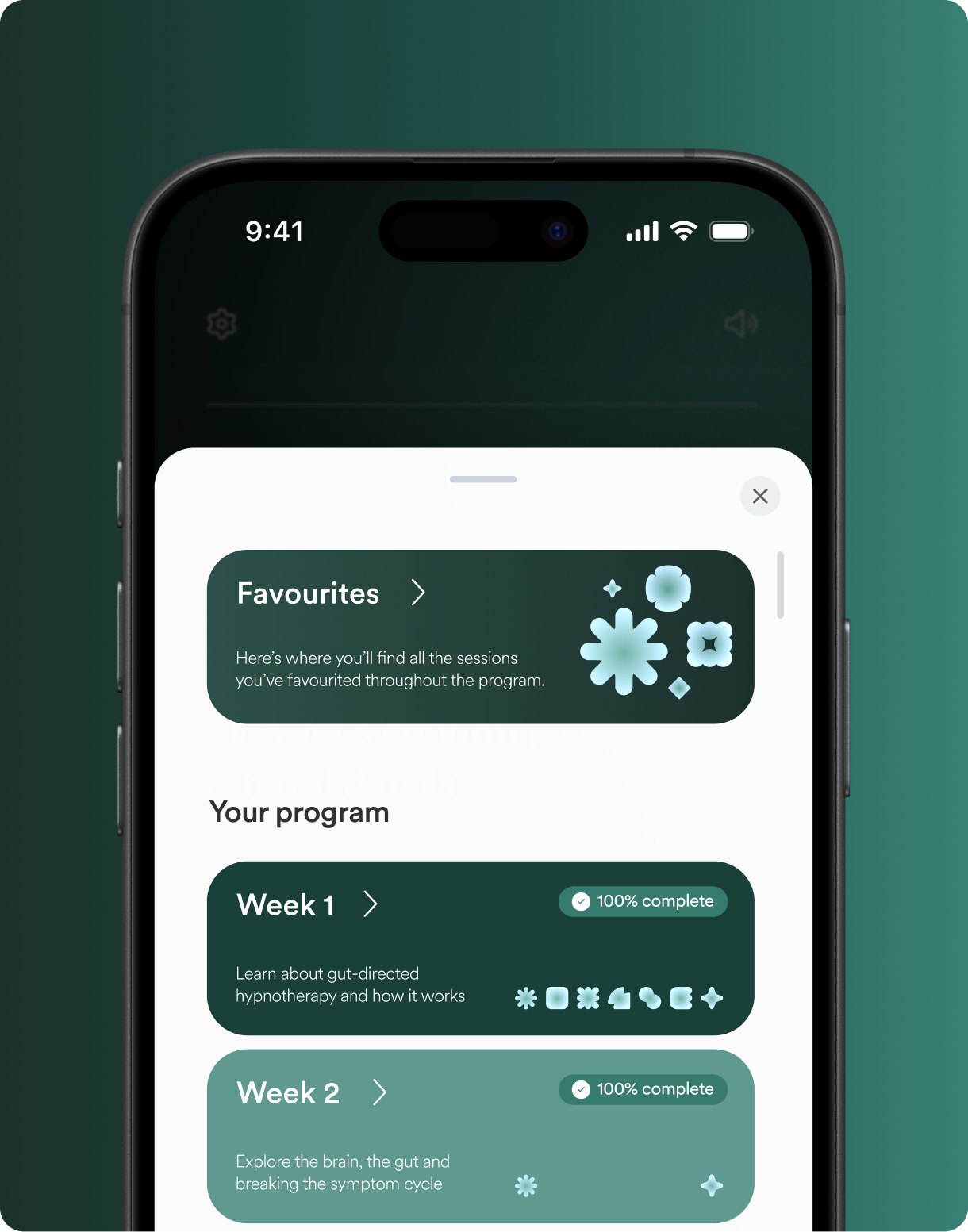
Digital programs have changed this. Nerva delivers a structured 6-week gut-brain therapy protocol – combining gut-directed hypnotherapy, cognitive behavioral techniques, breathing exercises, and symptom tracking – in 15–20 minutes per day.
In a randomized controlled trial published in the American Journal of Gastroenterology, 81% of participants achieved a clinically significant improvement on the IBS Symptom Severity Scale, and 71% had a clinically significant reduction in abdominal pain.¹¹
While it is not a cure, the evidence suggests that addressing the gut-brain connection directly is the most reliable path to lasting relief – and programs like Nerva have made that path accessible for the first time.
"If we do a good job managing the disruption between the gut-brain axis, many patients will have kind of mild to no symptoms the majority of the time, and that's really our goal." – Morgan Binder, Physician's Assistant and Registered Dietitian, Arizona Digestive Health
Frequently asked questions
Does IBS ever go away completely?
IBS can go into long periods of remission where symptoms are minimal or absent entirely. Population studies suggest that 30–45% of people experience extended symptom-free periods within the first year of diagnosis, and some people – particularly those with post-infectious IBS – may see symptoms resolve over several years.⁴
Does IBS get worse with age?
IBS prevalence actually tends to decrease with age, and research shows that visceral hypersensitivity – a key driver of IBS pain – becomes less common in older adults.¹² However, the condition is unpredictable and can fluctuate with changes in stress, diet, or overall health at any stage of life.
What is the difference between IBS and IBD?
IBS and IBD are not the same. IBD (Inflammatory Bowel Disease), which includes Crohn's disease and ulcerative colitis, involves visible inflammation and structural damage to the digestive tract, while IBS is a functional condition where the gut looks normal on tests but the nervous system processes digestive signals abnormally.⁵
Can gut-directed hypnotherapy help with all types of IBS?
Gut-directed hypnotherapy has been shown to improve symptoms across IBS subtypes, including IBS with diarrhea (IBS-D), constipation (IBS-C), and mixed patterns (IBS-M).¹ Because it works on the gut-brain connection rather than targeting a specific symptom, the benefits apply regardless of which bowel pattern predominates.
How quickly will I feel better after gut-brain therapy?
Most people begin noticing meaningful improvement within four to six weeks of starting a gut-brain therapy program. In Nerva's randomized controlled trial, participants showed clinically significant improvements in managing both overall symptom severity and abdominal pain over the course of the 6-week program.¹¹
References
Black CJ, Thakur ER, Houghton LA, Quigley EMM, Moayyedi P, Ford AC. Efficacy of psychological therapies for irritable bowel syndrome: systematic review and network meta-analysis. Gut. 2020;69(8):1441-1451.
Lacy BE, Pimentel M, Brenner DM, et al. ACG clinical guideline: management of irritable bowel syndrome. Am J Gastroenterol. 2021;116(1):17-44.
Mayo Clinic Staff. Irritable bowel syndrome. Mayo Clinic. Published October 2024.
Canavan C, West J, Card T. The epidemiology of irritable bowel syndrome. Clin Epidemiol. 2014;6:71-80.
Drossman DA. Functional gastrointestinal disorders: history, pathophysiology, clinical features, and Rome IV. Gastroenterology. 2016;150(6):1262-1279.
Halmos EP, Power VA, Shepherd SJ, Gibson PR, Muir JG. A diet low in FODMAPs reduces symptoms of irritable bowel syndrome. Gastroenterology. 2014;146(1):67-75.
Tack J, Fried M, Houghton LA, Spicak J, Fisher G. Systematic review: the efficacy of treatments for irritable bowel syndrome – a European perspective. Aliment Pharmacol Ther. 2006;24(2):183-205.
Häuser W. Gut-directed hypnosis and hypnotherapy for irritable bowel syndrome: a mini-review. Front Psychol. 2024;15:1389911.
Vasant DH, Whorwell PJ. Gut-focused hypnotherapy for functional gastrointestinal disorders: evidence-base, practical aspects, and the Manchester protocol. Neurogastroenterol Motil. 2019;31(8):e13573.
Gonsalkorale WM, Miller V, Afzal A, Whorwell PJ. Long term benefits of hypnotherapy for irritable bowel syndrome. Gut. 2003;52(11):1623-1629.
Anderson E, Peters SL, Halmos EP, Gibson PR. Digitally delivered gut-directed hypnotherapy program vs active control for irritable bowel syndrome. Am J Gastroenterol. 2025;120(2):396-405.
Moons LMG, et al. Age-related decrease in abdominal pain and associated structural- and functional mechanisms. Front Neurosci. 2022;15:806005.