All three treatments worked by the placebo effect, meaning treatments acted solely through the patient’s belief in them. This is a possibility since no placebo control was available in this study although the low FODMAP diet has previously been compared to a placebo.
The benefit of treatment was limited by the ceiling effect, in which there is a maximum proportion of IBS patients that respond to treatment.
Both treatments act via the same mechanism, despite different modes of entry.
The two therapies negatively impact one another, limiting the effect of combined treatment.
How strong is the evidence?
As a randomized controlled trial – the ‘gold standard’ of proof in medicine⸺the evidence generated from Dr. Peters’ trial is strong. Reasonable measures were taken by Dr. Peters and her team to eliminate sources of bias. Although the trial was relatively small with 74 patients and the period of hypnosis short at six weeks, the data was conclusive in statistical terms. Future studies with larger cohorts may confirm findings, but the present results should be accepted.
Results of similar studies
The Australian study consolidates findings from the UK that show hypnotherapy is effective. Research from the Manchester group in the UK of 1000 patients found 76% of patients treated with hypnotherapy improved symptom severity by almost half. Several other studies have reported reductions in IBS symptoms of between 25% to 75% with gut-directed hypnotherapy.here is a growing body of literature supporting hypnotherapy for IBS.
Does this mean IBS is all in the mind?
The result that hypnotherapy treats IBS does not suggest the disorder is a simply ‘functional’ disorder of the mind. Rather, it suggest that IBS is a biopsychosocial condition in which the mind-body connection can play a role in lessening symptoms.
In fact, Dr. Peters’ study showed that psychological benefits from hypnotherapy did not correlate directly with improvements to IBS symptoms. This implies that hypnotherapy did more than just affect the mind; it exerted a physiological effect on the GI tract that lessened symptoms of IBS.
How Hypnotherapy Works
The science of gut-directed hypnotherapy is new and unfolding, and the precise mechanism for how this therapy might relieve IBS is not known. However, there are several theories for how the effect might occur. Hypnotherapy may act by:
Reducing pain sensitivity in the gut
Reducing physiological arousal
Relaxing smooth muscle in the intestine
Increasing motility (the speed of which food moves through the gut)
Lowering the psychological trait of somatization (body sensation-focused distress)
How can this study help you?
If you have IBS, this study brings good news. It demonstrates hypnotherapy is a powerful treatment and that gastrointestinal symptom can be treated without needing to change what you eat. A six-week course of hypnotherapy improved symptoms in 70% of patients regardless of hypnotic susceptibility. For patients who have struggled with dietary treatments or found little benefit, hypnotherapy should be considered a clinically effective alternative.
Hypnotherapy or diet – which should I choose?
The low-FODMAP diet and gut-directed hypnotherapy are both likely to reduce IBS symptoms in most patients. The choice of therapy should come down to budget, the availability of hypnotherapists in your local area, and dietary preferences. When choosing a treatment, it is essential first to consult a doctor to confirm the IBS diagnosis. Below is a summary of the pros and cons of each procedure:
Low-FODMAP diet
Pros
Cons
Nutritionally inadequate. Studies have found calcium deficiency in some patients.Lack of fiber is also a concern.
Gut bacteria (and the ‘microbiome’) may be negatively affected by the lack of prebiotic effects of FODMAPs.
Eating disorders may arise from obsessive focus on food, such as orthorexia nervosa.
Gut-directed Hypnotherapy
Pros
Reduces IBS symptoms in 70% of patients. Effective regardless of the hypnotic status of the patient.
Additional psychological benefits, including improving associated anxiety & depression.
Exceptionally safe.
Accessible via an app, such as Nerva.
App-based treatment is lower cost than in-person.
Cons
Few therapists are trained in gut-directed techniques.
A financial burden is associated with sessions.
Time commitment is required.
How can I access gut-directed hypnotherapy?
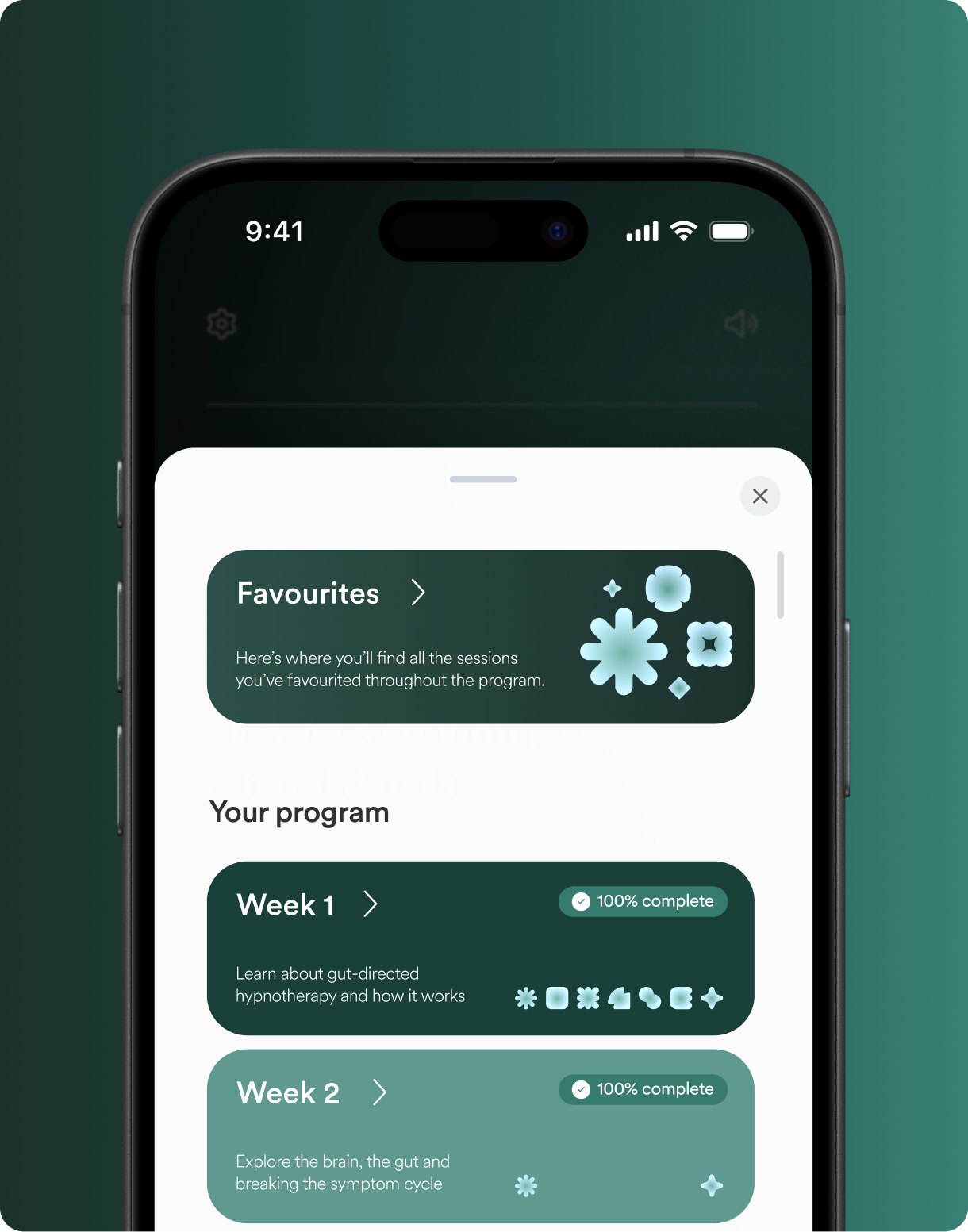
Gut-directed hypnotherapy is a relatively new IBS treatment and availability may be subject to location. Fortunately, there is evidence that app-based hypnotherapy is comparable to in-person treatment. Nerva was created with Dr Peters, leader of this Monash study.
The Wrap Up
The present clinical trial contributes to the growing body of work showing hypnotherapy is effective and may help to normalize this therapy in clinical practice. Patients with IBS in Australia, the United States and worldwide can expect better relief of GI symptoms through the expansion of hypnotherapy clinics. The health benefits of hypnotherapy are likely to be investigated in many more clinical trials in the future.
References
1. DrossmanDA, Dumitrascu DL. Rome III: New standard for functional gastrointestinal disorders. Journal of Gastrointestinal and Liver Diseases. 2006 Sep;15(3):237. Link
2. Drossman DA, McKee DC, Sandler RS, Mitchell CM, Cramer EM, Lowman BC,Burger AL. Psychosocial factors in the irritable bowel syndrome: a multivariate study of patients and non patients with irritable bowel syndrome.Gastroenterology. 1988 Sep 1;95(3):701-8. Link
3. Halmos EP, Power VA, Shepherd SJ, Gibson PR, Muir JG. A diet lowin FODMAPs reduces symptoms of irritable bowel syndrome. Gastroenterology.2014 Jan 1;146(1):67-75. Link
4. Lindfors P, Unge P, Arvidsson P, Nyhlin H, Björnsson E, Abrahamsson H,Simrén M. Effects of gut-directed hypnotherapy on IBS in different clinical settings—results from two randomized, controlled trials. The American journal of gastroenterology. 2012 Feb;107(2):276. Link
5. Peters SL, Yao CK, Philpott H, Yelland GW, Muir JG, Gibson PR.Randomised clinical trial: the efficacy of gut‐directed hypnotherapy is similarto that of the low FODMAP diet for the treatment of irritable bowel syndrome. Alimentary pharmacology & therapeutics. 2016 Sep;44(5):447-59. Link
6. CartwrightN. Are RCTs the gold standard?. BioSocieties. 2007 Mar;2(1):11-20. Link
7. MillerV, Carruthers HR, Morris J, Hasan SS, Archbold S, Whorwell PJ. Hypnotherapy for irritable bowel syndrome: an audit of one thousand adult patients. Alimentary pharmacology & therapeutics. 2015 May;41(9):844-55. Link
8. WhorwellPJ, Prior A, Faragher EB. Controlled trial of hypnotherapy in the treatment of severe refractory irritable-bowel syndrome. The Lancet. 1984 Dec1;324(8414):1232-4. Link
9. RobertsL, Wilson S, Singh S, Roalfe A, Greenfield S. Gut-directed hypnotherapy for irritable bowel syndrome: piloting a primary care-based randomised controlled trial. Br J Gen Pract. 2006 Feb 1;56(523):115-21. Link
10. Tan G,Hammond DC, Gurrala J. Hypnosis and irritable bowel syndrome: a review of efficacy and mechanism of action. American Journal of Clinical Hypnosis. 2005Jan 1;47(3):161-78. Link
11. Staudacher,H.M., Lomer, M.C., Anderson, J.L., Barrett, J.S., Muir, J.G., Irving, P.M. and Whelan, K., 2012. Fermentable carbohydrate restriction reduces luminalbifidobacteria and gastrointestinal symptoms in patients with irritable bowelsyndrome. The Journal of nutrition, 142(8), pp.1510-1518. Link
12. SimpsonHL, Campbell BJ. dietary fibre–microbiota interactions. Alimentary pharmacology& therapeutics. 2015 Jul;42(2):158-79. Link
13. 2.Hasan S, Pearson J, morris J, Whorwell P. SKYPE HYPNOTHERAPY FOR IRRITABLE BOWEL SYNDROME: Effectiveness and Comparison with Face-to-Face Treatment.International Journal of Clinical and Experimental Hypnosis. 2019;67(1):69-80. Link
14. 4.Sirigu D, Sole N, Musio M, Usai-Satta P, Oppia F. A Combined Hypnosis-echography Therapy in Irritable Bowel Syndrome: A Pilot Study. Journal of Advances in Medicine and Medical Research. 2018;25(12):1-10. Link

.jpeg)

.jpeg)