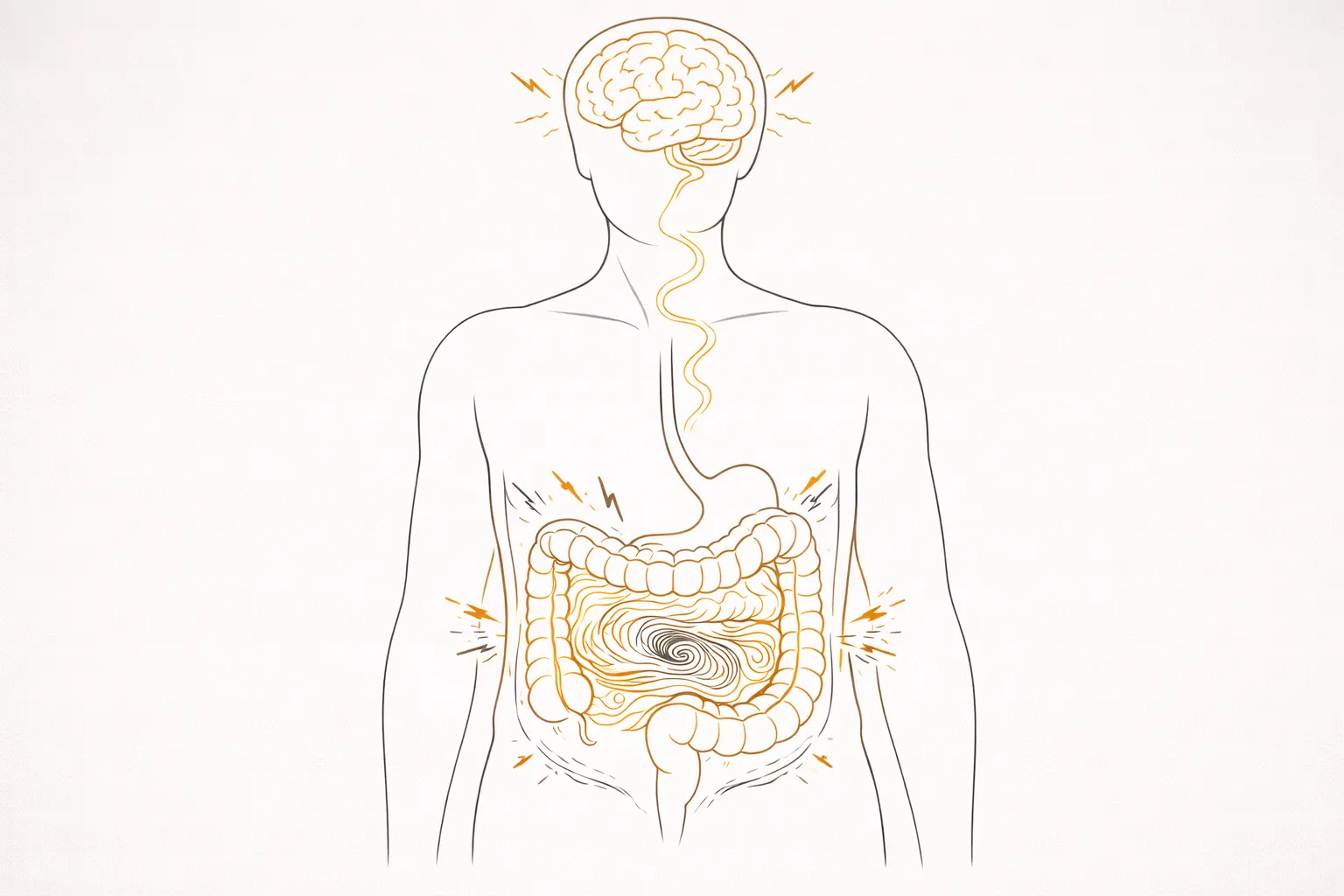
GLP-1 medicines affect digestion and the brain pathways involved in nausea. Gut-directed hypnotherapy uses focused attention and imagery to work with digestive sensations. Research in IBS shows that this approach can improve symptoms.
Understanding the gut-brain connection can help you make sense of symptoms that involve several processes at once. A medicine may affect digestion while an existing gut condition, previous experiences of nausea or worry about symptoms also plays a part.
This article explains that science and the studies behind it. For practical symptom advice, start with our GLP-1 digestive side effects guide.
Why GLP-1 medicines affect the gut and brain
GLP-1 is part of the body's communication system around eating. Medicines that act on GLP-1 receptors influence appetite and digestion, including how quickly the stomach empties. Brain pathways involved in nausea also contribute to the experience.
In a 2026 review in the Journal of Clinical Investigation, Lisa Beutler describes GLP-1 signaling across the gut-brain axis. Relevant receptors occur in several locations, including the brainstem. Researchers have identified pathways involved in eating and pathways involved in aversive responses, although much of this detailed circuit research comes from animals. Beutler, 2026.
This helps explain why nausea involves more than stomach-emptying speed. The brain processes information from the digestive system and helps determine how that information feels. A symptom can therefore have a physical trigger and a brain-processing component at the same time.
How a gut signal becomes a symptom
Your brain helps turn information from inside your body into sensations such as fullness, pain or urgency. The insula is one of the brain regions involved in processing these internal signals.
How strong a sensation feels and how unpleasant it feels are related but distinct. You might describe nausea by its intensity, how often it happens or how much it disrupts eating. Those descriptions answer different questions, which is why a treatment study needs to specify exactly what changed.
Laboratory studies use controlled stimuli and brain imaging to examine these differences. Clinical studies ask whether people feel or function better over time. The evidence table below includes both kinds of research, with the population and study design beside each result.
Nausea and anticipation
Feeling sick can make the next meal harder to approach. In cancer care, researchers have studied anticipatory nausea, where cues associated with chemotherapy become linked to nausea before a later treatment. Hypnosis has been investigated in that setting and in children with functional nausea.
These studies offer a reason to investigate whether behavioral support could help with the experience surrounding GLP-1 nausea. A similar learned response to an injection-day routine or food smell is a hypothesis in GLP-1 users. Timing alone can't identify its cause, because medication effects and other digestive problems can overlap.
Fullness and bowel sensations
Feeling full quickly and measuring slow stomach emptying are different ways of describing a digestive problem. A person reports the sensation; a test measures how the stomach functions. The relationship between them can be complicated.
Researchers have also examined sensitivity to stretching in the bowel and the gastrocolonic response, the colon's response to nutrients entering the digestive system. These measurements help explore how digestive activity and perception interact. The small studies below are useful for understanding that interaction; their findings depend on the condition and test used.
For everyday care, the pattern helps: fullness after meals, urgent loose stools and hard stools with straining need different questions. Our GLP-1 diarrhea guide and GLP-1 constipation guide cover the practical differences.
Symptoms that started before the medication
Your digestive history is part of the picture. If bloating or unpredictable bowel habits were already present, record how they changed after starting the medicine. That gives your clinician a clearer starting point than grouping everything under “side effects.”
An existing condition can be relevant without explaining every new symptom. IBS, for example, requires a healthcare provider's diagnosis after an appropriate evaluation.
What the hypnotherapy studies found
The studies below examine several distinct outcomes: symptom scores, nausea, responses to pain and measurements of digestive function. An acute physiological change and a lasting improvement in daily symptoms require different evidence.
| Study | Population and design | Finding | How to interpret it |
|---|---|---|---|
| Rainville, 1997 | Laboratory experiment using hypnotic suggestions during experimental pain | Pain unpleasantness and anterior cingulate activity changed while perceived intensity stayed the same | Demonstrates a distinction between intensity and unpleasantness in laboratory pain |
| Chiarioni, 2006 | 15 people with functional dyspepsia and 11 healthy volunteers; fixed-order conditions including a 90-minute hypnosis session | In the dyspepsia group, total stomach-emptying time was 274 minutes at baseline, 227 during cisapride and 150 during hypnosis | Small, acute, nonrandomized experiment. Symptom improvement didn't correlate with the emptying change, according to the author's later review |
| Simrén, 2004 | 28 adults with refractory IBS randomized to 12 weeks of clinician hypnotherapy or supportive care | Changes in sensory and motor responses to fat delivered into the small intestine | Small IBS study using a specialized laboratory test of the gastrocolonic response |
| Lea, 2003 | Before-and-after clinician hypnotherapy study of 23 people with IBS; 17 healthy reference participants | Pain threshold increased in the 10 initially hypersensitive patients; normal sensitivity was unchanged | No randomized treatment control; change in the seven less-sensitive patients was not statistically significant |
| Lowén, 2013 | 44 women with IBS enrolled; 31 completed intervention and repeat imaging; 20 healthy controls | Responders showed reduced anterior insula activity after hypnotherapy or education | Attrition limits interpretation; the brain response occurred with both interventions |
| Whorwell, 1992 | 18 people with IBS in a laboratory hypnosis and induced-emotion experiment | Colonic activity differed during hypnosis and induced emotional states | An acute physiological observation, with no measure of sustained symptom benefit |
| Browne, 2022 | 100 children aged 8-18 with functional nausea or dyspepsia; randomized hypnotherapy versus standard medical care | Primary 12-month success was similar: 60% versus 55%; some earlier outcomes favored hypnotherapy | Pediatric evidence with a mixed result; superiority wasn't demonstrated at the primary endpoint |
| Richardson, 2007 | Systematic review of six randomized chemotherapy nausea trials; five involved children | Positive findings for anticipatory and chemotherapy-related nausea | Older, mostly pediatric studies in cancer care; the authors called for further investigation, particularly in adults |
| Anderson, 2025 | 244 adults with IBS randomized; 240 in reported groups, 121 receiving Nerva and 119 active digital control; approximately 90% women | At program completion, 81% receiving Nerva versus 63% receiving control improved by at least 50 points on the IBS Symptom Severity Scale | Evidence for the specified IBS endpoint and population |
What gut-directed hypnotherapy involves
Gut-directed hypnotherapy uses focused attention, guided imagery and suggestions about responding to digestive sensations. Sessions usually begin with relaxation and continue with gut-focused imagery, with repeated practice over several weeks.
You listen and follow the guidance while remaining able to choose whether to participate. Clinician-delivered protocols and self-guided audio programs share techniques, but each needs evidence for its own use. Vasant and Whorwell, 2019.
The American College of Gastroenterology's 2021 IBS guideline suggests gut-directed psychotherapies for global IBS symptoms. This guidance concerns that category of care for IBS. Lacy et al., 2021.
Nerva brings this practice into a program you can use at home, combining guided hypnotherapy audio with breathing exercises and CBT-informed education. The Anderson trial in the table above provides its IBS evidence.
Nerva hasn't been tested for GLP-1 side effects. The studies above examined other conditions and settings. Explore the Nerva program.
Talking about the gut-brain connection in your care
Describe what the symptom does to your day. For example, feeling too full to finish meals is different from being able to eat but worrying that nausea will return. Both descriptions can help a clinician understand what you're experiencing.
Include when symptoms began, what existed before the medication and any changes in bowel habits. If you have a diagnosed gut-brain condition, ask how behavioral self-management could fit alongside your current care.
Don't change your medication or dose without talking to your prescriber.
When to get medical help
Call 911 for chest pain, trouble breathing, fainting or collapse.
Get medical help right away for severe or lasting abdominal pain, especially if it spreads to your back; vomiting blood or black or bloody stools; repeated vomiting, inability to keep fluids down or very little urine; a swollen, painful belly with inability to pass stool or gas; or upper-right abdominal pain with fever or yellow skin or eyes.
Trouble swallowing needs prompt medical assessment. If you can't swallow at all, go to an emergency department.
Sources: medication warnings, NIDDK, CDC and Mayo Clinic.
For an overview of the program, read Nerva for digestive symptoms on GLP-1s.
Ozempic, Wegovy and Rybelsus are trademarks of Novo Nordisk. Mounjaro, Zepbound and Foundayo are trademarks of Eli Lilly. Nerva is not affiliated with either company.
References
Beutler LR. GLP-1 physiology and pharmacology along the gut-brain axis. J Clin Invest. 2026;136(2):e194744. https://www.jci.org/articles/view/194744
Rainville P, Duncan GH, Price DD, Carrier B, Bushnell MC. Pain affect encoded in human anterior cingulate but not somatosensory cortex. Science. 1997;277(5328):968-971. doi:10.1126/science.277.5328.968. https://pubmed.ncbi.nlm.nih.gov/9252330/
Lowén MBO, Mayer EA, Sjöberg M, et al. Effect of hypnotherapy and educational intervention on brain response to visceral stimulus in the irritable bowel syndrome. Aliment Pharmacol Ther. 2013;37(12):1184-1197. doi:10.1111/apt.12319. https://pubmed.ncbi.nlm.nih.gov/23617618/
Browne PD, de Bruijn CMA, Speksnijder EM, et al. Skills or Pills: Randomized Trial Comparing Hypnotherapy to Medical Treatment in Children With Functional Nausea. Clin Gastroenterol Hepatol. 2022;20(8):1847-1856.e6. doi:10.1016/j.cgh.2021.10.029. https://pubmed.ncbi.nlm.nih.gov/34718171/
Chiarioni G, Vantini I, De Iorio F, Benini L. Prokinetic effect of gut-oriented hypnosis on gastric emptying. Aliment Pharmacol Ther. 2006;23(8):1241-1249. https://pubmed.ncbi.nlm.nih.gov/16611286/
Chiarioni G, Palsson OS, Whitehead WE. Hypnosis and upper digestive function and disease. World J Gastroenterol. 2008;14(41):6276-6284. https://pmc.ncbi.nlm.nih.gov/articles/PMC2768043/
Simrén M, Ringström G, Björnsson ES, Abrahamsson H. Treatment with hypnotherapy reduces the sensory and motor component of the gastrocolonic response in irritable bowel syndrome. Psychosom Med. 2004;66(2):233-238. doi:10.1097/01.psy.0000116964.76529.6e. https://pubmed.ncbi.nlm.nih.gov/15039508/
Richardson J, Smith JE, McCall G, Richardson A, Pilkington K, Kirsch I. Hypnosis for nausea and vomiting in cancer chemotherapy: a systematic review of the research evidence. Eur J Cancer Care (Engl). 2007;16(5):402-412. doi:10.1111/j.1365-2354.2006.00736.x. https://pubmed.ncbi.nlm.nih.gov/17760926/
Novo Nordisk. Wegovy (semaglutide) prescribing information. Revised June 2026; adult weight-management 2.4 mg injection cohort, Table 3. https://www.novo-pi.com/wegovy.pdf
Vasant DH, Whorwell PJ. Gut-focused hypnotherapy for Functional Gastrointestinal Disorders: Evidence-base, practical aspects, and the Manchester Protocol. Neurogastroenterol Motil. 2019;31:e13573. doi:10.1111/nmo.13573. https://onlinelibrary.wiley.com/doi/10.1111/nmo.13573
Lacy BE, Pimentel M, Brenner DM, et al. ACG Clinical Guideline: Management of Irritable Bowel Syndrome. Am J Gastroenterol. 2021;116(1):17-44. doi:10.14309/ajg.0000000000001036. https://pubmed.ncbi.nlm.nih.gov/33315591/
Lea R, Houghton LA, Calvert EL, et al. Gut-focused hypnotherapy normalizes disordered rectal sensitivity in patients with irritable bowel syndrome. Aliment Pharmacol Ther. 2003;17(5):635-642. doi:10.1046/j.1365-2036.2003.01486.x. https://pubmed.ncbi.nlm.nih.gov/12641511/
Whorwell PJ, Houghton LA, Taylor EE, Maxton DG. Physiological effects of emotion: assessment via hypnosis. Lancet. 1992;340(8811):69-72. doi:10.1016/0140-6736(92)90394-i. https://pubmed.ncbi.nlm.nih.gov/1352012/
Anderson EJ, Peters SL, Gibson PR, Halmos EP. Comparison of Digitally Delivered Gut-Directed Hypnotherapy Program With an Active Control for Irritable Bowel Syndrome. Am J Gastroenterol. 2025;120(2):440-448. doi:10.14309/ajg.0000000000002921. https://pubmed.ncbi.nlm.nih.gov/38940439/
Mindset Health. Nerva for clinicians. Product descriptions and eligibility; accessed September 29, 2026. https://www.nervahealth.com/clinicians
National Institute of Diabetes and Digestive and Kidney Diseases. Symptoms & Causes of Gastroparesis. Reviewed January 2018; accessed September 29, 2026. https://www.niddk.nih.gov/health-information/digestive-diseases/gastroparesis/symptoms-causes
Centers for Disease Control and Prevention. About Heart Attack Symptoms, Risk, and Recovery. Accessed September 29, 2026. https://www.cdc.gov/heart-disease/about/heart-attack.html
Mayo Clinic. Difficulty swallowing in adults: when to seek medical advice. https://www.mayoclinic.org/symptom-checker/difficulty-swallowing-in-adults-adult/related-factors/itt-20009075