.webp)
Key takeaways:
- Five real-world studies presented at Digestive Disease Week 2026 examined how digital gut-directed hypnotherapy performs in routine care for IBS and overlapping conditions.
- Across 194,879 real-world users, 45% of adherent users reached clinically meaningful pain reduction, with adherence and outcomes improving as the program was iteratively refined.
- Responder rates were comparable across IBS (58%), Crohn's disease (52%), and ulcerative colitis (60%), suggesting gut-brain therapy may help IBD patients with persistent IBS-like symptoms in remission.
- Diaphragmatic breathing added a dose-response benefit on top of gut-directed hypnotherapy in moderate-to-severe IBS, and IBS patients with upper GI overlap saw comparable or greater improvement.
Key takeaways
Access to trained therapists is the biggest barrier to delivering brain-gut behavioral therapy (BGBT) in everyday IBS practice – even though it's recommended by both the American College of Gastroenterology (ACG) and American Gastroenterological Association (AGA).
Across 194,879 real-world users, 45% of adherent users reached clinically meaningful pain reduction on a digital gut-directed hypnotherapy program.¹
Gut-brain therapy may help close a treatment gap for IBD patients with persistent IBS-like symptoms in remission, with similar response rates across IBS (58%), Crohn's (52%), and ulcerative colitis (60%).²
Patients with IBS plus upper GI symptoms saw comparable or greater IBS improvement than IBS-only patients – and their upper GI symptoms improved too.³
Diaphragmatic breathing added a dose-response benefit on top of gut-directed hypnotherapy in moderate-to-severe IBS.⁴
Digital gut-directed hypnotherapy produces clinically meaningful symptom improvement in IBS, IBD with IBS overlap, and IBS with upper GI overlap, according to five just-released real-world studies. For clinicians, these new insights offer a clearer picture of where digital brain-gut behavioral therapy fits in routine care and which patients it actually helps.
The studies were presented at Digestive Disease Week (DDW) 2026, the world's largest GI research conference, and led by research teams at Monash University, Mayo Clinic, and Mount Sinai.
They drew on one of the largest published digital BGBT cohorts to date, and addressed the questions clinicians ask most often when considering a behavioral therapy referral: does it work in routine practice, does it work in patients with overlapping conditions, and which components actually drive benefit? Two were selected as DDW 2026 Posters of Distinction, a designation reserved for the top-rated abstracts.
Watch Nerva's Dr. Simone Peters explain her and our partners' research that we presented.
Does digital gut-directed hypnotherapy work in real-world practice?
Real-world adherence is the soft spot in behavioral therapy evidence – RCT efficacy rarely translates cleanly into routine care, and digital programs are often assumed to have the same problem.
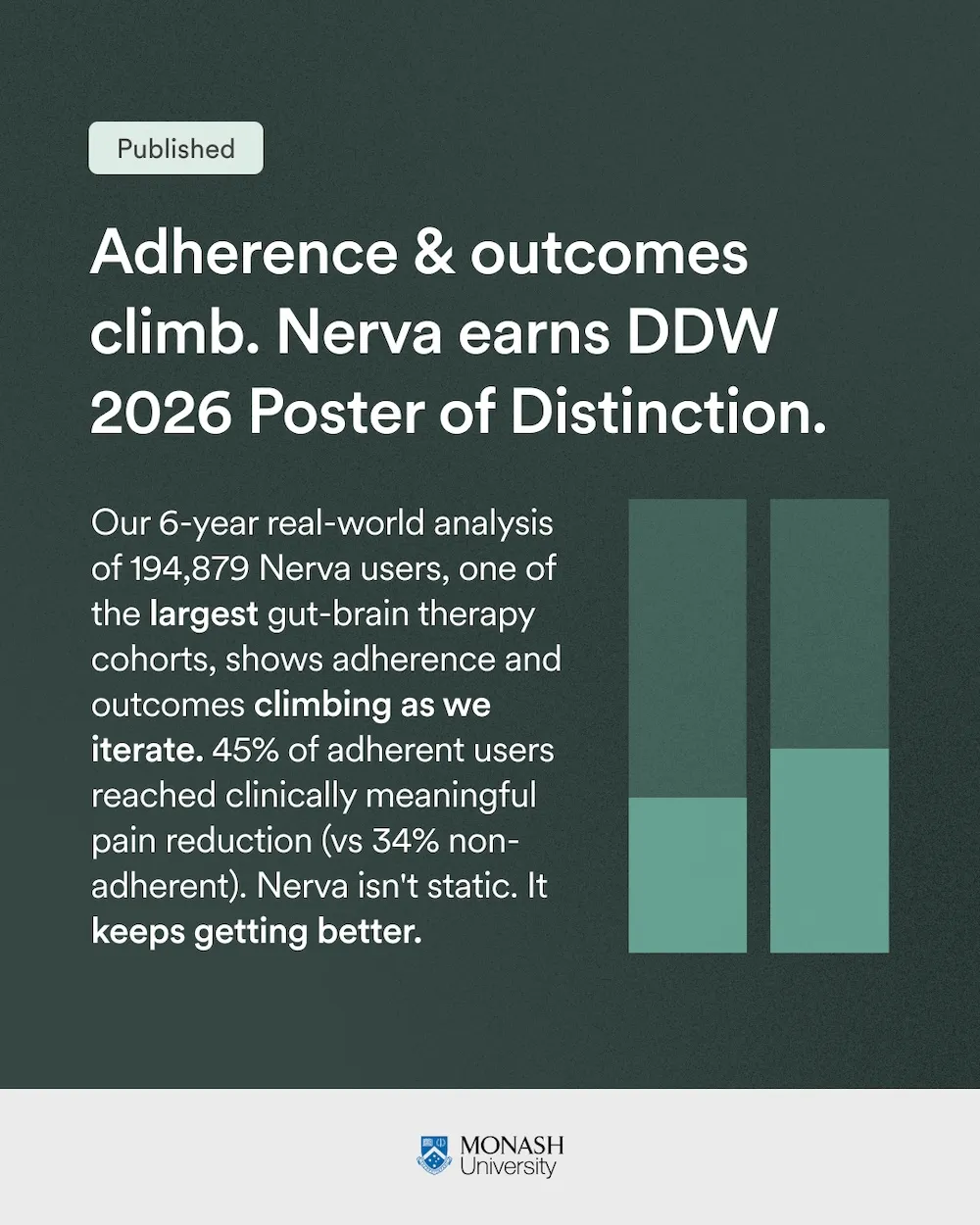
A six-year analysis of 194,879 Nerva users – one of the largest digital BGBT cohorts published to date – found the opposite: both adherence and symptom outcomes climbed steadily as the program was iteratively refined based on user data.¹
Among adherent users, 45% reached clinically meaningful pain reduction, compared with 34% of non-adherent users.¹ The bigger story is the longitudinal trend: unlike static interventions, a well-designed digital therapeutic can improve year over year as engagement and outcome data inform content design.
For clinicians, this counters a common concern about digital programs – that they're a one-shot intervention with no quality-control loop. The data show a measurable iteration effect at scale, in a real-world cohort.
DDW 2026 abstract Sa1744. Selected as a Poster of Distinction.
Can gut-brain therapy help IBD patients with persistent IBS-like symptoms?
Up to a third of IBD patients in clinical remission continue to experience IBS-like symptoms – ongoing pain, bloating, and altered bowel habits despite controlled inflammation. It's one of the most frustrating gaps in routine IBD care, and behavioral therapy has been an underused option largely because the evidence base in IBD populations has been thin.
.webp)
A new analysis of nearly 3,100 Nerva users – the first published evaluation of app-delivered gut-directed hypnotherapy in IBD – found responder rates were comparable across IBS-only (58%), Crohn's disease (52%), and ulcerative colitis (60%), with consistent psychological improvements in all three groups.²
For clinicians, this is the first real-world signal that digital BGBT can help close the post-inflammatory symptom gap – particularly for patients whose persistent symptoms reflect visceral hypersensitivity rather than active disease. It also opens up a referral pathway that didn't exist before for IBD patients, who have historically been excluded from BGBT trials.
DDW 2026 abstract Sa1736.
What about IBS patients with upper GI symptoms like reflux, heartburn, or dyspepsia?
Symptom overlap between IBS and upper GI conditions is the norm rather than the exception – a substantial share of IBS patients also report reflux, heartburn, belching, or dyspepsia. Until now, it hasn't been clear whether a gut-directed hypnotherapy program designed for IBS could help these patients, or whether the overlap would blunt response.
A new study led by collaborators at Mount Sinai found that IBS users with concurrent upper GI symptoms achieved comparable or greater IBS improvement than IBS-only users – despite more severe baseline symptoms. Their upper GI symptoms also improved.³
This is the first published evidence on Nerva in this group, and it points to a shared gut-brain mechanism across both symptom clusters. For clinicians, it widens the clinical case for gut-brain therapy beyond classic IBS – the overlap patient who's been bounced between PPIs, antispasmodics, and dietary advice may benefit from a single behavioral intervention rather than parallel symptom-by-symptom management.
DDW 2026 abstract Mo1780.
Why do men drop off digital IBS programs faster than women?
Men are underrepresented in behavioral therapy referrals for IBS – often assumed to be a demand problem. A Mayo Clinic analysis of 22,821 Nerva users challenges that assumption: 74% of men were self-referred, signaling strong patient-driven interest in gut-brain therapy.⁴

The retention picture is the more clinically actionable finding. Women showed higher retention at every checkpoint – Day 7 (81.9% vs 78.5%), Day 14 (75.9% vs 71.8%), and Day 30 (65.9% vs 59.3%) – with men dropping off most steeply in the first week.⁴
Because therapeutic benefit in BGBT typically emerges later in the course, early attrition may be limiting clinical impact for men specifically. For clinicians, this points to a clear window where additional support – a follow-up touchpoint, a check-in at the one-week mark, or framing expectations differently at referral – could meaningfully change outcomes for male patients.
DDW 2026 Poster of Distinction.
Does diaphragmatic breathing add benefit on top of gut-directed hypnotherapy?
Most digital BGBT programs combine multiple behavioral components – hypnotherapy, breathwork, psychoeducation – but until now, no published evidence has quantified what each component contributes on its own. That matters clinically because programs are usually evaluated as a whole, leaving the active ingredients unclear.

A Mayo Clinic analysis of 33,061 Nerva users provides the first published answer. Diaphragmatic breathing combined with gut-directed hypnotherapy produced a consistent dose-response in users with moderate-to-severe baseline IBS-VAS, with the greatest improvements in users completing four or more breathing sessions.⁵ Importantly, the benefit was stable across all hypnotherapy dose bands, suggesting diaphragmatic breathing contributes independent value rather than acting as a passive add-on.
No effect was seen in mild cases – likely because there's less symptom burden to shift – which is itself a useful clinical signal about where to focus the behavioral toolkit.
For clinicians, this is the first component-level evidence inside a digital BGBT program. It supports a more targeted conversation with patients: diaphragmatic breathing isn't filler, and engaging with it is associated with measurably better outcomes in moderate-to-severe IBS.
DDW 2026 abstract.
Is digital gut-directed hypnotherapy ready for routine IBS care? Key takeaways for clinical practice
Across five studies and more than 250,000 real-world users, the evidence converges on a consistent picture. Digital gut-directed hypnotherapy delivers clinically meaningful symptom improvement at scale, extends to patient groups historically excluded from BGBT trials (IBD with persistent IBS-like symptoms, IBS with upper GI overlap), and offers measurable, optimizable program components rather than a black-box intervention.
For clinicians weighing where digital BGBT fits in routine IBS care, three signals stand out:
It works in routine practice, not just RCTs – with adherence and outcomes improving as the program iterates on real-world data.
It widens the referral pool – particularly for IBD patients in remission with ongoing symptoms, and IBS patients with overlapping upper GI complaints, both groups with limited behavioral therapy options today.
Component-level evidence is emerging – meaning patient conversations about specific behaviors (like diaphragmatic breathing) can be data-informed, not generic.
Nerva is a 6-week, app-delivered gut-brain therapy program clinically validated for IBS, recommended by both the ACG and AGA, and available to patients without specialist therapist access. Clinicians can find HCP resources, referral materials, and the full DDW 2026 poster set at nervahealth.com.
Frequently asked questions
What is brain-gut behavioral therapy?
Brain-gut behavioral therapy (BGBT) is a category of evidence-based psychological interventions – including gut-directed hypnotherapy and cognitive behavioral therapy – that target the gut-brain axis to reduce symptoms in IBS and other disorders of gut-brain interaction. It is recommended by both the ACG and AGA as part of guideline-supported IBS care.
Is digital gut-directed hypnotherapy as effective as in-person therapy?
Digital gut-directed hypnotherapy has shown comparable efficacy to in-person delivery in clinical trials, with the added advantage of scalability and on-demand access.⁶ Programs like Nerva are clinically validated for IBS and used as a way to deliver guideline-recommended BGBT when access to a trained therapist is limited.
Which IBS patients are best suited to digital gut-brain therapy?
Patients with IBS who have not responded fully to dietary or pharmacological management, or who prefer a non-pharmacological option, are well-suited to digital gut-directed hypnotherapy. Recent real-world data also suggest a role for IBD patients with persistent IBS-like symptoms in remission and IBS patients with overlapping upper GI symptoms.
Are the DDW 2026 Nerva studies peer-reviewed?
The DDW 2026 abstracts underwent formal peer review for conference presentation, with full manuscripts in preparation for journal submission. Two of the five were selected as Posters of Distinction, the designation DDW reserves for top-rated submissions.
How can clinicians refer patients to Nerva?
Clinicians can direct patients to download Nerva through the app stores, or access HCP-specific clinical resources and referral materials through the Nerva clinician portal. Patient-paid access removes the prescription and reimbursement hurdles that often delay BGBT referrals.
References
1. Peters S, et al. Longitudinal improvement in adherence and efficacy of a digital gut-directed hypnotherapy program for IBS. DDW 2026, abstract Sa1744. Poster of Distinction.
2. Peters S, et al. Efficacy of app-delivered gut-directed hypnotherapy in IBS patients with co-morbid IBD. DDW 2026, abstract Sa1736.
3. Noorani S, et al. Brain-gut behavioral therapy program for IBS benefits patients with concurrent upper GI symptoms. DDW 2026, abstract Mo1780.
4. Hoeg A, Wang I, et al. Gender differences in early attrition during digitally delivered brain-gut behavioral therapy for IBS. DDW 2026. Poster of Distinction.
5. Jin F, Wang I, et al. Diaphragmatic breathing as an additive to gut-directed hypnotherapy for IBS. DDW 2026.
6. Peters SL, Yao CK, Philpott H, Yelland GW, Muir JG, Gibson PR. Randomised clinical trial: the efficacy of gut-directed hypnotherapy is similar to that of the low FODMAP diet for the treatment of irritable bowel syndrome. Aliment Pharmacol Ther. 2016;44(5):447-459. doi:10.1111/apt.13706