.webp)
Key takeaways
The breath test tells you the gas, not the treatment; symptoms and gas type often diverge, so don’t treat off the test alone.
The breath test tells you the gas, not the treatment; symptoms and gas type often diverge, so don’t treat off the test alone.
See if Nerva is right for you or your patients.
Deciding not to treat yet is a clinical skill; starting a protocol in an over-activated patient triggers die-off and dropout.
Relapse is usually a prokinetic problem: most clinicians stop it at weeks when the driver needs 6 to 12 months.1
The moment patients relapse psychologically is diet expansion, which is where gut-brain work earns its place.
Effective SIBO treatment reduces the overgrowth with antimicrobials matched to the dominant gas, then corrects the underlying driver, usually impaired gut motility, to prevent relapse. Getting this right, rather than stopping at the antibiotic, is what separates a durable result from the up to 44% of patients who relapse within nine months.¹
Most experienced clinicians can treat SIBO. Far fewer can prevent it coming back.
The gap isn't knowledge of the protocols; it's the judgment calls around them: when to hold off treating, why the breath test misleads you, how long to run a prokinetic, and when the real problem stopped being bacterial.
This guide is built around those decisions, drawing on a SIBO clinical education webinar with nutritionist Rebecca Coombs of The Healthy Gut.
The first clinical judgment isn't which treatment; it's whether to treat now, later, or not yet.
An over-activated patient who starts a full protocol often floods with die-off symptoms, reads that as harm, quits, and leaves more fearful than when they arrived.
Coombs describes patients so nervous-system-activated they report reacting "to water" and to the world around them. Treat these patients first with nervous-system regulation, gut-lining support, and confidence-building over a few weeks, then titrate into the antimicrobial protocol. Starting hard is the fastest way to lose them.
"Often those people, if you commence with a full treatment protocol, will often have an overwhelming response to that and will be flooded with negative symptoms." – Rebecca Coombs, Nutritionist and founder of The Healthy Gut
Before any of that, rule out the red flags: endoscopy and colonoscopy to exclude organic disease, and screen for the comorbidities that mimic or accompany SIBO, endometriosis, IBD, and celiac. Many patients carry more than one diagnosis at once.
Prognosis is a clinical tool, not a courtesy. How you set expectations determines whether a patient stays the course.
Two factors predict speed:
A patient whose symptoms began after a discrete food poisoning episode three months ago will usually resolve faster than one who has "always had a funny tummy." Recent, single-trigger onset is the good news presentation.
Younger patients tend to respond faster; older patients are consistently slower, so factor that into the expected timeline.
Set expectations to match: tell the lifelong-symptom patient it will take time, and tell the post-food-poisoning patient they can expect a quicker resolution. Getting this wrong upfront is why patients abandon treatment that was actually working.
SIBO isn't one condition but three, each defined by a different gas, and the breath test tells you which gas dominates. What it doesn't tell you is the whole patient: hydrogen-dominant patients can present with constipation, not diarrhea, so the gas result alone shouldn't drive your protocol.
The three types below each have a typical bowel pattern – but those are tendencies, not rules, which is why the gas result alone can mislead you.
SIBO is classified into three types, each defined by the dominant gas and the organisms producing it.
| Clinical feature | Hydrogen-dominant SIBO | Methane (IMO) | Hydrogen sulfide SIBO |
|---|---|---|---|
| Organisms | Bacteria (E. coli, Klebsiella) | Archaea (Methanobrevibacter smithii) | Sulfate-reducing bacteria |
| Bowel pattern | More often diarrhea | Constipation (worse with higher methane) | Diarrhea, constipation, or both |
| Location | Small intestine | Small and large intestine | Small intestine |
| Common trigger | Food poisoning | Variable | Sulfur-food reactivity possible |
| Breath testing | Widely available | Variable | Limited; Trio-Smart 3-gas test only |
Beyond classifying the type, the breath test involves two judgment calls that change outcomes:
1. A negative test may be the wrong substrate, not the absence of SIBO
Glucose is absorbed in the first few feet of small intestine and misses distal overgrowth; lactulose can produce false positives from its laxative effect; fructose picks up cases the others miss. If suspicion is high and the test is negative, retest with a different substrate before abandoning the diagnosis.²
2. You can treat hydrogen sulfide empirically
Most of the world can't test for it. A flat-line result across all substrates plus a suggestive picture (sulfur reactivity, pain, bloating) is enough to treat on clinical grounds.³
Antimicrobial choice by gas type is the part most clinicians get right. The error is treating eradication as the finish line.
SIBO treatment options fall into six main categories, matched to gas type and the underlying cause.
| Treatment | Best suited to | Key consideration |
|---|---|---|
| Rifaximin | Hydrogen-dominant SIBO | Stays largely in the small intestine; most studied |
| Rifaximin + neomycin or metronidazole | IMO (methane) | Combination needed; archaea respond poorly to rifaximin alone |
| Bismuth-based approaches | Hydrogen sulfide SIBO | Understudied category; limited evidence |
| Herbal antimicrobials | Any gas type | Berberine, oregano, neem (hydrogen); allicin (methane) |
| Elemental diet | Refractory or multi-type cases | Liquid formula, 14–21 days; slow food reintroduction required |
| Prokinetics | Post-infectious / motility-driven SIBO | Address the cause; often needed 6–12 months or longer |
There are two things the table can't show. First, the methane combination matters: Cedars-Sinai data shows 87% eradication on rifaximin plus neomycin versus 28 to 33% on either alone.⁵ Second, adding partially hydrolyzed guar gum improves rifaximin eradication rates and supports motility.⁴
The elemental diet works for refractory cases, but reintroduction must be slow, rushing it reliably reproduces symptoms.
Relapse is rarely antibiotic failure. It's failure to correct the driver, and the driver is usually impaired migrating motor complex (MMC) function after a post-infectious hit.⁷
Two specifics change outcomes more than the antibiotic choice itself:
1. Run the prokinetic for 6 to 12 months or longer, not weeks
Most clinicians stop far too early. Stubborn, long-standing constipation usually needs a pharmaceutical prokinetic; herbal ones aren't strong enough.
2. Confirm you actually cleared it
Coombs's challenge to clinicians: did you retest, or did you stop because symptoms improved? Residual overgrowth at the end of treatment is why it "comes back" within days.
Where post-infectious onset is suspected and antibody testing (anti-CdtB, anti-vinculin) isn't available, a clear history of memorable food poisoning is enough to assume MMC impairment and support motility accordingly.⁷
Add meal spacing or an overnight fast to support the MMC, except in underweight or eating-disordered patients.
"If we don't address the issues as to why it's developed, then it's going to come back, and often quickly." – Rebecca Coombs, Nutritionist and founder of The Healthy Gut
Diet is one of the most effective levers for symptom control in SIBO, but it works alongside treatment rather than eradicating the overgrowth itself. Used well it buys real relief while the antimicrobial and motility work addresses the cause; the skill is knowing how far to restrict, and with whom.⁸
The single most important screening question before restricting: does this patient have a history of disordered eating, current food fear, or existing self-restriction? If yes, don't restrict further, it is often contraindicated, and further restriction can tip them into deficiency or relapse an eating disorder.
Four dietary protocols are commonly used in SIBO, each with different trade-offs.
| Diet | Origin | Key consideration |
|---|---|---|
| Low FODMAP | Developed for IBS | More flexible; better for vegetarians and vegans; not always an ideal SIBO fit |
| SIBO Specific Food Guide | Dr. Allison Siebecker | Combines low FODMAP and SCD into a color-coded system |
| SIBO Biphasic Diet | Dr. Nirala Jacobi | Restricted and semi-restricted phases; quite restrictive |
| Low Fermentation Diet | Dr. Mark Pimentel, Cedars-Sinai | More relaxed; includes gluten and dairy; targets fermentation load |
For the robust patient, restriction can be a useful short-term lever, six months at the very most. But the goal is expansion, not restriction.
Most SIBO patients present under-eating, low on fiber, and low on diversity, all of which starve the wider microbiome. Build fiber back gradually toward roughly 40 grams a day, one food at a time.
Here is where clinicians lose ground they've earned. By the time the overgrowth is cleared and it's time to expand the diet, many patients have spent months or years learning that food equals symptoms. They're hypervigilant, scanning every meal for a reaction, and they read the normal, transient symptoms of reintroduction as failure.
"I will get people who come in who have been on a low FODMAP diet for years and they have a huge amount of anxiety around trigger foods. They are scanning menus, looking for the things that they can eat, scoping out where the bathrooms are. They are not comfortable in these situations." – Dr. Kim Bretz, Naturopathic Doctor, Menopause Certified Practitioner, Faculty at University of Waterloo School of Pharmacy
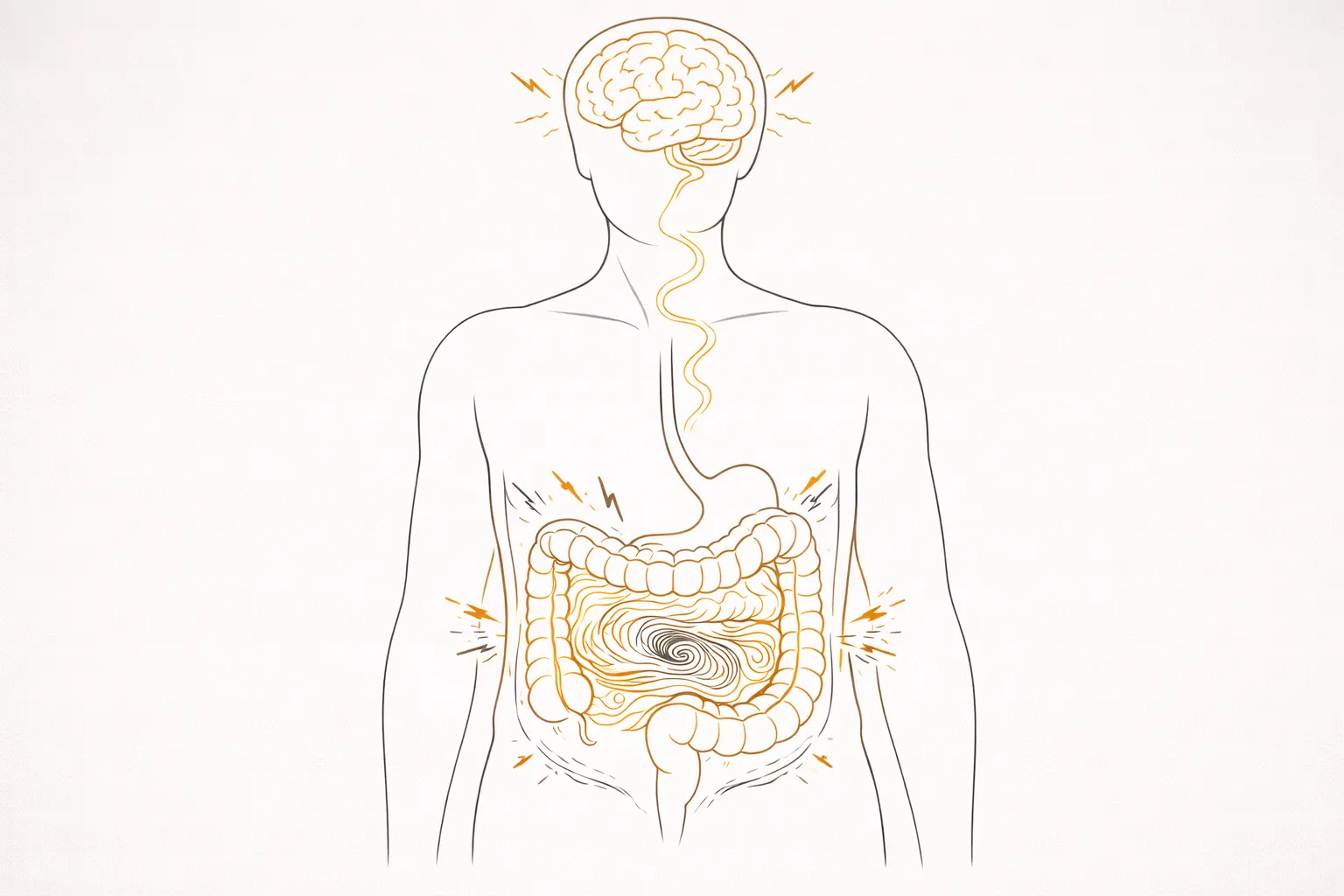
Supporting patients through this stage is as much about calming the nervous system as adjusting the plate. This is where gut-brain therapy does its most useful work, because the remaining problem is no longer bacterial; it's a sensitized, hypervigilant nervous system.
"I see with my client population that when they do regularly use gut-directed hypnotherapy, they have really great responses and reductions in their symptoms, even if we've done nothing else." – Rebecca Coombs, Nutritionist and founder of The Healthy Gut
Gut-brain therapy targets the visceral hypersensitivity that persists after the overgrowth is gone, which is exactly what's left driving symptoms in the patient who tests clear but still reacts to everything.
In SIBO specifically, this matters because so many cases are post-infectious, and post-infectious IBS keeps showing visceral hypersensitivity and altered gut-brain signaling long after the infection clears, the same mechanism, in the same patient.¹⁰
Gut-directed hypnotherapy is guideline-recommended as a first-line behavioral therapy for disorders of gut-brain interaction, and it can run alongside antimicrobial and dietary treatment rather than competing with it.
Programs like Nerva deliver it as a structured 6-week course; in the Nerva randomized controlled trial, 81% of participants achieved a clinically significant improvement on the IBS-SSS and 71% a clinically significant reduction in abdominal pain.⁹ For the SIBO patient stuck in hypervigilance at the expansion stage, that is often the difference between a diet that keeps widening and one that stalls.
This guide draws on a clinical education webinar with nutritionist Rebecca Coombs of The Healthy Gut on managing SIBO in clinical practice.
Watch the session below for her full approach to testing substrates, gas-type protocols, and the readiness assessment that decides when to treat. Or if you prefer to listen on the go, it's available as a podcast on Spotify, Apple Podcasts, Amazon Music, or YouTube Podcasts.
SIBO recurs when the underlying cause, most often impaired migrating motor complex function, is never corrected, with relapse reaching 44% within 9 months. The most common practical error is stopping the prokinetic after weeks when the driver needs 6 to 12 months of support.
Breath testing identifies the dominant gas but does not reliably predict the bowel pattern or the full clinical picture, so treatment should combine test results with symptoms and history. Hydrogen-dominant patients can present with constipation rather than diarrhea, which is why the gas type alone should not drive the protocol.
SIBO refers to hydrogen-dominant overgrowth driven by bacteria such as E. coli and Klebsiella, whereas IMO (intestinal methanogen overgrowth) is driven by the archaeon Methanobrevibacter smithii. IMO frequently involves the large intestine as well as the small and responds poorly to rifaximin alone, requiring a combination protocol.
Hydrogen sulfide SIBO can be treated empirically where testing is unavailable, particularly when all substrates return flat-line results alongside a suggestive picture such as sulfur-food reactivity and pain. A trial reduction of sulfur-rich foods that brings rapid improvement supports the working diagnosis.
Dietary restriction should be avoided in patients with a history of disordered eating, current food fear, or existing self-restriction, where it is often contraindicated. In these patients, further restriction risks nutrient deficiency and can trigger or worsen an eating disorder, so nervous-system and gut-brain work should come first.
Guidelines from the ACG, AGA, and NICE recommend gut-brain behavioral therapies, including gut-directed hypnotherapy, as first-line care for disorders of gut-brain interaction alongside diet and medication. For SIBO, this means pairing gas-type-matched antimicrobials and prokinetics with gut-brain therapy to address the visceral hypersensitivity that persists after eradication.
Patients often leave with more questions than answers. These explainers help fill that gap in plain language – download the PDF or share the links below.
Patient resources
Simple for patients, grounded in science.
A clear overview of what SIBO is, why it develops, how it's diagnosed and treated, and why symptoms can persist after the bacteria are cleared.
Explains how two conditions with near-identical symptoms differ in cause and treatment, and why getting the distinction right matters for lasting relief.
Find more resources to read & share with patients at www.nervahealth.com/blog
Lauritano EC, Gabrielli M, Scarpellini E, et al. Small intestinal bacterial overgrowth recurrence after antibiotic therapy. Am J Gastroenterol. 2008;103(8):2031-2035.
Pimentel M, Saad RJ, Long MD, Rao SSC. ACG clinical guideline: small intestinal bacterial overgrowth. Am J Gastroenterol. 2020;115(2):165-178.
Rezaie A, Buresi M, Lembo A, et al. Hydrogen and methane-based breath testing in gastrointestinal disorders: the North American Consensus. Am J Gastroenterol. 2017;112(5):775-784.
Furnari M, Parodi A, Gemignani L, et al. Clinical trial: the combination of rifaximin with partially hydrolysed guar gum is more effective than rifaximin alone in eradicating small intestinal bacterial overgrowth. Aliment Pharmacol Ther. 2010;32(8):1000-1006.
Low K, Hwang L, Hua J, et al. A combination of rifaximin and neomycin is most effective in treating irritable bowel syndrome patients with methane on lactulose breath test. J Clin Gastroenterol. 2010;44(8):547-550.
Singer-Englar T, Rezaie A, Gupta K, et al. Efficacy of bismuth in hydrogen sulfide-predominant SIBO. Am J Gastroenterol. 2018;113:S1049.
Pimentel M, Morales W, Rezaie A, et al. Development and validation of a biomarker for diarrhea-predominant irritable bowel syndrome in human subjects. PLoS One. 2015;10(5):e0126438.
Wielgosz-Grochowska JP, Domanski N, Drywień ME. Efficacy of an irritable bowel syndrome diet in the treatment of small intestinal bacterial overgrowth: a narrative review. Nutrients. 2022;14(16):3382.
Peters SL, Gibson PR, Halmos EP, et al. Comparison of a digitally delivered gut-directed hypnotherapy program with an active control for irritable bowel syndrome. Am J Gastroenterol. 2025;120(2):411-420.
Spiller R, Garsed K. Postinfectious irritable bowel syndrome. Gastroenterology. 2009;136(6):1979-1988.