
.webp)
Key takeaways
- A new CMS program called ACCESS could make gut-brain therapy available to your US-based Medicare patients at no out-of-pocket cost.
- Referring providers can bill a dedicated co-management fee under Medicare for coordinating care with ACCESS participants.
- The model pays based on patient outcomes, not service volume – aligning reimbursement with evidence-based IBS management.
- Nerva has applied for the ACCESS behavioral health track, which covers depression and anxiety, commonly comorbid with gut-brain disorders.
Can I refer Nerva at no cost to my patients?
ACCESS (Advancing Chronic Care with Effective, Scalable Solutions) is a new CMS Medicare model designed to cover technology-supported treatments for chronic conditions – and it could fundamentally change how your patients with IBS access gut-brain therapy.¹
You already know this pattern: you explain to a patient that their IBS is a gut-brain disorder, that behavioral therapies are recommended alongside diet and medication, that a program like Nerva could help – and not everyone follows through. For many, cost is the deciding factor. They want to try it, but they cannot afford it or their insurance will not cover it.
And while the American College of Gastroenterology (ACG) recommends brain-gut behavioral therapies for IBS management, without a reimbursement pathway, that recommendation has been difficult to act on at scale.
ACCESS is designed to change that.
When Nerva is accepted into the program, eligible US-based Medicare beneficiaries could access the full gut-brain therapy program at no out-of-pocket cost. As the referring clinician, you could then bill a dedicated co-management fee under Medicare for coordinating their care.²
Register to learn more about ACCESS coverage for IBS
Want to know when ACCESS becomes available? Add your details to our mailing list and we will update you as soon as it's confirmed.
What is the ACCESS model, and why does it matter for GI practice?
ACCESS is a voluntary national model from the CMS Innovation Center that introduces Outcome-Aligned Payments (OAPs) for chronic disease management.² Instead of paying per visit or per service, Medicare pays participating organizations a recurring amount for managing qualifying conditions – and full payment is earned only when a defined share of patients meet clinical outcome targets.
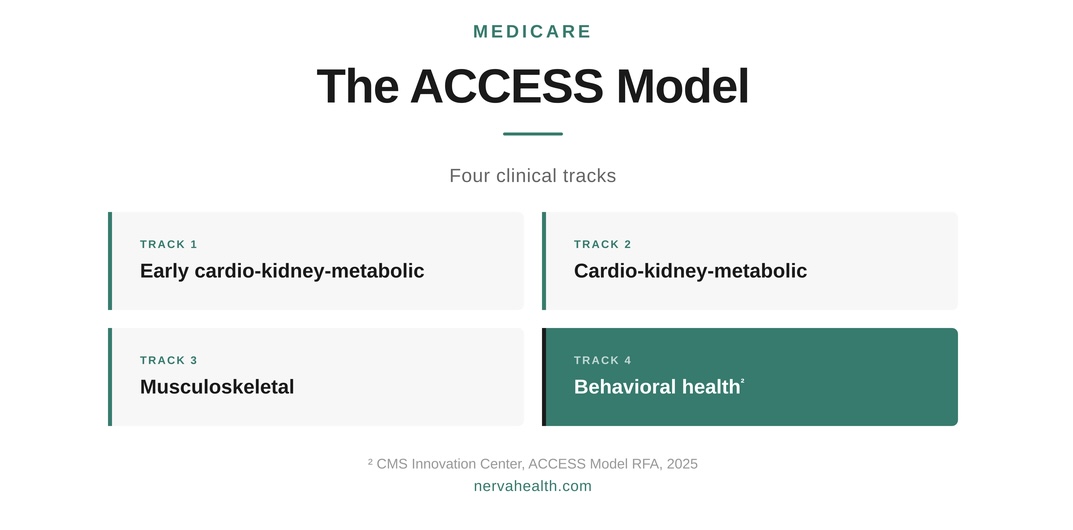
The behavioral health track covers depression and anxiety, measured through the PHQ-9, GAD-7, and WHODAS 12.²
The musculoskeletal track covers chronic pain conditions including fibromyalgia, chronic low back pain, and chronic pelvic pain.²
Both tracks are directly relevant to gastroenterology – gut-brain disorders share a central sensitization mechanism with chronic pain conditions, and the comorbidity rates are striking.³ˌ⁴ An estimated 28–65% of patients with IBS also have fibromyalgia, and up to 79% report chronic pelvic pain.⁴ Approximately 65% present with clinically significant anxiety or depression at intake⁵ – which means the patients you are already managing for gut-brain disorders are likely to qualify across more than one ACCESS track.
Watch CMS explain the ACCESS model in their own words:
How could ACCESS cover gut-brain therapy for your Medicare patients?
When Nerva is accepted into ACCESS, the practical impact for your Medicare patients would be straightforward: you will refer a patient to Nerva the same way you do now, but instead of the patient paying out of pocket, Medicare covers the cost.
The ACCESS model includes safe harbor provisions that allow participating organizations to waive beneficiary cost-sharing, meaning eligible patients could access the full 6-week gut-brain therapy program at no personal cost.²
Your patients keep all their existing Medicare benefits. They continue seeing you and any other Medicare provider. ACCESS is designed to complement traditional care, not replace it.¹
This matters because cost is consistently the most common reason patients do not follow through on a Nerva referral – a pattern that clinicians across gastroenterology, primary care, and dietetics report in practice.
"We hear the same thing from clinicians every week – my patient needs this, but they cannot afford it. Delivering a clinically governed, outcomes-measured therapy program costs real money to build and maintain, and right now that cost falls on the patient. ACCESS could finally shift that burden – creating a Medicare pathway where the only thing that matters is whether the treatment helps the patient get better.” – Alex Naoumidis, Nerva Co-Founder and Co-CEO
Removing that financial barrier could meaningfully increase the proportion of referred patients who actually start and complete treatment.
Can referring providers bill Medicare through ACCESS? The benefits for clinicians
ACCESS includes a co-management payment specifically for referring clinicians based in the US.
If you refer a Medicare patient to an ACCESS-participating organization, you can bill a dedicated co-management fee under Medicare for reviewing patient updates and coordinating care.² This is not additional unpaid work – it is a reimbursable service that formalizes the clinical coordination role many providers already play.
You would receive structured outcome reports from the program, giving you visibility into your patient's progress through treatment. This supports continuity of care and gives you data to inform follow-up decisions.
Why Nerva's evidence base fits an outcomes-tied model
An outcomes-based payment model only works if the intervention delivers measurable results. Nerva's evidence base is a strong fit. In a Monash University randomized controlled trial, 81% of participants achieved clinically significant improvement on the IBS Symptom Severity Score (IBS-SSS), and 71% reported meaningful improvements in abdominal pain.⁶
The program also captures validated measures of anxiety, depression, and functional impairment throughout treatment – the same categories the ACCESS behavioral health track evaluates.
To support its application, the Mindset Health team has enrolled in Medicare Part B, appointed a board-certified psychiatrist as medical director for clinical governance, and engaged specialized legal counsel for regulatory compliance. The application has been submitted and is under review.
For clinicians who have spent years recommending treatments their patients ultimately cannot utilize, ACCESS represents something more fundamental than a new billing code.
"There are millions of people on Medicare living with gut-brain disorders who have never been offered a treatment that addresses the gut-brain connection directly," says Naoumidis. "If ACCESS works the way it should, those patients will finally have access to care that was always out of reach – not because the evidence was missing, but because the payment model had not caught up."
We will share updates as the process progresses.
Register for ACCESS for IBS updates
If you want to know when ACCESS coverage becomes available for your patients, add your details to our mailing list. We will send updates as the process progresses.
Contact Nerva for more information about ACCESS
If you have any questions, reach out to Alex Naoumidis at alex@mindsethealth.com
Frequently asked questions
Can I bill Medicare for referring patients to an ACCESS organization?
Referring providers can bill a dedicated co-management fee under the ACCESS model for reviewing patient updates and coordinating care.² This applies to primary care physicians, gastroenterologists, and other Medicare-enrolled clinicians.
What conditions does the ACCESS behavioral health track cover?
The behavioral health track covers depression and anxiety, measured through the PHQ-9, GAD-7, and WHODAS 12.² CMS may add additional tracks and conditions in future model years.
Does ACCESS replace my patients' existing Medicare coverage?
ACCESS complements standard Medicare benefits without replacing them. Enrolled beneficiaries retain all existing rights and can continue seeing any Medicare provider while receiving technology-supported care through an ACCESS participant.²
Is the ACCESS program available for Medicare Advantage patients?
The current model is designed for Original Medicare (Parts A and B) beneficiaries. Medicare Advantage enrollees are not eligible during the initial phase.²
How would I refer a patient to Nerva through ACCESS?
The referral process is expected to integrate with existing workflows. Your patients can also enroll directly. The key difference from the current process is that Medicare covers the cost and you receive structured outcome reporting and a billable co-management role.


