For organizations

Free your members from GI distress. Cut avoidable spend.

Best-in-class digital GI therapy for the gastrointestinal conditions that drive most cost and frustration.
Talk to our team

Gastrointestinal conditions drive over $130 billion in annual healthcare costs.

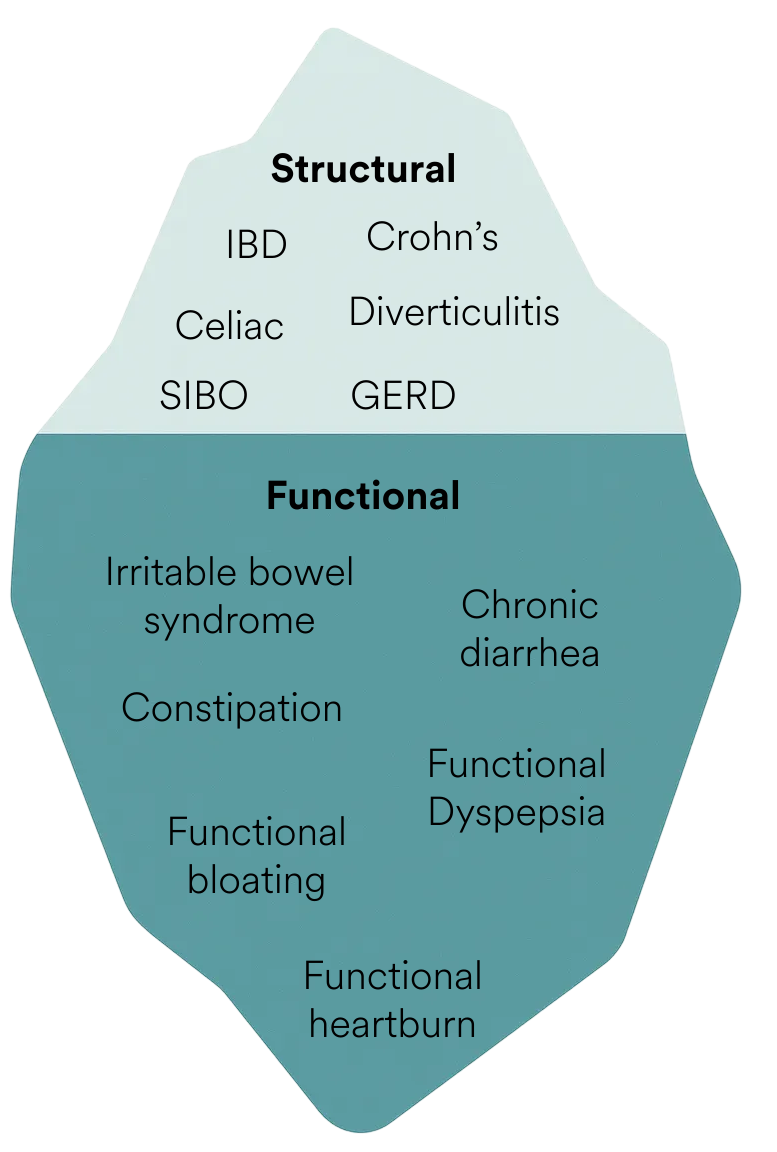
40% of people suffer from a gastrointestinal disorder, most of which are functional in nature - meaning symptoms are driven by the gut brain connection, not structural disease. Yet the system is built to treat structure, not function.

This mismatch drives:

  • Repeat scopes and imaging that rarely change care
  • Cycles between GI, primary care, mental health and ED
  • High pharmacy spend from trial and error medications
  • Absenteeism, presenteeism and member dissatisfaction

Impact of gastrointestinal conditions

$12,083
Direct and indirect costs of irritable bowel syndrome is $12,083 USD annually per person.2
Top 3
GI conditions are a top 3 cost driver for health plan sponsors.
#1
#1 reason for avoidable ER visits, and #2 reason for absenteeism after the common cold.

Our research partners

Highlighted condition

Irritable bowel syndrome

Irritable bowel syndrome (IBS) is the most common gastrointestinal disorder, affecting 46 million people in the US.5 IBS is a disorder of the gut-brain interaction (DGBI). Despite its prevalence, patients and providers
alike struggle to achieve sustainable symptom improvement that addresses the gut-brain interaction.
46 million
Irritable bowel syndrome affects 46 million people in the United States (about 14% of the US population5).
$7,044
Irritable bowel syndrome affects 46 million people in the The indirect cost of irritable bowel syndrome is $7,044 USD per person, annually.2 States (about 14% of the US population5).
Presenteeism: $5,402
Absenteeism: $1,642
$5,049
The direct cost of irritable bowel syndrome is $5,049 USD per person, annually.6
Out-patient: $4,001
In-patient: $719
Out-of-pocket: $329
75%
75% of IBS sufferers also have comorbidity of anxiety and depression.7

The only GI platform backed by a randomized controlled trial

40%
Nerva has a 40% completion rate.9
81%
81% of participants saw a clinically significant improvement within 6 weeks.8
3.3x
Internal ROI modelling and real-world cost reduction data shows 3.3x ROI in year one.10
15,000+
Over 15,000 healthcare practitioners refer Nerva to their IBS patients.
Dietary therapy can be a super important inclusion in your treatment plan for IBS, but you’re still missing out on an important part, and that’s working on the mind. That’s why I recommend Nerva – it’s a system patients can follow and get results from. 

Michael Smith, Naturopath, Planet Naturopath
300k+
Over 300,000 members have tried Nerva to manage their IBS symptoms.
After years, this is what I needed! For years I have know my IBS was brain-gut connection issues, but I didn’t know how to break the cycle. I was an athlete and my pre-race jitters would casue IBS-D. Now that I am an adult the jitters have somehow manifested into travel and feeling trapped without a bathroom in either a car or on an airplane, sometimes other situations too. It has been very troublesome and life-altering. This app is helping me so much. I can feel the brain-gut connection improving and my anxiety in my car is definitely improving! Thank you!
Nerva user, United States via app store review

We take member privacy seriously

Our SOC2 certification shows our commitment to keeping your members' sensitive data protected and handled with care.

Bring modern GI care to your population.

Partner with Nerva to deliver the therapy that digestive conditions respond to - and reduce the costs of everything else.
Learn more
References:
[1] Dieleman, J. L., Cao, J., Chapin, A., et al. US Health Care Spending by Payer and Health Condition, 1996-2016. JAMA, 2020, 323(9):863–884. doi:10.1001/jama.2020.0734
[2] NYROP, K.A. et al. (2007a) ‘Costs of health care for irritable bowel syndrome, chronic constipation, functional diarrhoea and functional abdominal pain’, Alimentary Pharmacology & Therapeutics, 26(2), pp. 237–248. doi:10.1111/j.1365-2036.2007.03370.x.
[3] U.S. Bureau of Labor Statistics (2022). Women in the labor force: a databook : BLS Reports: U.S. Bureau of Labor Statistics. [online] www.bls.gov. Available at: https://www.bls.gov/opub/reports/womens-databook/2021/home.htm.
[4] Gaspar, F.W. et al. (2021) ‘Guideline adherence and lost workdays for acute low back pain in the California Workers’ Compensation System’, PLOS ONE, 16(6). doi:10.1371/journal.pone.0253268.
[5] Buono, J.L., Carson, R.T. and Flores, N.M. (2017) ‘Health-related quality of life, work productivity, and indirect costs among patients with irritable bowel syndrome with diarrhea’, Health and Quality of Life Outcomes, 15(1). doi:10.1186/s12955-017-0611-2.
[6] Internal data, Mindset Health, Survey 2022
[7] Kim, Y.S. and N. Kim, Sex-Gender Differences in Irritable Bowel Syndrome. J Neurogastroenterol Motil, 2018. 24(4): p. 544-558.
[8] Peters, S.L., Gibson, P.R. and Halmos, E.P. (2023) ‘Smartphone app‐delivered gut‐directed hypnotherapy improves symptoms of self‐reported irritable bowel syndrome: A retrospective evaluation’, Neurogastroenterology & Motility, 35(4). doi:10.1111/nmo.14533.
[9] Internal data, Mindset Health, Program data 2023
[10] Internal data, Mindset Health, Program data 2023
[11] Cohen, S.P., Vase, L., & Hooten, W.M. (2021). Chronic pain: an update on burden, best practices, and new advances. The Lancet, 397(10289), 2082-2097. doi:10.1016/S0140-6736(21)00393-7.
[12] Stringer, H. (2023). Providers predict longer wait times for mental health services. here’s who it impacts most. [online] Apa.org. Available at: https://www.apa.org/monitor/2023/04/mental-health-services-wait-times.
[13] Elkins, G.R., Fisher, W.I., Johnson, A.K., Carpenter, J.S. and Keith, T.Z. (2012). Clinical hypnosis in the treatment of postmenopausal hot flashes. Menopause: The Journal of The North American Menopause Society, p.1. doi:https://doi.org/10.1097/gme.0b013e31826ce3ed.
[14] Alldredge, C.T., Muñiz, V., Ekanayake, V., & Elkins, G.R. (2024). Preliminary survey data from an app-delivered hypnosis intervention for smoking cessation. Tobacco Use Insights, 17, 1179173X241287398. doi:10.1177/1179173X241287398.
Preferences saved