.webp&w=3840&q=75)


Key takeaways:
- Anxiety and depression don't reduce how well gut-directed hypnotherapy eases abdominal pain in IBS.¹
- Even patients with severe anxiety or depression respond to hypnotherapy for IBS as often as those without.¹
- Higher anxiety or depression raises baseline IBS pain but not the response to gut-directed hypnotherapy.¹
- Anxiety or depression alone isn't a reason to withhold a gut-directed hypnotherapy referral for IBS.
Anxiety and depression don't appear to predict how well a patient's abdominal pain will respond to gut-directed hypnotherapy (GDH) for IBS. In a real-world study of 76,138 users, response rates remained remarkably consistent across every level of psychological symptom severity, from none to severe (52.2%–53.6%).¹ The findings suggest psychological comorbidity alone should not deter clinicians from recommending digital GDH.
Read on for why anxiety and depression are so common in IBS, what the data show across every level of symptom severity, and how this should – and shouldn't – shape who you refer for gut-directed hypnotherapy.
How common are anxiety and depression in IBS?
Anxiety and depression are very common in IBS: about 39% of patients report anxiety symptoms and 29% depressive symptoms, roughly three times the odds seen in people without IBS.² Most of the patients you're weighing up for referral will carry some psychological load.
That can complicate decisions about where GDH fits. Should anxiety or depression be addressed first? Does greater psychological symptom severity make someone less likely to respond? The new data suggest it shouldn't be used as a reason to defer GDH.
"A DGBI is not a psychiatric diagnosis. I think using the term stress sensitive versus stress-induced is way more helpful. DGBIs are stress sensitive." – Dr. Mark Salvatore, pediatric gastroenterologist, Assistant Professor of Pediatrics at Harvard Medical School
Do patients with severe anxiety or depression respond to gut-directed hypnotherapy?
Patients with severe anxiety or depression were no less likely to respond to gut-directed hypnotherapy (GDH) for IBS. In our new real-world study of 76,138 Nerva users, abdominal pain response rates stayed consistent across every level of psychological symptom severity, from none to severe (52.2%–53.6%).¹
We grouped users by baseline PHQ-4 score, with response defined as a ≥30% reduction in abdominal pain. Patients with greater psychological symptom severity started with more pain – baseline scores rose from 51 mm to 66 mm – but response rates barely moved.
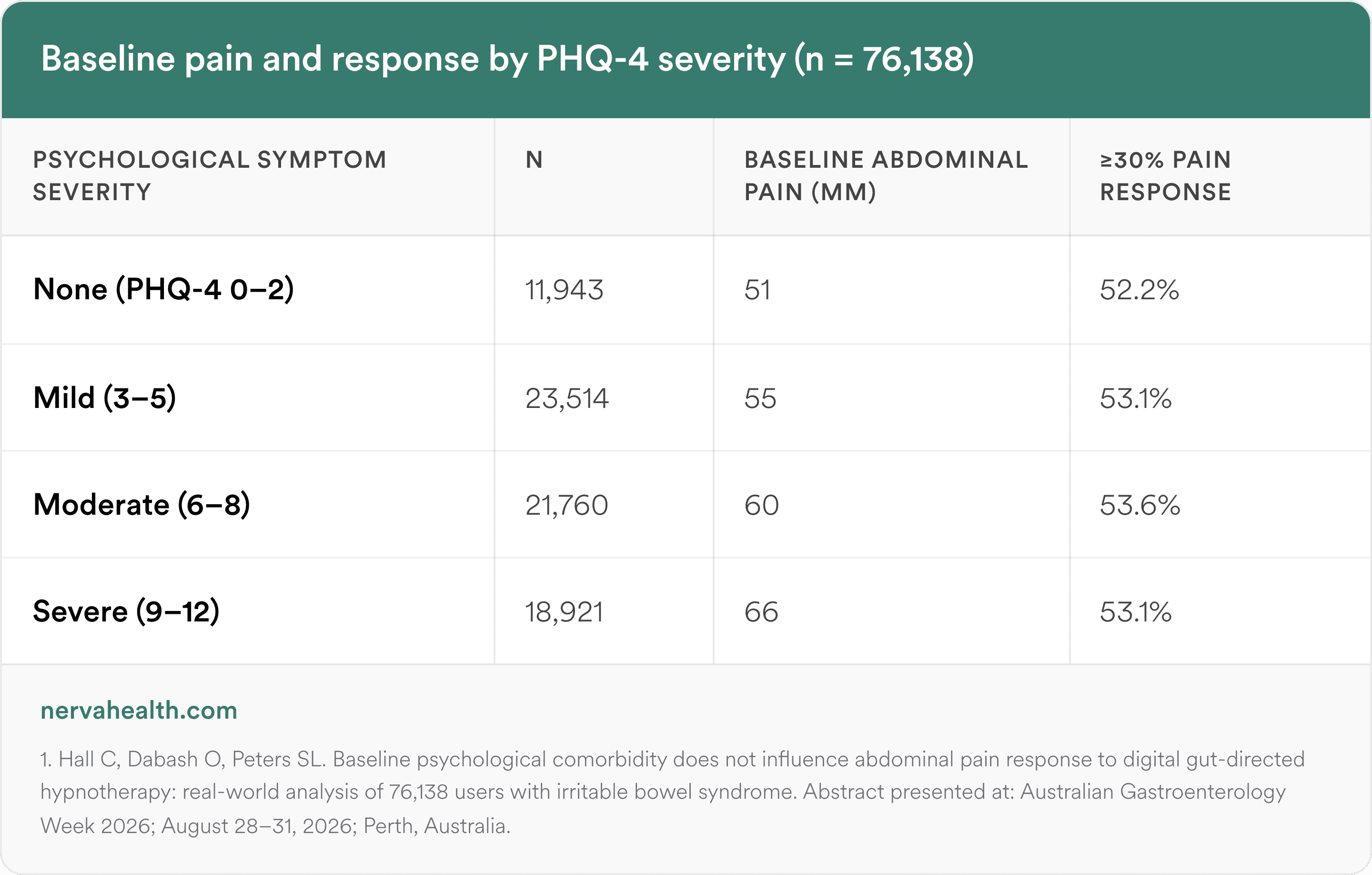
So while psychological burden tracked with how much pain patients started with, it didn't predict whether that pain responded to GDH.
How effective is gut-directed hypnotherapy for IBS?
Gut-directed hypnotherapy is one of the most effective IBS management options available – and the benefit lasts. A network meta-analysis of 41 trials put GDH and CBT at the top for both evidence and durability among psychological therapies for IBS.³ In a head-to-head trial, GDH matched the low FODMAP diet, with the benefit still there at six months.⁴
That's why the ACG's 2021 guideline recommends gut-directed psychotherapies for IBS as an evidence-based option, not a last resort.⁵
"Brain-gut behavioral therapies have great efficacy. They work really well in placebo-controlled trials. The effectiveness is strong long-term, up to seven years, and they're very safe. Should these therapies be offered earlier? The data suggests yes." – Dr. Jordan Shapiro, gastroenterologist, founder of Gentle GI
Does gut-directed hypnotherapy also improve anxiety and low mood?
There is evidence that gut-directed hypnotherapy can improve anxiety and low mood alongside gut symptoms.
In a separate published analysis of 17,931 Nerva users, average PHQ-4 scores fell from the moderate to the mild range over six weeks (6.2 to 3.8), with the biggest improvements in those who started worst.⁶ Abdominal pain eased in the same cohort too, from 57 mm to 37 mm.
That both improved together makes sense. GDH works on the shared brain-gut pathway, so easing the gut also eases the distress it feeds – which matters for the many patients whose anxiety and gut symptoms are hard to pull apart.
How do I refer a patient for gut-directed hypnotherapy?
If anxiety or depression shouldn't determine who is offered GDH, the next question is how to help appropriate patients take that next step.
Recommending Nerva in a consult can help, but a direct referral has been proven to make patients much more likely to get started. In Nerva's own data, patients referred through the online HCP form go on to start the program at around two and a half times the rate of those who sign up independently.⁷
Nerva is a six-week digital gut-directed hypnotherapy program for IBS, completed in daily 15–20 minute sessions. If GDH is appropriate for your patient, you can refer them directly through the online form (https://nerva.mindsethealth.com/refer).
These AGW findings are real-world and observational, so they show association, not cause, and the cohort was limited to completers with paired data. Contact Nerva Research Lead Claire Hall with your enquiries at claire@mindsethealth.com.
Frequently asked questions
Should a patient's anxiety or depression be treated before starting gut-directed hypnotherapy?
Anxiety or depression doesn't need to be treated before starting gut-directed hypnotherapy for IBS. Response to GDH was consistent regardless of psychological symptom severity in a study of 76,138 users, and it can run alongside mental health care.¹
Does gut-directed hypnotherapy work for IBS that isn't stress-related?
Gut-directed hypnotherapy is not only for stress-driven IBS. In a study of 76,138 users, patients with no or minimal psychological symptoms responded as often as those with severe symptoms, so a low psychological burden doesn't make someone a poorer candidate.¹
Can gut-directed hypnotherapy replace treatment for anxiety or depression?
Gut-directed hypnotherapy is not a substitute for dedicated treatment of anxiety or depression; it targets the gut-brain symptoms of IBS. It can ease psychological symptoms alongside gut symptoms, but patients who need mental health care should still receive it.⁶
Can gut-directed hypnotherapy be used alongside antidepressants or gut neuromodulators?
Gut-directed hypnotherapy can be used alongside antidepressants or gut-brain neuromodulators, because it works through a behavioral pathway rather than a pharmacological one. There is no need to stop or adjust medication to start it, and the two can run concurrently.
References
Hall C, Dabash O, Peters SL. Baseline psychological comorbidity does not influence abdominal pain response to digital gut-directed hypnotherapy: real-world analysis of 76,138 users with irritable bowel syndrome. Abstract presented at: Australian Gastroenterology Week 2026; August 28–31, 2026; Perth, Australia.
Zamani M, Alizadeh-Tabari S, Zamani V. Systematic review with meta-analysis: the prevalence of anxiety and depression in patients with irritable bowel syndrome. Aliment Pharmacol Ther. 2019;50(2):132-143. doi:10.1111/apt.15325
Black CJ, Thakur ER, Houghton LA, Quigley EMM, Moayyedi P, Ford AC. Efficacy of psychological therapies for irritable bowel syndrome: systematic review and network meta-analysis. Gut. 2020;69(8):1441-1451. doi:10.1136/gutjnl-2020-321191
Peters SL, Yao CK, Philpott H, Yelland GW, Muir JG, Gibson PR. Randomised clinical trial: the efficacy of gut-directed hypnotherapy is similar to that of the low FODMAP diet for irritable bowel syndrome. Aliment Pharmacol Ther. 2016;44(5):447-459. doi:10.1111/apt.13706
Lacy BE, Pimentel M, Brenner DM, et al. ACG clinical guideline: management of irritable bowel syndrome. Am J Gastroenterol. 2021;116(1):17-44. doi:10.14309/ajg.0000000000001036
Peters SL, Gibson PR, Halmos EP. Improvements in psychological outcomes following app-delivered gut-directed hypnotherapy [abstract]. Am J Gastroenterol. 2023;118(10S):S694.
Mindset Health. Referral-to-activation conversion analysis [internal data]. Melbourne, Australia: Mindset Health Pty Ltd; 2026.