.webp&w=3840&q=75)


Key takeaways:
- Anxiety and depression did not predict response to gut-directed hypnotherapy for IBS in a real-world analysis of 76,138 users.
- Food-triggered and stress-triggered IBS showed similar engagement and improvement with digital gut-directed hypnotherapy.
- Older adults showed higher engagement with digital gut-directed hypnotherapy, with completion reaching 61% among users aged 65–74.
- Anxiety, depression, food-related triggers and older age should not alone rule out gut-directed hypnotherapy for people with IBS.
Gut-directed hypnotherapy (GDH) is suitable for a broad range of people with IBS, including patients with anxiety or depression, patients who identify food rather than stress as their primary symptom trigger, and older adults, according to new research.
Three large real-world studies presented at Australian Gastroenterology Week (AGW) 2026 found that psychological symptom severity, food-related symptom attribution, and older age did not predict poorer engagement or outcomes with digital gut-directed hypnotherapy.¹⁻³ The findings challenge common assumptions about who is a good candidate for gut-directed hypnotherapy for IBS and suggest these factors should not, on their own, exclude patients from gut-directed behavioral care.
1. Psychological symptom severity did not predict abdominal pain response
Anxiety and depressive symptoms frequently co-occur with IBS and can influence symptom severity, quality of life, and healthcare utilization. This can also shape clinical decision-making around gut-directed behavioral interventions, including an assumption that psychological comorbidity may affect treatment response.
A study of 76,138 digital GDH users examined whether baseline psychological symptom severity was associated with abdominal pain outcomes.¹
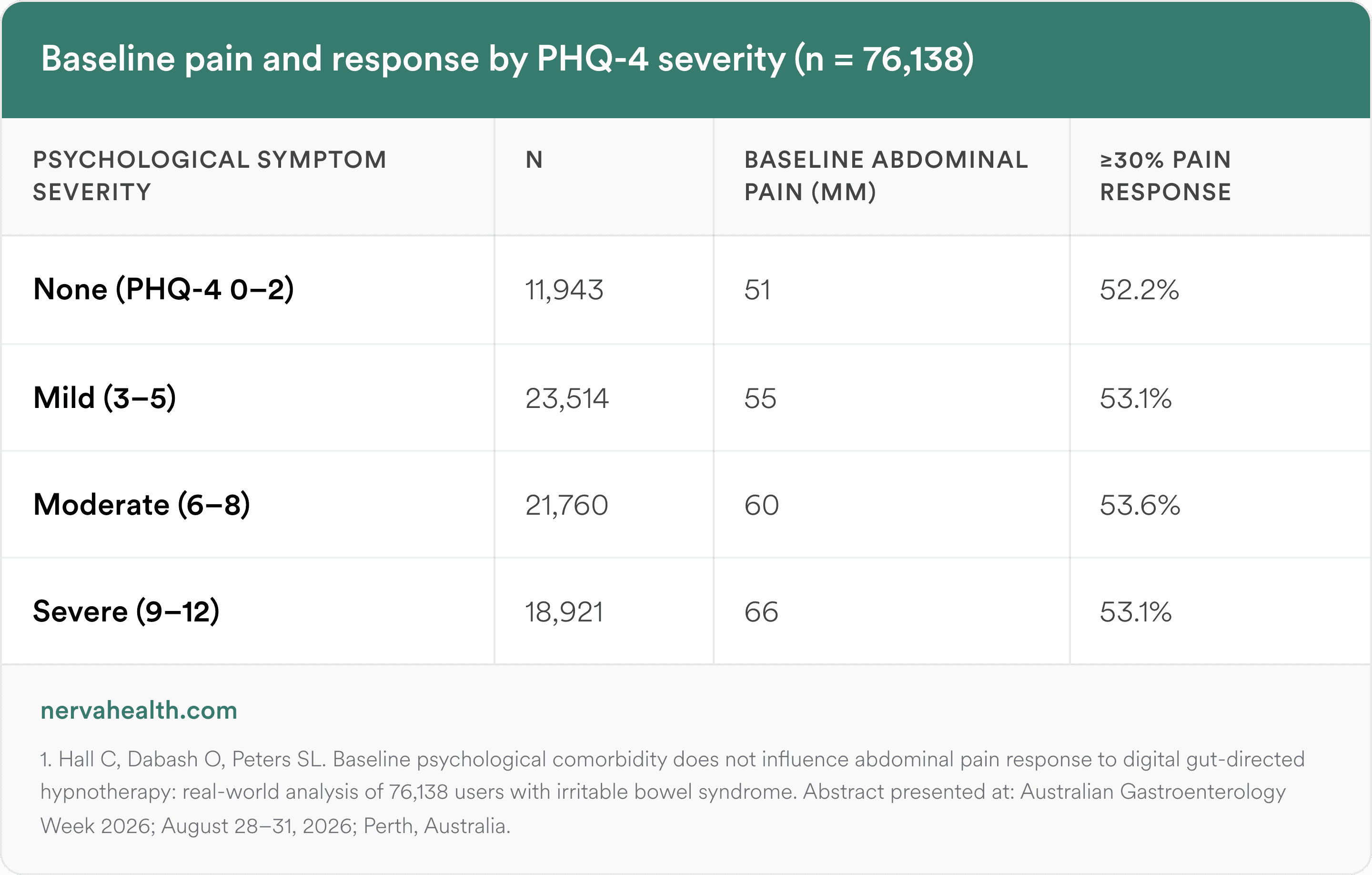
More than half of completers in every category – including those with severe psychological symptoms – met the pain-response threshold.
Applying this in practice
Anxiety or depression on their own aren't a reason to hold off on GDH. And the flip side is just as true: a patient doesn't need to have psychological symptoms for GDH to be worth considering.
The takeaway is simple. Look at the whole picture – how much a patient's symptoms are affecting them, what they'd prefer, what they need – rather than using their mental health as a gauge of whether GDH will work.
2. Does gut-directed hypnotherapy work when food is the main IBS trigger?
In a real-world analysis of 26,008 users, identifying food rather than stress as the predominant IBS trigger was not associated with poorer engagement or symptom improvement with digital gut-directed hypnotherapy.²
That finding challenges a familiar distinction in IBS care: patients who identify food as their main trigger may be directed toward dietary interventions, while gut-directed behavioral care can be more readily considered when stress or psychological factors are prominent.
We examined whether that distinction was reflected in outcomes. Users with completed onboarding and six-week outcome data were grouped according to the trigger they identified at baseline: food only, stress only, or both.
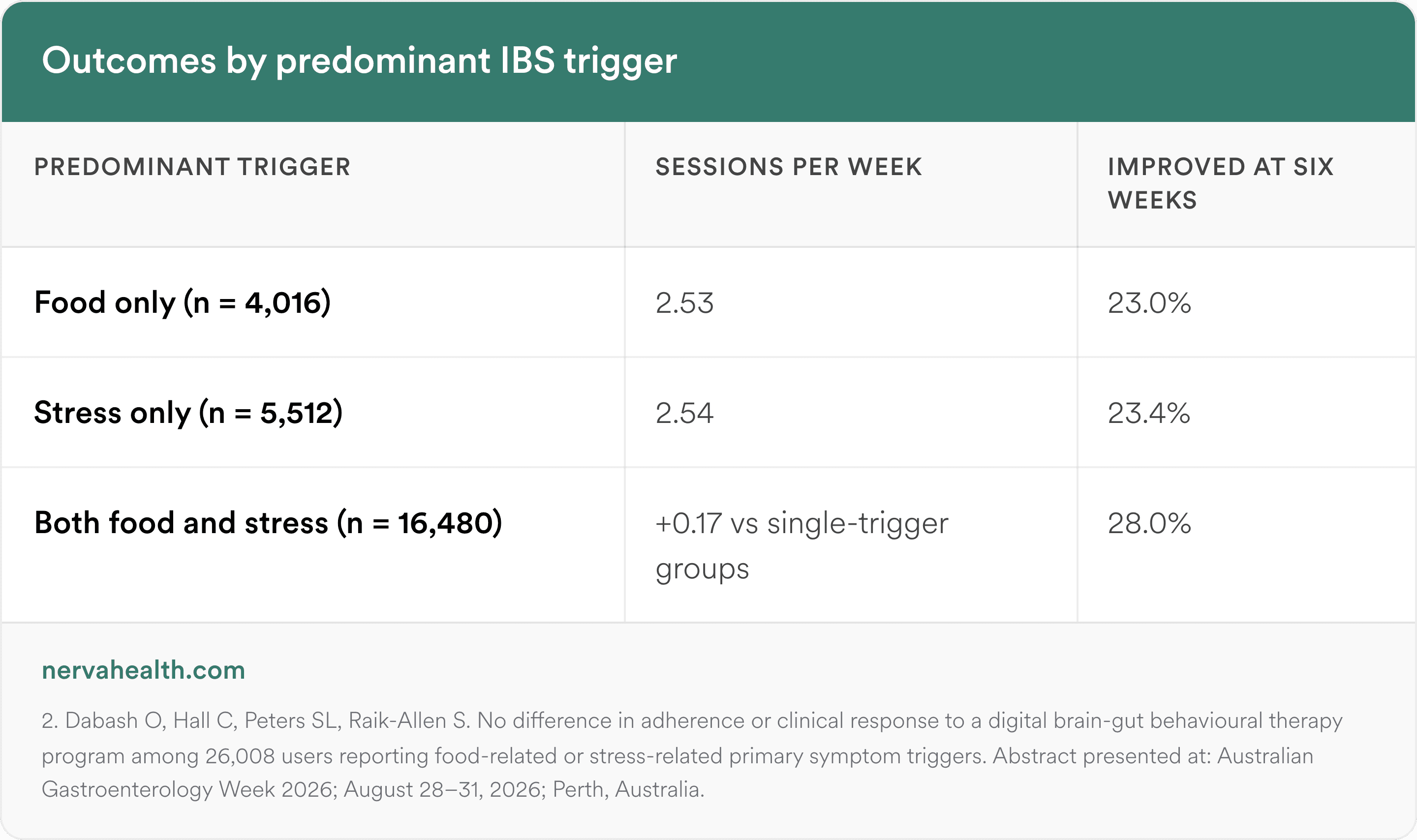
The key finding is the absence of a difference between the food-only and stress-only groups. Identifying food as the predominant trigger was not associated with poorer engagement or improvement, suggesting these patients may not be less suited to digital gut-directed hypnotherapy.
Applying this in practice
The findings question the idea that patients with food-triggered symptoms need to move through dietary management before gut-directed behavioral care is considered. Instead, GDH can be considered alongside nutrition care where clinically appropriate – particularly when dietary response is incomplete, restriction is escalating, or a multimodal approach is warranted.
This also aligns with earlier clinical evidence from Monash University, where gut-directed hypnotherapy produced similar symptom improvement to a low FODMAP diet, with benefits maintained at six months.⁴
3. Older adults showed higher engagement with digital GDH
Digital behavioral interventions have made gut-directed care more accessible, but assumptions about digital literacy and acceptability can still influence whether these options are offered to older patients.
Our data suggest those assumptions are worth reconsidering: of 131,900 adults enrolled in digital GDH, 13,454 were aged 65 or older – 10.2% of the cohort.³
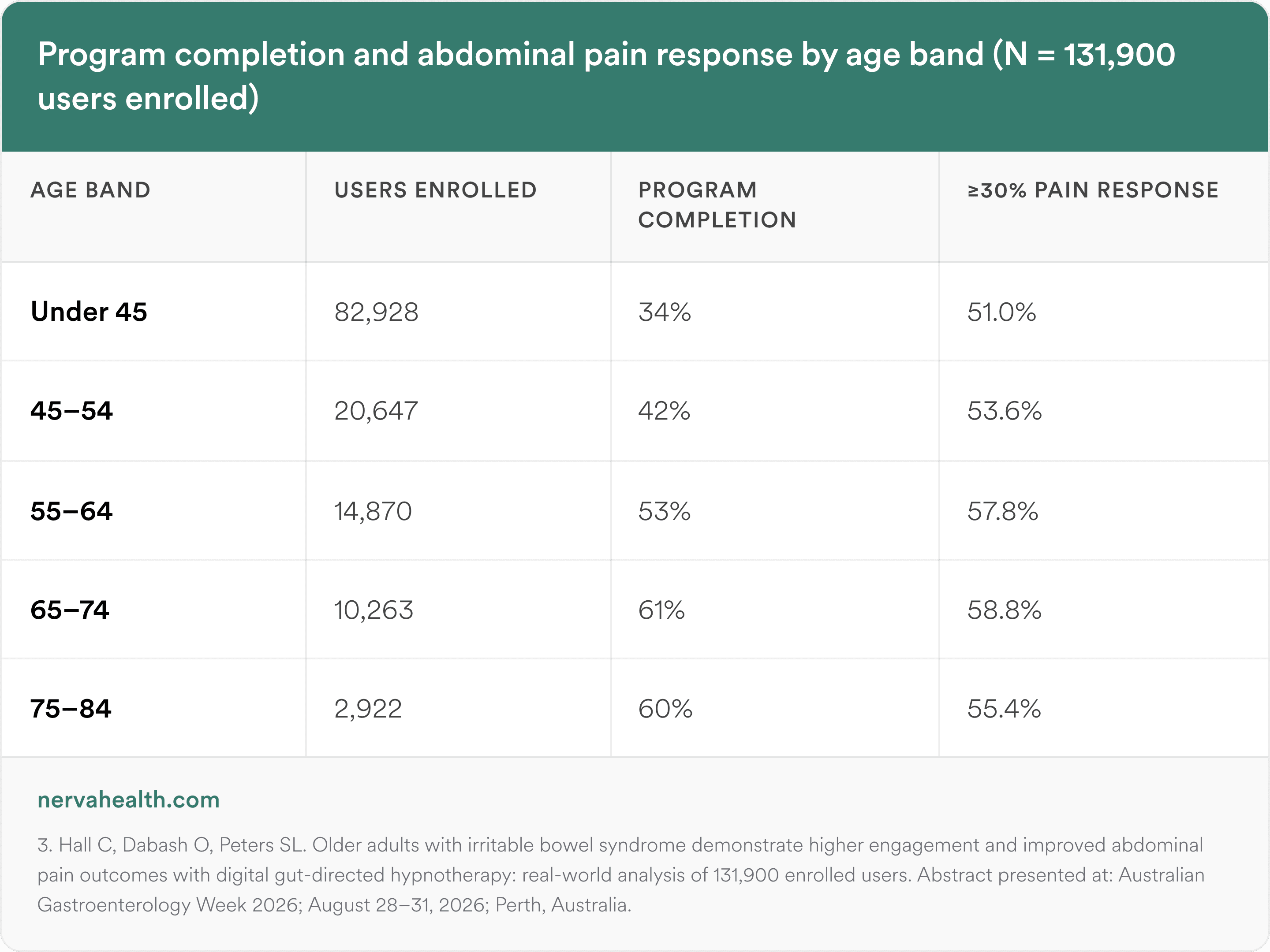
The 85+ group is not shown here, as the sample was too small to draw conclusions from.
Applying this in practice
Chronological age alone appears to be a poor proxy for likely engagement with digital GDH.
Rather than assuming an older patient will prefer or require non-digital care, suitability can be assessed individually based on access to technology, confidence using it, patient preference, and capacity to engage independently.
The higher completion observed among older adults is particularly notable given that digital delivery is sometimes perceived as a barrier in this population. For appropriate patients, it may instead provide a practical route to gut-directed behavioral care without the geographical, scheduling, and workforce constraints associated with clinician-delivered therapy.
Broadening patient selection for digital hypnotherapy
Across these studies, psychological comorbidity, perceived symptom triggers, and age did not limit engagement or outcomes as might be expected.
Greater psychological symptom severity was not associated with lower pain response, food-trigger patients performed similarly to stress-trigger patients, and older adults had higher completion rates.
For clinicians, the findings support considering GDH across a broader range of patients – and alongside dietary and pharmacological care rather than only after other approaches have been exhausted.
The takeaway: patient characteristics that have traditionally shaped assumptions about suitability for GDH may not be good reasons to rule it out.
Questions about the research?
Nerva Research Lead Claire Hall was part of the research team across all three studies and is happy to talk through the findings or answer any questions. We always value hearing how research like this lands with clinicians in practice, so please feel free to reach out at claire@mindsethealth.com.
These observational, real-world studies do not establish causality. The psychological comorbidity analysis included completers with paired outcome data and may be subject to selection bias.
Frequently asked questions
How does gut-directed hypnotherapy compare with the low FODMAP diet?
A randomized trial found gut-directed hypnotherapy produced symptom improvement similar to the low FODMAP diet in IBS, with durable benefit at six months.⁴ In a separate randomized trial of a digitally delivered program, 81% of people saw significant improvements in symptom management compared with 63% on an active control.⁵
Is gut-directed hypnotherapy recommended in IBS guidelines?
The 2021 ACG clinical guideline suggests gut-directed psychotherapies for global IBS symptoms, positioning them as an evidence-based option rather than a last resort.⁶ Digital delivery extends the same modality to settings without local access to a trained therapist.
How long does a course of gut-directed hypnotherapy take?
Nerva’s structured GDH protocol is six weeks, with daily sessions of about 15 to 20 minutes. Setting that expectation at the point of referral is one of the strongest influences on whether a patient completes the program.
Does gut-directed hypnotherapy improve psychological symptoms as well as gut symptoms?
In a published analysis of 17,931 users, mean PHQ-4 scores improved from the moderate range to the mild range over the six-week program, from 6.2 to 3.8.⁷ Patients starting with moderate to severe scores showed the greatest improvement.
Who is a good candidate for gut-directed hypnotherapy?
Gut-directed hypnotherapy is suitable for a broad range of people with IBS. New real-world data suggest anxiety or depression, food-related symptom triggers, and older age should not, on their own, exclude patients from digital GDH.¹⁻³
References
Hall C, Dabash O, Peters SL. Baseline psychological comorbidity does not influence abdominal pain response to digital gut-directed hypnotherapy: real-world analysis of 76,138 users with irritable bowel syndrome. Abstract presented at: Australian Gastroenterology Week 2026; August 28–31, 2026; Perth, Australia.
Dabash O, Hall C, Peters SL, Raik-Allen S. No difference in adherence or clinical response to a digital brain-gut behavioural therapy program among 26,008 users reporting food-related or stress-related primary symptom triggers. Abstract presented at: Australian Gastroenterology Week 2026; August 28–31, 2026; Perth, Australia.
Hall C, Dabash O, Peters SL. Older adults with irritable bowel syndrome demonstrate higher engagement and improved abdominal pain outcomes with digital gut-directed hypnotherapy: real-world analysis of 131,900 enrolled users. Abstract presented at: Australian Gastroenterology Week 2026; August 28–31, 2026; Perth, Australia.
Peters SL, Yao CK, Philpott H, Yelland GW, Muir JG, Gibson PR. Randomised clinical trial: the efficacy of gut-directed hypnotherapy is similar to that of the low FODMAP diet for irritable bowel syndrome. Aliment Pharmacol Ther. 2016;44(5):447-459.
Anderson EJ, Peters SL, Gibson PR, Halmos EP. Comparison of digitally delivered gut-directed hypnotherapy program with an active control for irritable bowel syndrome. Am J Gastroenterol. 2025;120(2):440-448. doi:10.14309/ajg.0000000000002921
Lacy BE, Pimentel M, Brenner DM, et al. ACG clinical guideline: management of irritable bowel syndrome. Am J Gastroenterol. 2021;116(1):17-44. doi:10.14309/ajg.0000000000001036
Peters SL, Gibson PR, Halmos EP. Improvements in psychological outcomes following app-delivered gut-directed hypnotherapy: highlighting the importance of the biopsychosocial model of care in IBS [abstract]. Am J Gastroenterol. 2023;118(10S):S69