Guidelines recommend gut‑brain therapy for DGBIs like IBS.
Specialist availability is the challenge.
Distance, long waitlists, and patients' reluctance to engage in face-to-face psychological therapy can all make referrals challenging, even when you know gut-brain therapy has a place alongside diet and medication in IBS care.1,2
120 millionUS adults live more than 25 miles from a listed in-person GI psychology specialist (46% of all adults)
16 stateswith no listed in-person GI psychology specialist
750,000US adults for every listed in-person GI psychology specialist
Source: Mindset Health analysis of The Rome Foundation's GastroPsych Directory and US academic medical centers, November 2026.
Explore your area
Search or tap the map to see how far adults in each county or state live from a listed in-person GI psychology specialist.
Loading map…
Share of adults more than 25 miles from the nearest listed in-person GI psychology specialist0%50%100%
Distance isn't the whole story
The map shows proximity to listed in-person GI psychology specialists, but geographic distance is only one factor affecting access to care.
The map may overestimate access barriers, as some specialists aren't listed and telehealth may be an option.
Equally, it may underestimate them. Distances are measured in straight lines rather than actual travel routes, and a listed specialist may not be accepting new patients – in a 2023 survey, 56% of US psychologists across all specialties reported having no availability for new patients.3
Specialist-led or self-guided care?
Gut-brain behavioral therapy doesn't need to be reserved for patients who haven't responded to diet or medication – all three approaches have a role in integrated DGBI care.2 Whether specialist-led or self-guided care is appropriate depends on the patient's clinical needs, preferences, and access to services.
In person
Refer to a specialist
Consider when:
- A specialist is within reasonable traveling distance, with a manageable waitlist
- Your patient has significant psychological distress or comorbid mental health needs
- Your patient would benefit from individualized therapeutic support
Find a specialist through the Rome Foundation's GastroPsych Directory.
Self-guided
Refer to a self-guided program
Consider when:
- Distance or long waitlists make specialist care difficult to access
- Your patient prefers a flexible, independent approach
- Your patient is clinically suited to self-guided care
Patients requiring more individualized support may benefit from specialist-led care.
A self-guided option you can refer today
When self-guided care is clinically appropriate, Nerva offers a practical referral pathway.
Nerva is a digital, on-demand gut-brain therapy program supported by 17+ published studies. It includes six weeks of structured sessions, with ongoing access to maintenance and flare-up tools for long-term symptom management.
Refer a patient to Nerva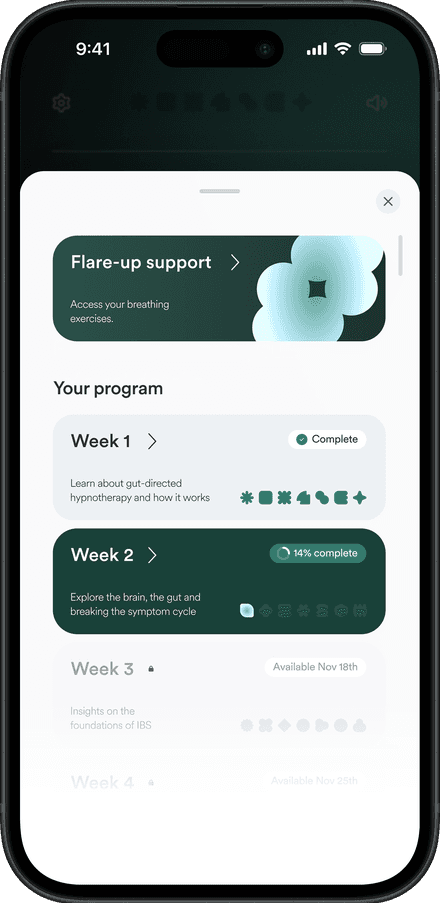
DisclosureMindset Health, the producer of Nerva, produced this analysis. The distance figures are independent of Nerva, and you can see exactly how we calculated them below.
How we built this map
- What this is. An illustration of how far adults live from in-person GI psychology care, not a complete count of every provider. Clinicians who are not listed in either source below do not appear, so the gap may be smaller than shown. Straight-line distance and the absence of wait-time data mean the gap may also be larger than shown.
- Source 1: The Rome Foundation's GastroPsych Directory. Every US listing on romegipsych.org, including each profile page, as of November 2026: 422 listings. Listings are self-reported by members.
- Who counts. Psychologists, social workers, other therapists and mental health providers, psychiatrists, and psychiatry and psychology trainees: 351 listings (341 people). GI physicians, nurse practitioners, and "Other" roles are left out. 2 duplicate listings and 1 Puerto Rico listing were removed.
- In person. Telehealth-only listings (52) are excluded. 14 listings leave the in-person field blank and are counted as in person; excluding them changes the share of adults within 10 miles of a specialist from 30.9% to 30.5% (we ran this check at 10 miles only). That leaves 296 in-person offices.
- Source 2: academic medical centers. We searched official program pages at major academic GI centers in all four US regions for named GI psychology clinicians (psychologists, social workers, therapists, and psychiatrists in a GI service). We found 95. 42 were already in the directory, and 50 more were added to the map. 3 were not mapped because their pages gave no location. We left out clinicians whose service says it is virtual only, and anyone whose GI role was not stated on an official page. Some institution pages do not name staff, so this is a sample, not a census.
- Location. Addresses were matched with the US Census Geocoder (225 directory offices and most academic clinicians). Where there was no usable street, the office sits at its ZIP code's population-weighted center, built from the Census ZIP-to-tract relationship file (69 offices), or the nearest city ZIP for 2 hospital-only ZIP codes. Where an academic page gave no street, we used the institution's main campus address.
- Adults. Adults 18 and over by census tract, from the US Census American Community Survey 2019 to 2023 five-year estimates (table B05003): 258.7 million in the 50 states and DC. Each tract sits at its 2020 Census population center.
- Distance. Straight-line distance from each tract to the nearest listed office, not drive time. The map does not measure appointment availability, cost, or insurance coverage.
- Headline figures. 46.4% of adults (120.0 million) live more than 25 miles from a listed in-person specialist. Using the directory alone, the figure is 47.8%. 10 states have no adult within 25 miles of one.
- Adults per specialist. 258.7 million adults divided by 344 listed in-person specialists in the 50 states and DC: about 752,000 adults per specialist, shown as 750,000. 16 states have none listed in our sources.