
Key takeaways:
- About half of AI Overview health statements aren't backed by their cited source, leaving patients with unverified advice.¹
- Support rates were similar for low-, medium-, and high-risk health questions, at 45–49%.¹
- In a 2026 Tufts analysis, poor-quality TikTok gut health claims drew 3.37 times the likes of high-quality claims.²
- Nerva's gut-directed hypnotherapy program has been tested in a peer-reviewed randomized controlled trial in IBS.³
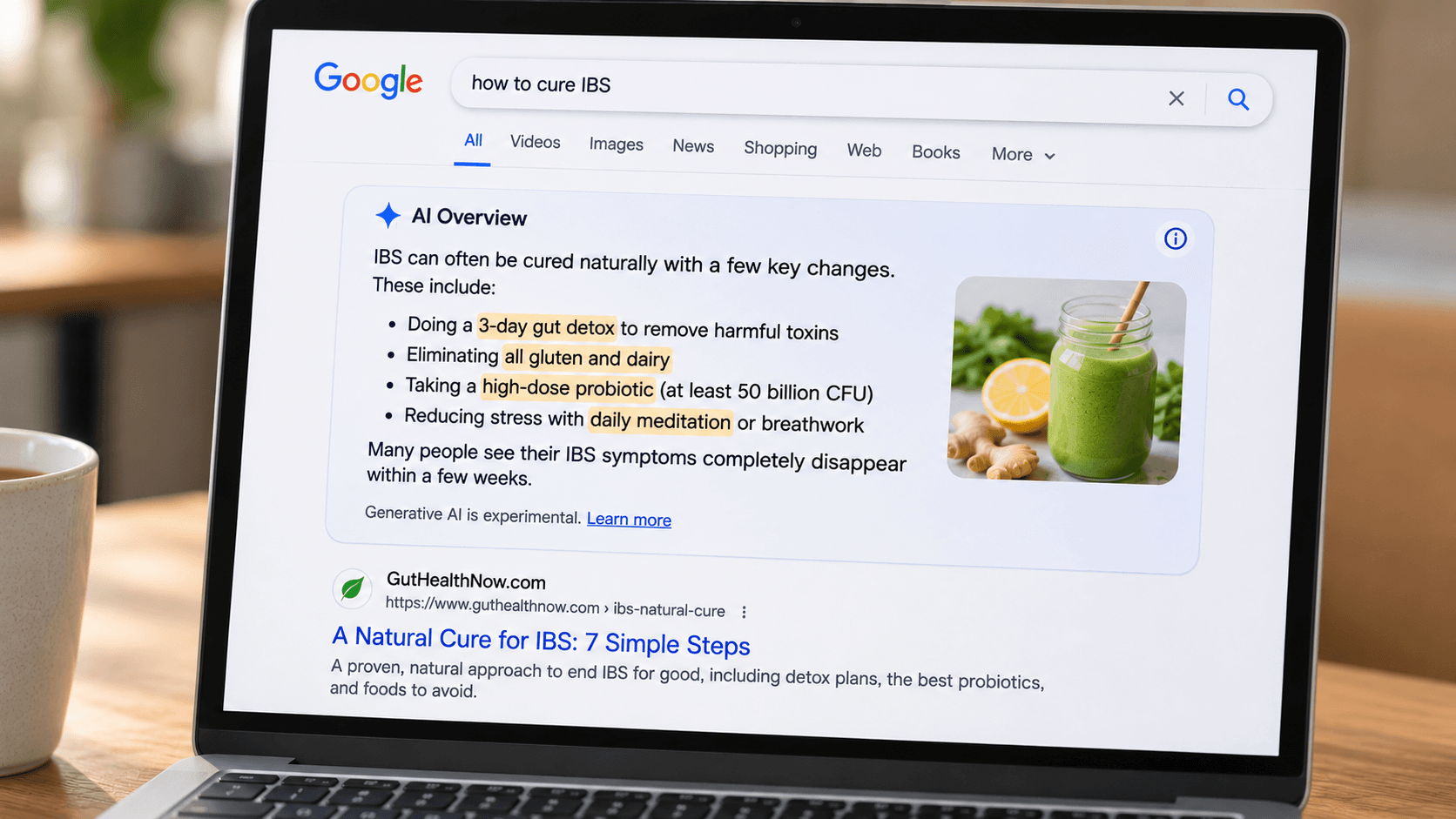
AI Overviews often aren't backed by their own sources on health questions: in a 2026 preprint, only about half of their statements were supported by the page they cited.¹ For your IBS patients, that adds to a feed already crowded with unverified gut health advice.²
Google AI Overviews health accuracy: what the 2026 preprint found
Northwestern University researchers ran more than 3,000 health questions through Google and checked each AI Overview statement against the page it cited.¹
About half held up: 47% by the automated check, or about 57% after correcting for the tool's error rate.¹ The study is a preprint and hasn't been peer reviewed yet.
A separate January 2026 analysis of 50,807 German-language health searches points the same way. The single most cited source in AI Overviews was YouTube, and 65.6% of citations came from sites not designed to ensure medical accuracy.⁴ Academic research and medical journals made up just 0.48%.⁴
That gap matters because a citation looks like proof. A patient who sees a source link beside an answer rarely clicks through to check it.
AI search and TikTok gut health advice: why IBS patients arrive confused
AI answers now sit alongside a social feed that rewards confidence over accuracy. In a 2026 Tufts analysis of 174 TikTok gut health creators, 83% had no medical background, and poor-quality claims drew 3.37 times the likes of high-quality ones.²
So your patients get confident answers from two directions, and neither one shows them which parts are evidence-based.
“Much of what is out there in social media, YouTube, in gut health, we know that it's misinformation or wrong. But it is so confident. It is simplified to such a fault that it can be harming patients.”
– Dr. Kim Bretz, Naturopathic Doctor, Faculty at University of Waterloo School of Pharmacy
Applying this in practice: asking IBS patients about AI and social media
Add one question to your history: "What have you read, watched, or asked AI about your IBS?"
If a patient quotes an AI answer, ask what the cited source actually said. That question alone often opens the conversation.
Then give them somewhere better to go. We've compiled a list of trustworthy gut health resources you can share with patients, including the ACG patient center, IFFGD, and Monash University's FODMAP resources.
Where evidence-based gut-brain therapy fits for IBS patients between visits
Patients turn to search and social media because they want something to do between appointments. When what they find is an AI summary whose source doesn't say what it claims, or a video built for likes, the time between visits can work against them.
The answer isn't telling them to stop looking. It's giving them something to do that passes the same test this article applies to AI Overviews: a claim that traces back to a source that actually supports it.
That's the standard Nerva is built to. Its gut-directed hypnotherapy program was developed with Monash University researchers, and its results were published in a peer-reviewed randomized controlled trial in the American Journal of Gastroenterology.³ It also follows the approach the ACG guideline suggests for global IBS symptoms: gut-directed psychotherapy.⁵
So when a patient asks what they can do between visits, you can point them to an option where the citation holds up.
You can refer patients through the clinician form or simply recommend Nerva.
Frequently asked questions
Are AI Overviews reliable for health questions?
AI Overviews were no more reliable for high-risk health questions than for low-risk ones: about 45% of statements were supported for low-risk questions, 49% for medium-risk, and 46% for high-risk.¹ Patients can't assume that answers about serious symptoms are better sourced.
Can you trust AI for medical advice?
AI health answers were least well supported for complex questions, falling from 52% of statements for low-complexity questions to 46% for high-complexity ones.¹ That makes AI a starting point for patients, not a substitute for clinical advice.
How reliable is Google AI for medical advice?
Google AI Overviews cited more commercial health sites, such as WebMD and Healthline, and fewer academic and government sources than the top regular search results.¹ Only 44.4% of the top five search results were also cited in the AI Overview.¹
Do people trust AI over doctors?
Some patients do: in a representative 2025 survey of 1,145 people in Germany, 16% said they had at some point not followed a doctor's recommendation and trusted an AI chatbot instead.⁶ That's a good reason to ask about AI use directly, rather than wait for patients to mention it.
How do you refer a patient to a digital gut-brain therapy program?
A referral to Nerva can be made through the clinician form or by recommending the program in a consult. Referrals don't expire, so patients can start when they feel ready.
References
Agnoli S, Reilly B, Barna L, Horvát EÁ. Does the citation matter? Quality, grounding, and physician-rubric accuracy of Google's AI Overviews for medical information. arXiv. Preprint posted online October 29, 2026. arXiv:2610.39339
Vu K, Garcia-Rogers K, Li B, et al. Gut health claims and monetization features on TikTok: cross-sectional analysis. Online J Public Health Inform. 2026;18:e105391. doi:10.2196/105391
Anderson EJ, Peters SL, Gibson PR, Halmos EP. Comparison of digitally delivered gut-directed hypnotherapy program with an active control for irritable bowel syndrome. Am J Gastroenterol. 2025;120(2):440-448. doi:10.14309/ajg.0000000000002921
Deda Y. Health-related AI Overviews turn to YouTube 2–3x more than trusted medical sites. SE Ranking. Published January 14, 2026. Accessed November 6, 2026. https://seranking.com/blog/health-ai-overviews-youtube-vs-medical-sites/
Lacy BE, Pimentel M, Brenner DM, et al. ACG clinical guideline: management of irritable bowel syndrome. Am J Gastroenterol. 2021;116(1):17-44. doi:10.14309/ajg.0000000000001036
Bitkom. Dr. KI: Wenn der Chatbot zum medizinischen Ratgeber wird [Dr. AI: when the chatbot becomes a medical adviser]. Press release. Published November 20, 2025. Accessed November 6, 2026. https://www.bitkom.org/Presse/Presseinformation/Dr-KI-Chatbot-medizinischer-Ratgeber