


Key takeaways:
- New data presented at ACG 2026: in 64,025 IBS users, a 6-week digital gut-brain therapy program was associated with a 36.8% reduction in PHQ-4 anxiety and depression scores.¹
- Positive anxiety screens fell from 68.2% to 34.1%, and depression from 41.3% to 20.0%, by program end.¹
- Median time to resolution was 34 days for anxiety and 27 days for depression.¹
- Higher baseline abdominal pain predicted greater psychological improvement in completers, not a blunted response.¹
A 6-week digital gut-brain therapy program was associated with roughly halving positive anxiety and depression screens in 64,025 people with IBS, according to new research presented at ACG 2026.¹
For many patients, anxiety and depression are part of the IBS picture, yet they're hard to address in a busy GI visit with so much else to cover. As a result, they're often what patients leave with unaddressed. Gut-brain therapy is known to ease abdominal symptoms, but its effect on this psychological burden has been less clear.
Our research, presented at the American College of Gastroenterology (ACG) conference in 2026, set out to measure it. We tracked validated anxiety and depression screens before and after the program, showing how much that burden eased, which patients improved most, and who to prioritize for referral.¹
For clinicians, that means one referral can help address both the gut and psychological sides of IBS, without adding time to an already full visit.
Why anxiety and depression matter when you manage IBS
Anxiety and depression sit at the center of IBS, not at its periphery: they affect close to a third of patients and independently track with worse symptom severity, higher healthcare use, and poorer quality of life.² ³
For you, that is often the line between a patient who responds and one who keeps coming back, because unaddressed distress is a common reason first-line GI care stalls, and it is the piece a standard visit has the least room to handle.
Mood clearly matters in IBS. What's harder to find is an option that reliably improves both gut and psychological symptoms within the limits of a routine consult.
What the new ACG 2026 study found on anxiety and depression in IBS
Across 64,025 IBS users completing a 6-week digital gut-brain therapy program, PHQ-4 anxiety and depression scores fell 36.8%, with the biggest gains in the patients who started with the most distress.¹
We measured the PHQ-4 (GAD-2 for anxiety, PHQ-2 for depression) at baseline and program end,⁴ and the shift in who screened positive was the clearest signal.
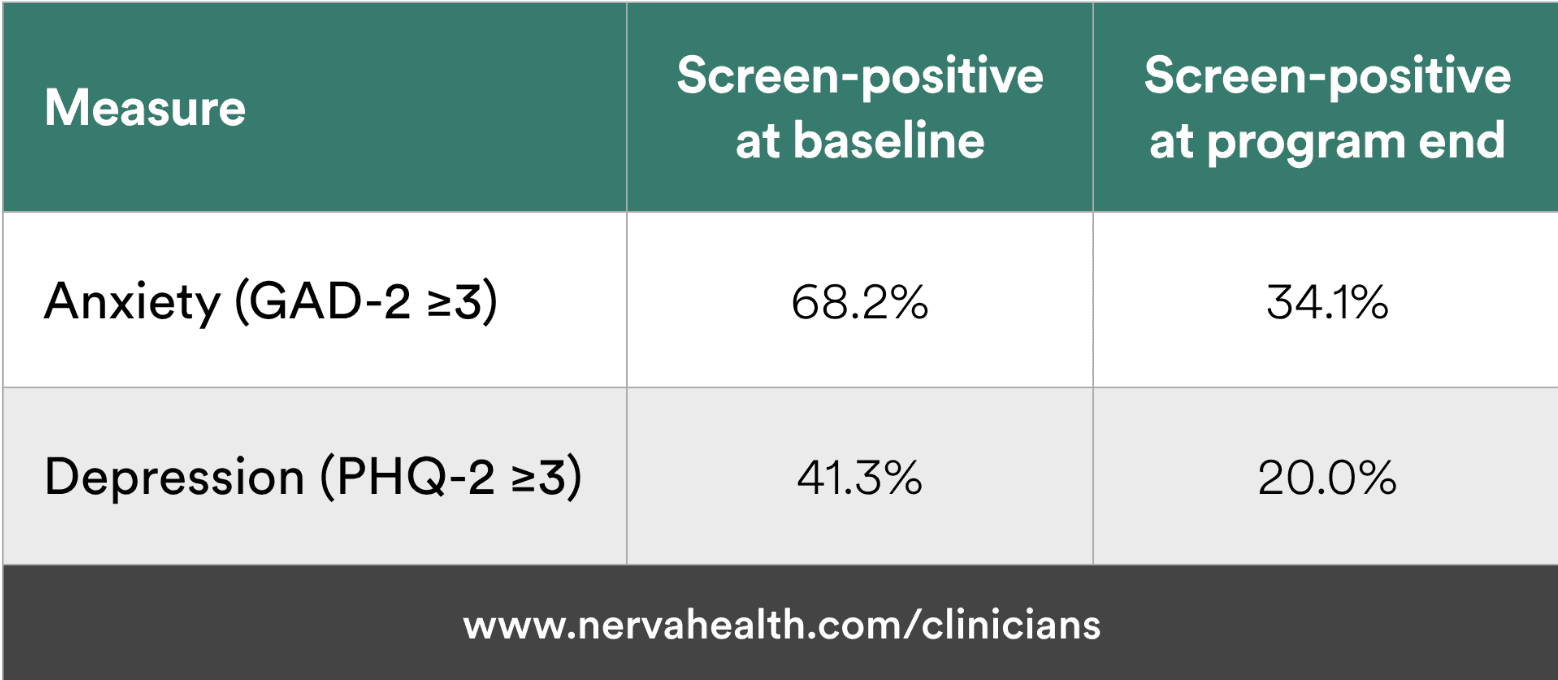
Among users positive at baseline, 57.2% (anxiety) and 64.5% (depression) dropped below threshold, and two thirds of those with any baseline distress moved down at least one severity band.¹
Median time to resolution was 34 days for anxiety and 27 for depression, so most of the shift lands inside the six weeks.¹
Applying this in practice
Prioritize your highest symptom-burden patients for referral, and actively support them to finish, because that is where the psychological payoff is largest and the dropout risk is highest.¹
The gains tracked with completing the program, and the patients who dropped out were the ones with more abdominal pain and bloating, not more distress.¹
Completers and non-completers looked near-identical on baseline mood, and higher baseline pain predicted a larger improvement in those who finished, not a smaller one, so set expectations early and follow up with the ones most likely to disengage.¹
What the ACG 2026 data changes about anxiety and depression in IBS
The ACG 2026 data shows anxiety and depression in IBS can change over time rather than being a fixed trait: across 64,025 patients who completed the program, distress scores came down, and two thirds of those with baseline distress moved down at least one severity band.¹
Most prior evidence on mood in IBS is cross-sectional, showing anxiety and depression are common and track with worse symptoms but not whether they move; this is a large longitudinal read that they do, on a timeline you can quote (a median of about a month to resolution).¹ ²
It also lands where the burden is heaviest, with the most somatic, highest-severity patients gaining the most, not the least.¹
The reframe matters because in these patients, the anxiety often surfaces as gut symptoms before anything else.
"Often I'll see a lot of very high achieving individuals successful in their personal and professional lives who don't register stress or anxiety in any other way other than their GI symptoms."
– Dr. Jeffrey Nathanson, Gastroenterologist, Co-Owner of Comprehensive Gastrointestinal Health, Illinois
Where a gut-brain therapy program like Nerva fits in your IBS management plan
Gut-brain behavioral therapy earns its place for the IBS patients whose mood and gut symptoms travel together, and ACG guidance suggests gut-directed psychotherapies for global IBS symptoms.⁸
Its place in the pathway is a matter of clinical sequencing: you can introduce it early, alongside dietary or pharmacological therapy, or later in care, whatever you and your patient decide together.
That gives you something concrete to do with the comorbidity a visit rarely has room for: a structured program you can refer to and revisit, rather than another prescription or a psychology waitlist.
Nerva is a digital IBS self-management program built around gut-directed hypnotherapy, done in 15 to 20 minutes a day. In a randomized controlled trial of its app-delivered gut-directed hypnotherapy, 81% of participants had a clinically meaningful drop in IBS symptom severity (at least 50 points on the IBS-SSS) at week 6, compared with 63% in the active control group.⁷
For an IBS patient carrying anxiety or low mood, that is one referral that can support both the gut and the mood at once. It suits most patients with gut-brain disorders, with caution reserved for severe psychiatric instability or active psychosis.
How to add gut-brain therapy to your IBS toolkit: Your referral pathway to Nerva
Referring takes about a minute and adds no administrative work on your end. You can point a patient to Nerva directly or send a referral through the form below, and they begin the 6-week program at home.
It helps to introduce it the way you would any gut-brain approach: a structured program that works on the gut-brain signaling behind their symptoms, 15 to 20 minutes a day.
Frequently asked questions
Does gut-directed hypnotherapy help anxiety and depression in IBS patients?
Gut-directed hypnotherapy is associated with meaningful reductions in anxiety and depression alongside GI symptoms, with positive screens for both roughly halving over a 6-week program in a 64,025-user analysis presented at ACG 2026.¹ The effect was largest in patients with more severe baseline distress.¹
What is the connection between IBS, anxiety, and depression?
The connection runs through the gut-brain axis, the bidirectional signaling between the central and enteric nervous systems that links mood and gut symptoms in DGBI.⁵ Around a third of IBS patients screen positive for anxiety or depression, and that comorbidity tends to worsen symptom severity.² ³
How quickly does gut-brain therapy improve anxiety and depression?
Median time to resolution in the ACG 2026 analysis was 34 days for anxiety and 27 days for depression, within the 6-week program window.¹ This gives a realistic timeframe to set with patients considering the approach.
Can Nerva be used alongside antidepressants or neuromodulators?
Nerva is designed to complement medical care and can sit alongside pharmacologic management as part of an integrated plan, not in place of it.⁷ Coordinating it with existing therapy is reasonable for most DGBI patients.
Which IBS patients are the best candidates for referral to a gut-brain therapy program?
IBS patients with coexisting anxiety or low mood, symptoms that track stress, or interest in a self-management tool are strong candidates for a gut-brain therapy program.⁷ Caution is warranted only in severe psychiatric instability or active psychosis.
References
Dabash O, Hall C. S1320 Clinical efficacy of digital brain-gut behavioral therapy in reducing anxiety and depression: a large-scale longitudinal study of 64,025 patients with IBS. Am J Gastroenterol. 2026;121(10S1). doi:10.14309/01.ajg.0001214532.14862.ca
Zamani M, Alizadeh-Tabari S, Zamani V. Systematic review with meta-analysis: the prevalence of anxiety and depression in patients with irritable bowel syndrome. Aliment Pharmacol Ther. 2019;50(2):132-143.
Trindade IA, et al. Anxiety and depression in disorders of gut-brain interaction. Am J Gastroenterol. 2024;119:165-175.
Kroenke K, Spitzer RL, Williams JBW, Löwe B. An ultra-brief screening scale for anxiety and depression: the PHQ-4. Psychosomatics. 2009;50(6):613-621.
Drossman DA. Functional gastrointestinal disorders: history, pathophysiology, clinical features, and Rome IV. Gastroenterology. 2016;150(6):1262-1279.
Ford AC, Lacy BE, Harris LA, Quigley EMM, Moayyedi P. Effect of antidepressants and psychological therapies in irritable bowel syndrome: an updated systematic review and meta-analysis. Am J Gastroenterol. 2019;114(1):21-39.
Anderson EJ, Peters SL, Gibson PR, Halmos EP. Comparison of digitally delivered gut-directed hypnotherapy program with an active control for irritable bowel syndrome. Am J Gastroenterol. 2025;120(2):440-448.
Lacy BE, Pimentel M, Brenner DM, et al. ACG clinical guideline: management of irritable bowel syndrome. Am J Gastroenterol. 2021;116(1):17-44.

